Strategy & Tactics 42

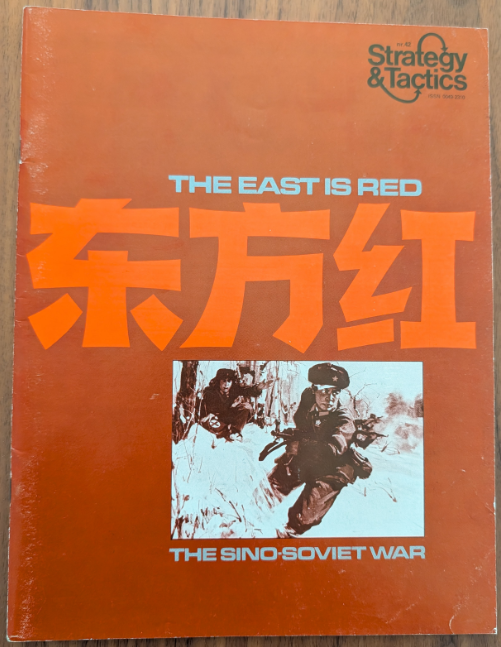
Front cover of S&T 42 featuring an image of Chinese soldiers advancing from cover.

Date of publication (as given): January/February 1974

Context

  • January 1974: Start of the three-day week in the UK due to the energy crisis. The Miami Dolphins beat Minnesota Vikings 24-7 in Super Bowl VIII, at Rice Stadium, Houston.The $6 Million Man starring Lee Majors premieres on ABC TV.
  • February 1974: Playmobil toys debut at the Nuremberg Toy Fair. A bomb, planted by the Provisional IRA, explodes on a bus in West Yorkshire, England, carrying British soldiers and family members. Blazing Saddles, the Mel Brooks western comedy, premieres in California.

Game Included

The East is Red by James F. Dunnigan is a two-player game about a hypothetical Soviet invasion of China in the 1970s. Units are at the division and corps level. Hexes represent 50km of real terrain and each game turn is one week of real time. One distinctive feature of the game is that it includes, as standard, rules for atomic warfare.

Within the theater of operations it is assumed that tactical nuclear weapons and atomic demolitions will be used.

For more information about the game, see here.

Articles

  • Outgoing Mail – editors
  • The East is Red – Stephen B. Patrick

The vulnerability of the Transsiberian Railway will pose a problem to the Soviet forces to permit them to actually wage prolonged war. However, the USSR is capable of using the seas, especially since China is not a sea power itself and cannot, therefore, threaten naval resupply except as the shipping gets close to port.

  • Napoleon at Waterloo – Albert A. Nofi

By 1800 the French had charged four times. Losses on both sides were extremely heavy, but at the end Napoleon’s cavalry was pretty much useless. Wellington’s cavalry was also more or less useless, having been expended in a series of countercharges, and his infantry was not in much better condition. Although no squares were reported broken, most were on the verge of collapse as a result of the heavy pounding they had received. The lack of horse artillery, beyond one battery which had somehow joined the charge, told on the French. With it, they might well have broken a number of squares. Without it, the cost of breaking squares became prohibitive.

  • Sackson on Games – Sid Sacksom
  • Pass in Review (book reviews) – Albert A. Nofi
  • For Your Eyes Only – editors

SPI Games Advertised

Might Have Been

From Outgoing Mail, page 38:

The game in issue #44 will be Tank. This game will involve Tank-to-Tank combat during World War II…Tank, to give you fair warning, will probably be an unusual game. We are kicking around a number of rather radical game systems. The one that is currently a front runner for selection as the game system to be used relies upon a very different movement system. It is rather difficult to describe without actually showing it to you, but we’ll give it a try. Basically the one to five armored vehicles on each side will each occupy a hexagonal shaped area containing perhaps fifteen hexes across from one side to another. The actual playing board will be a much smaller area with each hexagon on the playing board representing one of the larger hexagons in which each side’s tanks actually maneuver. The actual playing board will be called the control board. The large hexagonal shape board will be the maneuvering board. A tank’s position will always be shown on the control board. That, in effect, will be its strategic position. Its tactical position will be shown on the manever board. We will have to use an as yet undefined system to show the terrain features on each of the many control board hexes. Each of the control board hexes, again, represents the much larger maneuver board hex. This system, hopefully, will allow for the sometimes substantial range differences between tanks, although we are aware of the fact that most tank battles occurred at under 500 meters range. The system just partially described makes use of control charts upon which each player keeps track of various mechanical functions for each of his tanks, such as current speed, position of turre[n]t, ammunition status, and the like. There is a lot more work yet to be done on the game Tank. In fact, it is not supposed to start, in theory, until January. But we usually get started on the design concepts far in advance of this.

Two points of interest. First, the version of Tank that was released bore no relation to the design described above. Second, note the emphasis on the design with no mention of scenarios.

On a Personal Note

This issue of S&T introduced me to the concept of gaming future, potential conflicts. The game, itself, was not of great interest and my recollection is that I hardly played it. The topic didn’t appeal to me. Also, the implementation – aside from the rules about nuclear weapons – had nothing novel.

I read the advert for War in the East knowing I had neither the funds to buy it nor the space to play it. By now I was realizing that if SPI kept up their output, I wasn’t going to have time to play all their games anyhow. As a gamer, that realization was depressing. I’m not sure I have ever recovered from it.

PanzerArmee Afrika

PAA at-start setup at  El Agheila, showing several stacks of Axis units versus a sole Allied brigade.
At-start setup at El Agheila

PanzerArmee Afrika (PAA) is a two-player game about the war in the desert from April 1941 to November 1942 designed by Jim Dunnigan. Game turns represent one month of real time, units are battlions, regiments, or brigades, and each hex is 12 miles.

PAA was released with Strategy & Tactics 40. The original components were good for their time, but now show their age. The counters are not backprinted. The map uses a limited color palette, is clear, and more than functional. Redmond Simonsen – responsible for Physical Systems Design and Graphics – produced some outstanding work at SPI and this early effort of his set a high standard. I don’t recall having any issue with the rules other than whether eliminated units get to counterattack (they do) and I worked that out by a close reading of the overrun process.

Note: SPI later sold the game to Avalon Hill (AH), who published their version around 1982. Images on this page are from the AH version. I have the original map and rules, but the counters are missing in action.

To give some context, before looking at the game’s key features, let’s start with the game turn sequence.

Game Turn Sequence

Each game turn has an Allied player turn followed by a German player turn. The game turn sequence is:

  1. Supply Determination Phase
  2. Command Control Phase (Allied player only)
  3. Movement Phase
  4. Combat Phase
  5. Replacements and Reinforcements Phase

Supply

No game about this campaign would be complete without supply rules. PAA’s supply rules are easy and essential to master if you want to succeed. Supply flows from a source via depots (counters on the map). Depots can form a chain, extending supply as far as desired. However, you need to use your transport facilities (a truck counter) to move depots and you only have one truck. You can create another truck by sacrificing some units, but it’s a heavy price to pay.

  • Units more than 20 movement points from a depot (connected to a supply chain) are out of supply. They defend at half strength and can neither attack nor move. They are also known as sitting ducks.
  • Units within 20 movement points (and more than 8) of a depot (connected to a supply chain) are generally supplied, meaning they can move and defend at full strength, but their attack strength is halved.
  • Units within 8 movement points of a depot (connected to a supply chain) are attack supplied, meaning they can move, defend, and attack at full strength.
  • Units within 8 movement points of a depot (connected to a supply chain) which they consume in an attack are maximum attack supplied, meaning they attack at double their normal strength.

Therefore, in this game, you can quickly tell that each side needs to guard its supply lines. These straightforward rules do a nice job of representing the realities of warfare in this arena. You can quibble about the details, but the general impact seems to work.

Image of German and Italian units approaching Allied defenders.
A tentative start by the Germans as they ponder what route to take.

Command Control

Before the Allied player moves, he has to roll for command control. The result of each roll is 3 numbers. If the number of the hex a unit or stack is on ends with one of these generated numbers, the unit or stack sits on its hands for the turn and does nothing; it may neither move nor attack.

This implementation of a restriction on the player’s control of his units is interesting. It’s not the first time something like this was used as a similar limitation was applied to barbarian units in Fall of Rome. However, that was a case of the enemy to the solitaire player being handicapped. Here, it’s you – if you’re the Allied player – who has to contend with this. It’s realistic, but it’s clunky. As printed, players can (and did) try to minimize the effects by putting their units on hexes with humber endings that come up less often.

A better process to achieve the same goal was to make a pool of 10 chits and randomly draw three chits, refilling the pool after each draw. This way, each hex was equally at risk.

An even better option was to take a broad brush approach, ignore the existing table and hex numbers and instead roll a six-sided die for each unit or stack, 1-2 meaning the units were affected and 3-6 meaning they were free of any restriction. More rolls of the die, but more chaos.

At the time it didn’t bother me that the German player got off scot-free. Now, I’m more inclined to believe the rule should also apply to the German player, but less severely. For example, using the last mentioned option, only a roll of 1 would affect the German player.

Movement

The units in this game had huge movement allowances: 40 movement points (MP) for the Italians, 50 MP for the Commonwealth units, and 60 MP for the Germans. This gave the game a very different flavor.

In my limited playing experience, it made the Allied player focus every turn primarily on trying to prevent the Germans sweeping around the flank and cutting off supply. Only when that position was secure, could the Allied player think about advancing, slowly. I have seen online discussions suggesting the game was broken because the German player could always easily achive that flanking maneuver, but the responses and my own play leads me to think that it’s far from a given. The German player has his own challenges about keeping his flanking forces in supply. A cautious, careful Allied player – assuming command control doesn’t screw him over completely – should be able to stay out of trouble. The discussion, however, shouldn’t hide the fact that it’s fun to have such liberated movemnent abilities.

Where the large MP numbers do have an adverse affect is on the simulation value. PAA is a good game, possibly a great game, but having one side being powerless – ie., sitting still – in the face of the enemy’s huge movement potential, is not realistic. There were optional rules kicking about that gave the non-moving player some reaction ability. (Look, for an example, at the AH version.) I have no experience of them. If I had the time or inclination, I would experiment by halving the MP of all units and doubling the number of turns, so each represented two weeks.

Combat

PAA used combat differential instead of combat odds. So, 6 strength points (SP) attacking 2 SP gave a +4 differential. This was the same as if 12 SP were attacking 8 SP. However, despite the differeng size of forces, the potential casualties remained the same. The other new tweaks on show here, or at least new to me, were (a) allowing the defender a chance to counterattack, even if eliminated so that no attack was risk free, and (b) overrun combat, allowing a moving stack to eliminate an enemy unit or stack during combat if it had a high enough combat differential.

Reinforcements and Replacements

PAA was also unusual in having reinforcements and replacements arrive at the end of a game turn instead of the more usual arrival at the start. This may have been done to make it easier for the Allied player who has to cope, additionally, with units being withdrawn. Dealing with the requirement at the end of the turn gave the Allied player extra time to get the withdrawing units back home. Failing to do this allowed the German player to pick the withdrawing unit; something to be avoided.

Overall

PAA is a good, challenging game. It’s easily accessible, there are not too many counters to maneuver and you can get through some turns quite quickly. Combat is never risk free because even an eliminated force gets to counterattack before dying. It was innovative in its time and remains a benchmark design. To prepare this article, I took the game out for a spin and solitaired a few turns. It was fun.

The strikes against it are that it is too long at 20 turns (unless the Germans capture Alexandria), the command control procedures need to be simplified, and it falls short as a simulation. For example, the victory conditions give the Allies a marginal victory by holding Alexandria and having more than twice as many combat strength points as the Germans. The Germans can get a marginal victory by holding El Agheila and having more than half as many combat strength points as the Allies. There’s no incentive, in terms of victory, for either side holding Tobruk, for example. These conditions need tweaked to encourage more historical strategies. PAA would also benefit greatly from some shorter scenarios, and a decent reaction rule. (The AH one doesn’t convince me.)

Her’s the acid test: if someone asked me to play PAA, I’d gladly accept the challenge. PAA is a game that deserves to be played.

Strategy & Tactics 41

Cover of Strategy & Tactics 41 showing an early-war tank in a 3/4 side-on view.

Date of publication (as given): November/December 1973

Context

  • November 1973: three Arab terrorists hijack KLM flight 861 over Iraq, forcing the plane to Damascus, Nicosia, Tripoli, Malta, and then Dubai, where the hijackers surrender. A bloodless military coup ousts Greek President George Papadopoulos. Reggie Jackson (Oakland A’s) unanimously wins the AL MVP award. Last of the Summer Wine debuts on the BBC; it goes on to become the longest running sitcom ever, airing for 31 seasons.
  • December 1973: the American Psychiatric Association declares homosexuality is not a mental illness. Gulag Archipelago, an expose of the police-state of the USSR, is published by Alexander Solzhenitsyn. Johan Cruyff is chosen to be European Football Player of the Year. Apple Records releases the Paul McCartney/Wings album Band on the Run in the UK and USA.

Game Included

KampfPanzer by James F. Dunnigan is a two-player game about early tank warfare (1937-40) with each unit representing five tanks, a platoon of infantry, or a battery of guns. Hexes represent 100 meters of real terrain and each game turn is three minutes and forty seconds of real time. One of several distinctive features of the game is that it uses pre-plotted simultaneous orders. For my view of the game, see here. For more information about the game, see here.

Articles

  • Outgoing Mail – editors/publisher
  • Mechanized Warfare – Albert A. Nofi

One of the curious things about the development of armored mobile warfare outside of Germany is the fact that the Germans never kept their work secret. They wrote articles in military journals, invited foreign military experts to observe armored maneuvers, and they even lectured in foreign military institutions. For all of this, no one paid them any attention. It was, and remains, an interesting comment on humanity that this occurred. So well entrenched were certain elements in certain armies that reality made no impact upon them.

  • War in the East – Stephen B. Patrick
  • Sackson on Games – Sid Sacksom
  • Pass in Review (book reviews) – David C. Isby

SPI Games Advertised

PC?

From page 46 of the editorial (Outgoing Mail):

You will notice an ad for the SPI DATABUS. This is for all you computer freaks out there. We’re starting to use our computer in the design of games and we’ve already had quite a few letters from computer people subscribers offersing suggestions and advice. SPI DATABUS is an attempt to give you all a forum to express yourselves in whatever language turns you on (COBOL, FORTRAN, BASIC, RPG II etc.). English won’t do. Most computer people seem to be only semi-literate.

On a Personal Note

The Yom Kippur War was close to my heart (and community) in 1973, but I never imagined there would be a game about the topic available so quickly. I added Sinai to my list of wanted games. Unfortunately, when I eventually got a hold of one, I discovered the game wasn’t to my liking.

Strategy & Tactics 40

Cover of S&T 40 showing Afrika Korps soldiers riding a motorcycle with sidecar and machine gun.

Date of publication (as given): September/October 1973

Some context. In September 1973: Jackie Stewart’s 4th place finish in the Italian Grand Prix (Monza) secures his 3rd Formula 1 World Drivers’ Championship. The elected president of Chile, Salvador Allende, is overthrown by a military coup led by General Augusto Pinochet.  The Prisoner of Second Avenue, a theatrical comedy by Neil Simon, starring Peter Falk, Lee Grant, and Vincent Gardenia, closes at the Eugene O’Neill Theatre in New York City after 798 performances.

In October 1973: the Yom Kippur War begins with Syria & Egypt attacking Israel.  Dolly Parton releases her single Jolene, the title track of her then forthcoming album. Europe and Asia are connected over the Bosphorus for the first time by the completion of the Bosphorus Bridge (also known as the 15th July Martyrs Bridge and the First Bridge) in Istanbul, Turkey.

Game included

PanzerArmee Afrika by James F. Dunnigan. PanzerArmee Afrika is a two-player game about the war in the desert from April 1941 to November 1942. Game turns represent one month of real time, units are battlions, regiments, or brigades, and each hex is 12 miles. SPI later sold the game to Avalon Hill, who published their version around 1982. For my view of the game, see here. For more information about the game, see here.

Articles

  • Outgoing Mail – editors/publisher
  • Panzerarmee Afrika and the War in the Desert – Albert A. Nofi
  • Seelöwe – Frank Davis
  • Sackson on Games – Sid Sacksom
  • Military Unit Symbols – Redomnd A. Simonsen
  • Pass in Review (book reviews) – Albert A. Nofi

SPI Games Advertised

Enter the Lawyers

From page 41 of the editorial (Outgoing Mail):

As you may have noticed, we have changed the names of two games. Battle of Stalingrad is now Turning Point: The Battle of Stalingrad. Lee at Gettysburg is now Lee Moves North. These changes were made on the advice of our lawyer. We are trademarking the titles of our games now that we are selling them in stores and the above two titles might have run into trouble with the trademark people in Washington. Just more details to attend to.

On a Personal Note

Having an S&T subscription was a blessing and a curse. The blessing was getting all these new games. The curse was seeing adverts for all these other new games (not part of the subscription) that I couldn’t afford. From the adverts, I kept a note of those I wanted, so the information was readily to hand when my birthday and Chanukah came round. From this issue, WWII was top of my wanted list. My financial position improved when I went to university, but that’s a story for another time.

The Fall of Rome

On the table now is The Fall of Rome, the SPI game included with Strategy & Tactics 39 back in 1973. It is a solitaire game pitting you (as the Romans) against those threatening to bring down the empire. Designed by John Young, it has an area movement map and counters representing legions, militia, barbarians, and raiding parties. Each turn represents one year. There are five scenarios: 67 A.D, 247 A.D. 260 A.D., 332 A.D, and 420 A.D.

First, the perspective here is very high-level. Although each scenario attempts to recreate the situation facing a particular emperor, there is no distinction in the game between the differing leaders and their respective strengths and weaknesses. Instead, you are cast in the role and it will be your skill, judgement, and luck that will determine if you can keep the empire from falling.

In a similar vein, each legion strength point is the same as any other – no troop quality here – and, indeed, the respective military forces of legions, militia, and barbarians may break down and build up like money.

The components are perfectly serviceable, though basic. The map is clean, clear, and easy to follow. The counters are OK, but are not backprinted. The rules are deficient in several key areas, so ensure you have the errata before starting out.

Game Turn

  1. Internal Revolution Phase
  2. Non-Roman & Non-Loyal Roman Movement Phase
  3. Non-Roman & Non-Loyal Roman Combat Phase
  4. Barbarian Creation Phase
  5. Loyal Roman Movement Phase
  6. Loyal Roman Combat Phase
  7. Legion Rebellion Phase
  8. Control Determination Phase
  9. Barbarian Attrition Phase
  10. Tax Collection & Disbursement Phase
  11. Roman/Persian Replacement Phase
  12. Barbarian Bribe Phase
  13. Game Turn Record Phase

The game turn begins with a check to see if there is any internal revolution. If so, a subsequent die roll determines where the trouble starts and how big it is (how many Roman militia are revolting). For example, in the first scenario (67 A.D.), only a roll of 6 in the appropriate phase would generate an internal revolution. This is where some of the limited color is on show because each scenario has its own column on the table. So, a roll of 4-6 in the second scenario (247 A.D.) would mean there was a revolution. The subsequent die roll will typically generate revolts in various locations of various strengths.

Part of the Fall of Rome map showing Egypt with rebel milita facing loyal Roman forces.
Trouble in Egypt!

At this point, you should be able to guess if the game will be to your liking because that phase replicates much of what goes on in a turn: you roll the die and chaos ensues. This is not a criticism, just me emphasizing that there’s a large luck factor involved. In other words, you can play well and the game may still beat you.

Next up in the game turn, any at-loose Barbarian and non-loyal Roman type forces move in a preordered sequence. Roughly one-third of the post-publication errata was about this part of the game, and it’s easy to see why. The system tries to have the enemy forces move in a way that makes sense. For the Persians, for example, there is a priority list of areas they must try to control. (Persia is top of the list, followed by Mesopotamia, Armenia, Syria, and Asia, in descending order.) The Barbarians try to move to the nearest, richest, Roman-controlled Province, unless they are a raiding party, in which case it’s simply the nearest Province*. You roll a die each time a Barbarian force tries to move into a new Area, with 1-2 resulting on the move being canceled and the barbarians staying put. Note that Roman-controlled – and other scenario-specified – Provinces have Militia that pop up to fight the invaders.

In general, after these moves, combat takes place. (Barbarians etc. encountering barbarians fight immediately during movement.) Attacking is odds-based, requiring a minimum of 1:1 odds. So, if the Persian force of 15 strength points is on the march into Syria, a force of 6 strength points of legions, backed up by the 10 strength points of milita, will be safe. At times, these gamey tactics are essential. However, massing the right forces at the right place is not always so easy. Combat results are a combination of the usual eliminations and exchanges topped up with 1/2De – meaning half the defending force is eliminated – and 1/2Ex -meaning the defending force is eliminated and the attacker loses half the number of strength points the defender lost.

Then you must face the possibility of new Barbarian forces. In the first scenario (67 A.D.) you roll for this every second turn. In the second scenario (247 A.D.) you roll twice per game turn. In scenario five (420 A.D.) you roll four times a turn! Not every roll is guaranteed to bring about new Barbaraian forces – it’s about a 50% chance – meaning you once again face the vagaries of fate.

Part of the Fall of Rome map showing Picts and Romans in Britannia.
Here come the Picts!

After this, the loyal Romans get to move and fight. This is straightforward, though you need to be wary of having too many legions in the one Area as that increases the chances of a rebellion. And that’s what you check for next. Rebelling Roman legions may march on Rome or try to form an independent state.

Following this, you determine control for the Provinces, work out the effects of attrition on Barbarian forces, collect and spend taxes, bribe Barbarians, and finally advance the game turn marker.

Treasury

The Roman legions are there to do the fighting, but you need tax revenue – determined by the Provinces you control – to keep them in the field and to rebuild losses. Further, you can stave off Barbarian incursions by bribing them. So, your financial resources are key. You must repeat the bribes every game turn if they are to remain effective. If you are lucky enough, you can bring the bribes to an end when attrition has taken its toll and you have collected enough loyal legions to wipe the remnants out.

Game Play

Although the game turn sequence looks long, it’s largely self-explanatory and easily followed. This means you can quickly focus on working out what you need to do to survive and win. However, the game lacks any meaningful play aids – for example, to track the treasury amounts, to track Province control, and so on. So, if you try to play it as it is, you will quickly be reaching for pen and paper and may well find yourself drowning in crap. I solved this by creating my own handmade control and treasury counters, as well as markers to note the starting strength of the legions and the Persians (because you cannot rebuild beyond these starting strengths). Thereafter, play proceeded quite smoothly. I did spend a fair bit of time checking the rules out – especially when moving the Roman foes – in the first few turns, but that petered out.

Game play can be summarised thus: the baddies appear and you have to work out how to deal with them – military action or bribery. You put your plan into action and, inevitably, not all of it works. Then more baddies appear. Rinse, and repeat. In between it all, if you are fortunate, you can try and grab some extra territory (and tax revenue). There’s a reasonable game narrative and, if you win, a sense of achievement.

I played the first two scenarios. I won the first one quite easily. It took me several attempts before I won the second scenario.

It’s a fun game. It’s not a serious study of the subject, but it assuredly gives you a (high-level) flavor. It’s also a great example of game design, an opportunity to see, at this stage, what the state of the hobby was in solitaire gaming, and how the designer tackled the issues. For the time, it was pretty novel. It’s been suggested, but I don’t know for sure, that it was the first proper solitaire wargame. Quite a landmark. Incidentally, the supporting article in Strategy & Tactics 39 is well done.

I enjoyed my time with Fall of Rome.


*Provinces are named groups of one or more Areas on the map. For example, the Province of Persia has three Areas. However, Cyprus is a single Area Province. Rather unhelpfully, the rules sometimes refer to a Region, an undefined term that appears to be an alternative name for Provinces. I assume that at some point the game used Regions before it used Provinces and the change wasn’t universally implemented by the editorial team.


James Dunnigan famously described wargames as “paper time machines”. (It’s one of the fundamental pillars of my wargaming life.) The quote came to mind as I realized that by playing this game now, in 2025, I was not only travelling back in time to that of the Roman Empire, but also to 1973 when I first bought and played the game. (It was probably 1973 when I last played the game!) Fall of Rome triggered lots of happy and some wistful memories. The latter time-travel experience is indulgent nostalgia – and I love it.

Strategy & Tactics 39

Cover of S&T 39 featuring Romans fighting.

Date of publication (as given): July/August 1973

Some context. In July 1973: the Summer Jam rock festival featuring The Grateful Dead, The Band, and The Allman Brothers Band at Watkins Glen, New York, attracted an audience of 600,000, at the time the largest ever audience at a pop festival. General Juvenal Habyarimana was installed as president of Rwanda after a military coup d’état. Billie Jean King beat Chris Evert at Wimbledon for her 10th career Grand Slam singles title. In August 1973: Arab terrorists opened fire at Athens airport, killing 3 and injuring 55. The six-day siege at Norrmalmstorg, Stockholm after a robbery attempt, ended with a successful police action covered by tear gas. It was the first Swedish crime broadcast live on TV and the origin of the Stockholm Syndrome term. Gary Sobers scored 50 runs against England at Lord’s, his 26th and last Test cricket century.

Game included

The Fall of Rome by John Young. The Fall of Rome is a solitaire game in which you, as the player, try to keep the Roman Empire intact as best you can in the face of barbarian incursions, legion rebellions, and local uprisings. It has an area movement map, and counters representing legions, militia, barbarians, and raiding parties. There are five scenarios: 67 A.D, 247 A.D. 260 A.D., 332 A.D, and 420 A.D. For my look at the game, see here. For more information about the game, see here.

Articles

  • Outgoing Mail – editors/publisher
  • The Fall of Rome – Albert A. Nofi
  • The Battle for Guadalcanal – Stephen B. Patrick
  • Pass in Review (book reviews) – Albert A. Nofi

SPI Games Advertised

What’s That Coming Over the Hill?

From page 45 of the editorial (Outgoing Mail):

There was no joy in SPI-Land when we discovered that we’d finally have to do War in the East. It’s a godawful monster of a game. Well, you win some, you lose some.

On a Personal Note

SPI fumbled the initial release of The Fall of Rome game as the solitaire system needed subsequent fine tuning to make it work properly. My copy came – via the UK agent SIMPUBS (?) – with the errata included. That had two impacts. First, I was able to play the game without much difficulty. Second, I was introduced to the concept of errata and all that flowed from it. Another significant event.

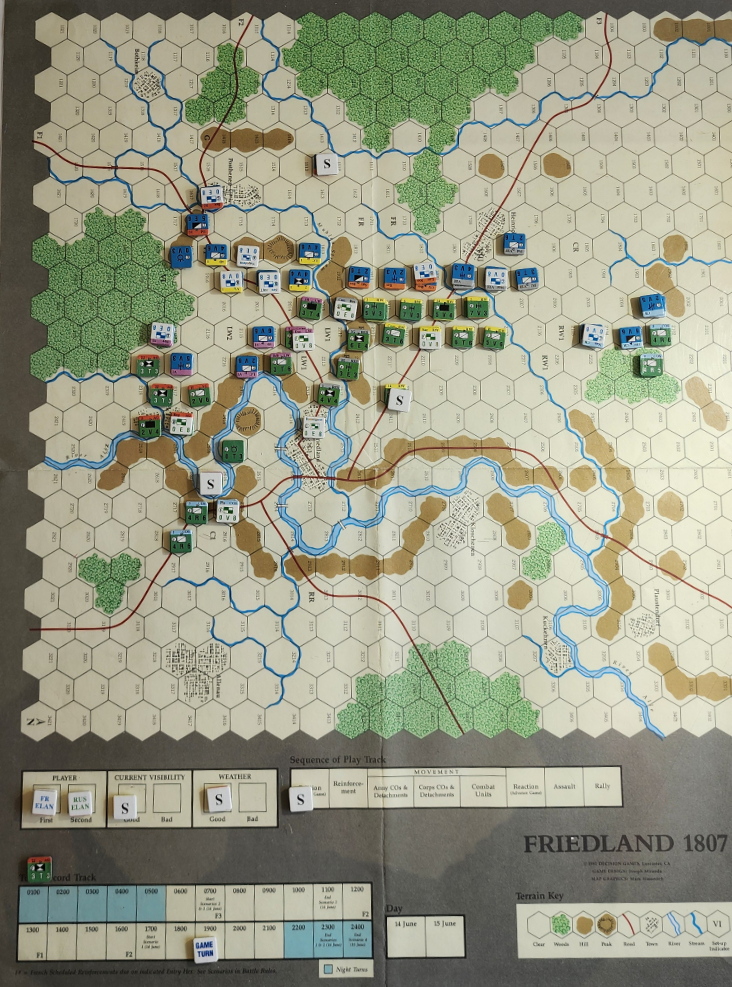
Friedland

Friedland game by Joseph Miranda.

On my game table now is Friedland 1807, a division level game about Napoleon’s defeat of the Russians on 14 June 1807. No ground scale is given, but it appears to be about 4-500 yards per hex. Turns are one hour.

Designed by Joseph Miranda, this was the first (and only) of his Napoleonic Battles System games. The natural reaction might be to assume the short-lived series was due to Friedland being a bad game, but I don’t think that’s accurate. The first strike against the game was probably that it was published in Strategy & Tactics 151 alongside Vittoria resulting in the rules and charts for both games being intertwined. That made each game less accessible. The second strike against the game was that it uses some novel techniques, many of which reduce player control. In other words, the soldiers of your army don’t always do what you want them to do. The challenge of new systems and disobedient soldiers is a hard one for gamers to overcome! To add insult to injury, the rules were presented in a basic and advanced version. It would have been better to combine them into one standard system.

Let’s step back a moment and look afresh at the game. My thoughts are based on using the advanced rules apart from Fog of War. (More on that later.)

Each side’s game turn consists of:

  • Friction
  • Reinforcements
  • Command Control and Movement
  • Reaction
  • Assault
  • Rally

Before looking at the game turn sequence, some preliminary points:

  • Each army has a disintegration limit which, if matched or exceeded, causes bad things to happen. The disintegration level goes up with casualties and can be reduced by staying out of action for a complete turn.
  • Units have Engagement Zones (EZ) which seem to be Zones of Control, renamed. EZ are sticky, meaning that once in an EZ, getting out of it requires undergoing an attack from the enemy projecting the EZ.
  • A common result of combat is disorder, causing a unit to flip to its reverse side. This makes it slower and less effective in combat.

Now, let’s look at each part of the game turn sequence.

Friction

You roll 1d10 and refer to the appropriate table to find out if any random event has occured. This may be a temporary ammunition shortage (which magically affects the whole army) a change to army morale, bad weather, and so on.  

Reinforcements

Self-explanatory. Note that certain Friction results can bring on reinforcements one turn earlier.

Command Control and Movement

This is one of the core parts of the system. Each leader, from the army commander down, is rated as to his leadership: (A) Genius, (B) Good, (C) Standard, (D) Aggressive, and (F) Lethargic. To get a leadership result, starting with the army commander, you roll 1d10 on the Leadership Table and determine if the commanded leaders and soldiers do what you want (a Command result) or not (an Out of Command or Impetuous result).

For example, the French player starts with Napoleon. Being a Genius, he is going to give you a Command result 80% of the time. On that basis, he and all the French leaders within his command control range are good to go. Then, the French player rolls for any leaders outside Napoleon’s range and then any individual combat units out of any leader’s range.

This system highlights the difference in the quality of the leaders on each side. It also shows how dangerous Aggressive leaders can be as an Impetuous result forces the involved combat units to move adjacent to the enemy. Once adjacent, it’s not so easy to get free.

Reaction

This is where the opposing side gets to go. There’s lots of neat stuff here. First, reaction is subject to a roll on the Leadership Table. Second, there’s a neat optional rule that make Reaction checks mandatory. Why? It allows those Aggressive leaders and Impetuous results to throw a spanner in the works of both players.

Assault

There’s more innovation here. There are six combat results tables: one for artillery, two for cavalry (probe and charge) and three for infantry (skirmish, linear, and column). Combat is, generally, driven by the strength of the attacking force and the terrain, with many of the results requiring a morale check. Combat units are rated, in decreasing order of quality, as one of elite, veteran, trained, or rabble with a matching decrease in the chance to pass a morale check. The results are not your typical DR, DE, and EX. Instead, you get an alphabet soup of results including C (counterattack), P (pursuit – when cavalry can be deadly), and H (heavy cavalry charge). After a few combats, they are easily assimilated.

Note:

  • Out of command units can assault. I assume that’s to avoid even more die rolls, but if you think it’s more realistic to require them, it’s an easy fix.
  • Only light infantry may use the skirmish combat results table (CRT). However, there’s no restriction on the use of linear or column CRT. So, every gamer is going to pick the CRT which gives him the best chance of success. In reality, much would be dictated by doctrine. As a generalization, that means the French attacking using the column CRT. But the game gives them complete freedom which may be unrealistic.
  • The system includes Elan counters which each side can spend to speed a unit’s movement or enhance a combat. The French do better when using Elan for the column CRT, so maybe that goes part of the way to counter my criticisms about doctrine.
  • Artillery can blow away entire divisions, even at long range – up to three hexes. This may happen too often for comfort. I implemented a house rule which restricted such results to point-blank combat only.

Rally

In this part, you get to try and rally your disordered or shattered units.

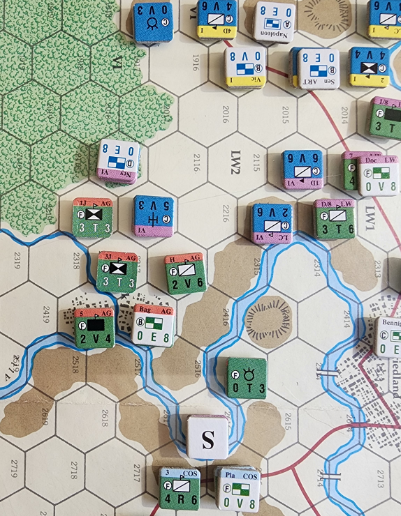
Part of the action from a game of Friedland.
It’s 14:00 on 14 June 1807 and the French VI Corps are driving a wedge between the Russian Left Wing and Advanced Guard forces, pinned against the Alle River. Will the Russian engineers get a pontoon in place quickly enough to allow a retreat?

So, how does it play?

My overall conclusion is that this game is a wee cracker – something of an overlooked gem. Like all games, it has its faults, and the packaging alongside Vittoria surely doesn’t help, but perseverance brings good rewards.

I should also say that the rules are in better condition than I initially thought. There are some rough edges, but nothing critical.  For example, it appears each side is supposed to have the possibility of gaining more Elan markers from the Friction Table, but the results are silent on this. As another example, engineers can put up pontoon bridges, but the rules are silent as to whether the engineer can move in the turn of creation. I don’t like how artillery all on its own imperiously defends against waves of cavalry charge. Also, the ability to (apparently) rally while still in an EZ doesn’t ring true. Even at this scale, I would expect some units to need to withdraw to recover. A house rule could fix that.

The command and control system, albeit there’s a lot of die rolling going on, does a pretty impressive job of replicating many of the issues the real combatants faced. The French are swift and decisive, but every so often, things go awry. In reverse, the Russians are unreliable, but can often spring a surprise. The lack of player control is good.

The combat system is unlike anything I have ever seen before. The absence of any combat ratios sure takes some getting used to. My hesitation in accepting the whole shebang is because my play generated one or two unusual results. Overall, the design for effect approach works reasonably. But I cannot help feeling that a 2d6 version of the combat results table would be an improvement. Also, while there is a rule about artillery fire being more effective against infantry if the artillery is stacked with cavalry, I’m not convinced the full scissors-rock-paper interaction of the three combat arms of Napoleonic times is shown here. Quite how that could be done at this scale is not obvious to me. At least you get some of the flavor.

So far as I can tell, the Friedland map scale is about 4-500 yards per hex. The closest development of the system seems to have been to treble the scale and go forward into the later part of the 19th century. The games Empires at War (here) and Chancellorsville (here) use much of the core command ideas. That makes them appeal to me. (I only have Chancellorsville & Plevna.) However, the combat system in these games is very old school and that is a big turnoff. One detail: the Empires at War command rules introduced an ‘F’ result meaning that the affected units had to fall back. That, I very much like. However, fitting it into the current 1d10 structure would be a struggle because it would probably happen too often to be realistic.

Summary: I have enjoyed my time with Friedland.

Fog of War

I am playing solo, so I didn’t attempt the fog of war rules. However, they look like they could be fun. Units are stored on a display off-map. Each counter on the map may represent a major force or a detachment. Depending on the visibility, you may try and see what is out there. When seen, the combat units are deployed on the map.

Dreams

If I ever get to meet Joseph Miranda, I would want to ask him why this series wasn’t continued. And, I’d love to understand the logic behind the different combat results tables. It will never happen, but I would love to create a new game using a 2d6 version of the tables – both CRT and command. I wonder if this would work for the American Civil War…

Why Now?

Why am I playing and writing about a game that is over 30 years old? Having retired, I now have a bit of time to scratch my gaming itch by playing some of the games in my collection that I have either never or barely played. (I won’t be able to play them all. Too many games. Not enough time!) I am also giving particular emphasis to looking back at my Strategy & Tactics magazines, but in no particular order) knowing that many of the games there got short thrift for one reason or another. SPI games should get some coverage to as befitting the S&T publishers. If I can keep going, there will be more of this type of blog post in the future.

Tip of the Hat

My thanks to fellow gamer John Forgy. John supplied me with a scan of the rules that allowed me to put together a set without any Vittoria material. That made assimilating thge rules easier. And our email exchanges helped me to focus my thinking about the game, play it extensively, and write about it.

Strategy & Tactics 38

Cover of S&T 38 showing front view of a WW2 cruiser ship.

Date of publication (as given): May 1973.

Some context. In that month:  a Provisional Irish Republican Army bomb in Omagh, County Tyrone killed five British Army soldiers. U.S. President Nixon confessed his role in the Watergate cover-up. Ajax won the European Cup in 1973, defeating Juventus 1-0 in the final held in Belgrade, Yugoslavia. Chicago Cubs managerr Whitey Lockman was ejected during the game and replaced by Ernie Banks who, by doing so, technically became baseball’s 1st African American manager.

Game included

CA by James F. Dunnignan. CA is a game about naval combat in the Pacific from 1941-43. For more information about the game, see here.

Articles

  • Outgoing Mail – editors/publisher
  • Tactical Warfare in the Pacific – David C. Isby
  • The Gettysburg Campaign – Albert A. Nofi
  • Sackson on Games – Sid Sackson

SPI Games Advertised

On a Personal Note

This was the first issue of my S&T subscription. CA was my first ever proper wargame. It was my first exposure to the concept that history and games could be fused together, and it was a combination I found exhilarating and addictive.

I’ve always had a particular interest in the battle of Gettysburg and I suspect that Al Nofi’s article in S&T 38 was at least partly responsible for this.

Strategy & Tactics 151

Cover of S&T 151.

Date of publication (as given): May 1992.

Some context. In that month: Oakland outfielder Ricky Henderson stole his 1,000th MLB career base in the A’s 7-6 win at Detroit. The Yugoslav Army captured Bosnian President Alija Izetbegovic. The US Army and Marine Corps were deployed in Los Angeles to end rioting following the acquittal of four police officers over the Rodney King beating. Linda Martin from Ireland won the Eurovision Song Contest in Malmo with “Why Me?”.

Games included:

  • The Battle of Vittoria by Vance von Borries. Vittoria is a simple, brigade-level game about Wellington’s victory against the French in Spain on 21 June 1813. For more information about the game, see here.
  • The Battle of Friedland 1807 by Joseph Miranda. Friedland is a division level game about Napoleon’s defeat of the Russians on 14 June 1807. Touted as the first of Miranda’s Napoleonic Battles System games, it was the only one produced. The system was novel and it suffered from having its rules and charts mixed in with those of Vittoria. For my look at the game, see here. For more information about the game, see here.

Articles:

  • The Napoleonic Revolution in Battle – Joseph Miranda
  • Raphia and the Militray System of Alexander’s Successors – Anthony Shaun Howarth
  • For Your Information – A. A. Nofi

ASL

When asked, I tell people that Advanced Squad Leader (ASL) is my favorite game of all time. In brief, it’s a highly-detailed game about tactical level combat in World War 2 and Korea. The counters represent squads of soldiers plus leaders, heroes, heavy weapons, guns, and individual tanks and vehicles. Each game turn represents about two minutes of combat.

To give you some context, the rules come in a three-ring binder and the core content you need to master to play the game runs to about 160 pages.

For more information about the game, see here.

What I like about ASL:

  • Immersive game play. No other game comes close.
  • Components. The maps and counters are excellent.
  • Variety of theaters. You can fight actions from every WW2 theater.
  • Variety of encounters. You can fight with just infantry or have guns, tanks, artillery, attack aircraft, gliders, and landing boats. (Not in the same scenario…I think.)
  • Variety of conditions. You can fight in day, night, summer, winter, good weather, or bad weather.
  • Variety of scenarios. I will never run out of scenarios to play. There must be over a thousand, and the majority have high replayability.
  • Each scenario is a challenge. You cannot just push around the pieces and see what happens. Or rather, you can, but you’ll lose. You have to have a plan, it has to be a good one, and you have to know how to tweak it in the face of enemy action.
  • Swings and roundabouts. Fate plays a part and you have to be able to take the highs and the lows. For example, in one turn, your sniper might eliminate the top enemy leader. In the next, your tank’s main gun may malfunction just as an enemy tank appears in its sights.
  • It’s tactical level combat. I love games at this level. I’m addicted to them.

What I dislike about ASL:

  • I’m not very good at it.
  • It doesn’t represent command and control very well.
  • There are too many gamey tactics that have no relation to real-life combat.

Despite these dislikes, ASL is still my favorite.

For many ASL gamers, it’s the only game they play. Given the commitment to be any good at ASL, this is understandable. I could probably improve my gameplay if I restricted my gaming time to only ASL, but I’m not prepared to give up the other games that I enjoy playing.

Finally, the rulebook. It’s a monster. It’s hard to read. It’s so tough to learn the game via the rulebook, the publishers put out Starter Kit versions with cut-down rules. That having been said, the rulebook is an amazing piece of technical writing. It operates very well as a reference meaning that, generally, you can find the answer to your query quickly.