Wurzburg — I played scenario one of this classic Modern Battles system from SPI. It went down to the last turn.
Advanced Squad Leader — The first scenario was Courage of Cowan (J242) set in December 1944, featuring SS infantry and tanks trying to break through American lines. The Americans held the line for four out of six turns, but the SS broke through on turn five to make the last turn a formality. The second scenario was First Dance (AP228), an early war encounter in Belgium between French and German mixed forces of infantry and tanks. The French first turn saw them enter the map and set up a strong defensive line which hammered the Germans as they tried to break through and that was that.
Fields of Fire — I went back to the Naktong River Campaign from the Korean War in this top-quality solitaire game system. I completed missions 1 to 3 successfully.
Undaunted: Normandy — A new game to me that combines card management with tactical movement of counters on a board. I had read some reviews but none had triggered a ‘must buy this’ response. After playing it, I know why. In short, it’s half a wargame and half a eurogame. So, it doesn’t fully satisfy on either account. There are a lot of cool ideas, but I won’t be rushing to play it again.
Today I had one of the worst experiences of my life.
I went to the funeral of the six-month old baby grandson of some friends.
My tears flowed freely. And as I was there, to do the only meaningful thing I could do to help, to show support for the family, I recognized that as hard as it was for me — and all the other mourners gathered there — it had to be almost unbearable for them. I cannot begin to imagine their pain and suffering.
Based on my own experiences, mourning for a loved one is a personal, individual pain that transcends physical limitations. It swamps you with darkness. It impacts your thoughts about life and the future while sometimes necessitating a pause for breath before returning to mourn some more. You think of things you might have done differently. Regrets gnaw you. Guilt lurks in the corner.
Eventually, one hopes, the pain will lessen. But it rarely disappears. And life goes on. Pain is a key part of being human.
I’ve had my bike (a Trek full-suspension mountain bike) for around 20 years. Today, it died: one of the clips holding a gear cable in place snapped off, leaving a great big hole in the frame. Without realizing the extent of the damage, I took it to the bike shop. The mechanic there said it wasn’t worth repairing because — even were a repair possible — once the integrity of the frame has been compromised, the whole frame could collapse at any moment. It was a sign: time to move on. Now I need to look around for a new bike.
Postcript: I took my bike from the storage area where it’s kept to the garbage collection area. Just moving the bike that short distance was enough to crack the frame completely. A close escape.
Date of publication (as given): January/February 1975
Context
January 1975: John Ehrlichman, John Mitchell, and Robert Mardian are convicted of Watergate crimes. The Pittsburgh Steelers beat Minnesota Vikings 16-6 in Super Bowl IX at Tulane Stadium, New Orleans. The musical Over Here! by Richard and Robert Sherman closes at the Shubert Theatre in New York City after 341 performances.
February 1975: Billy Herman, Earl Averill, and Bucky Harris are inducted into the Baseball Hall of Fame. Edward Heath is beaten by Margaret Thatcher in the leadership contest for the British Conservative Party. Linda Ronstadt tops both the US singles chart (You’re No Good) and the US album chart (Heart Like A Wheel).
Game Included
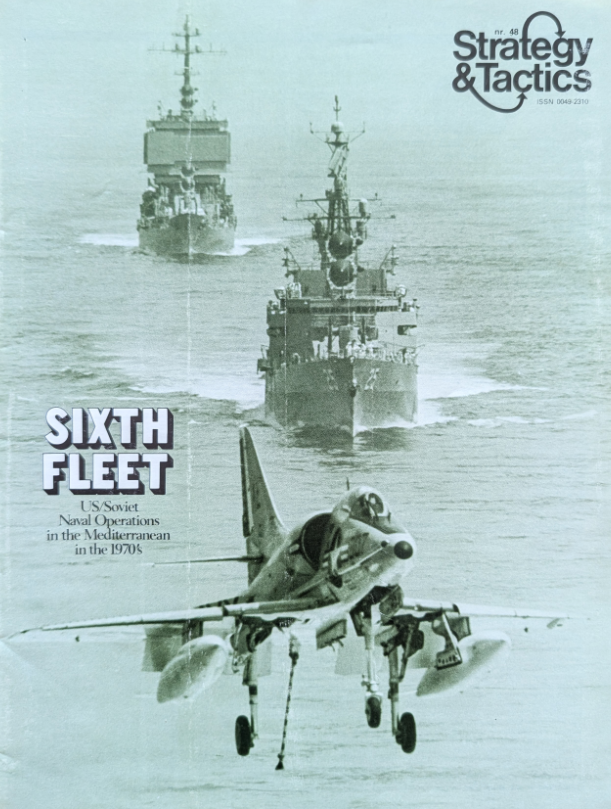
Sixth Fleet by James F. Dunnigan is an operational level game about naval warfare in the Mediterranean Sea in a hypothetical scenario in which the Cold War goes hot in the late 1970s, pitting the forces of the NATO Alliance against those of the Soviet Union.
Ever since we’ve been conducting Feedback surveys, we have found about 1% of our subscribers are women. Additionally, from time to time, we have had women gamers come by SPI. Usually just to buy games. In addition, one of our female staff members is a gamer. There are any number of reasons put forward as to why the composition of historical gamers is 99% male and 1% female. We would like to hear the viewpoint of the women gamers. We appreciate hearing from women gamers, either in writing or, if you’re in the New York area, in person. Since the subject matter of historical games affects all people, male and female, we would like to explore ways in which we can make historical gaming more accessible to women.
Sixth Fleet; US/Soviet Naval Operations in the Mediterranean in the 1970’s — David C. Isby and James F. Dunnigan
One thing that is certain about any future naval struggle in the Mediterranean is that the main destroyer of ships will not be other ships, but aircraft. As in the Second World War, ship-to-ship combat will only take place when environmental or tactical conditions prevent one side from placing aircraft in the area. The fact that airpower controls the seas was demonstrated in 1939-1945 and it is even more decisive today.
Global War; The War against Germany and Japan 1939-1945 — Martin Campion
There is no telling what Germany might have produced if it had not been for the Allied strategic bombing campaign. Speer guessed that, while the damage done by bombing in 1943 was nil, the loss in 1944 was in the neighborhood of 30 to 40%. In spite of this, while the Allied bombers wrecked more and more factories, German war production went up. In July, 1944, when nearly 100,000 tons of bombs were dropped on German-held territory by Allied strategic bombers, German war production hit its peak at a level that was more than three times the rate of production in 1941. Even at the end of 1944, armaments production was still at a level higher than it had been at the beginning of the same year. Strategic bombing dealt a death blow to the Geramn war effort, not by destroying the ability to produce weapons, but by wrecking Germany’s transportation system and ability to produce synthetic oil. So, the tanks and planes that were still coming out of the factories at the end of 1944 could not be delivered to the troops and could not be run very much anyway.
This issue was the first advert for the PRESTAGS (pre-seventeenth century tactical game) series: Chariot, Spartan, Legion, Viking, and Yeoman. I cannot remember why, but this generated no interest with me. Like 95% of the times when I decided to pass on a game, it was a mistake.
Dominion is a book about Christianity and its impact on aspects of the modern world. It’s not a comprehensive history, instead focusing on what the author sees as the key moments in its development and spread. The author’s main message is to promote the idea that Christianity’s influence has been revolutionary throughout history. Indeed, the front cover of the paperback version has the subtitle The Making of the Western Mind. That’s quite a claim. I’ll come back to it.
To make his point, the author delivers a compelling narrative. It starts, not with the birth of Christ, but 500 years before in Greece. The story continues with that civilization’s clashes with Persia and then the Kingdom of Israel’s defeat at the hands of the Romans before Jesus makes his brief appearance followed by Paul and the rest of his disciples. This scene setting is one of the book’s strengths because comparing the world before and after Christianity highlights — thanks to the author’s commentary — the diverse impact it had and why.
Holland deftly weaves multiple strands together to form an interesting, engrossing, and informative read as he tells the story puctuated with terrific bits of trivia and nuggets that only a true master of the topic could know in such depth.
I have always been impressed by Holland’s grasp of the material he tackles, but reading this book increased my admiration for his ability and the depth of his knowledge. To give just one example, the following quote is from the part of the book where he discusses persecution of the Jews by the Christians.
Yet the backwardness of the Jews was not quite as manifest as the Church authorities liked to pretend. Unlike the Waldemsiand, they had a degree of erudition that put most Christians to shame. Aquinas was not alone in admiring the achievements of their scholarship. Even the pope’s own household had long been managed by Jewish administrators. As a pupil of Abelard had freely acknowledged. ‘A Jew, however poor, if he had ten sons, would put them all to letters, not for gain as the Christians do, but for the understanding of God’s law — and not only his sons, but his daughters.’
Now back to the claims about Christianity’s significance. Of course, I don’t have Holland’s expertise and I am nowhere near as well read. Therefore my opinion is of little value. But, for that little it’s worth, I wasn’t completely persuaded by his arguments. Almost, but not quite. However, that didn’t stop me enjoying every minute I spent in the company of his writing. It truly is a joy to behold and read.
This is an excellent book. Even though it’s not a detailed history, it thoroughly covers the elements that are included. (In other words, there are still plenty of details in the book.) So, it’s not a light read. On the other hand, the author does a great job of making his argument without — metaphorically — trying to bash the reader over the head multiple times to pay attention to the author’s message. In this regard it’s as much show as tell. You will find a lot to inform and enlighten you. Highly recommended.
One of my favorite post-Pesach moments is retrieving my whisky. This year, because I’d removed the whisky from our home instead of just hiding it, it was a bigger job to put it back, so I left it until after Shabbat. Now I have the rest of the week to decide what the first taste of whisky will be in the new season. Given that the headline image shows only a sample of my collection, it’s a tough choice.