Wolfpack

Wolfpack is a solitaire game in which the player takes the role of the WW2 Germans trying to have their U-boats sink as much Allied merchant shipping in the North Atlantic as possible. Despite the game’s subtitle – Submarine Warfare in the North Atlantic, 1942-44 – the four scenarios provided cover February, March, April and May all in 1943.

The game, designed by James F. Dunnigan, is a high-level, low-complexity treatment of the subject, much of the action being abstracted, though it does enough to reflect some of the real-life challenges and decision making. It was published with S&T 47.

Scale

Each game turn is 24 hours, each hex is 43 nautical miles, and each counter represents individual U-boats or packs of U-boats, a convoy, a group of escort ships, or an unknown number of aircraft. Each scenario is 15 game turns. The game map displays part of the North Atlantic from Britain to Newfoundland.

The Wolfpack map.

Sequence of Play

Convoy Initial Placement

You put the next convoy on the map. Convoys appear in numerical order, alternating from eastern to western-bound, and with a hidden escort. The escort may be a dummy or a real one with a combat strength from 1 to 3.

Weather Phase

In this phase, existing foggy weather is removed, then existing storms randomly move on the map. Convoys that are touched by a storm may straggle making them more vulnerable to U-boat attack. You also randomly determine whether another storm or fogged-in-zone appears.

Air Phase

First, you allocate air units as escort to qualifying convoys. Then you conduct searches for U-boats with remaining air units. Air units may then attack any U-boats they have found. These procedures are programmed into the rules so you cannot cheat the system.

Naval Phase

In this phase, you move each convoy according to a random movement procedure. You may find that a juicy target has moved in a most inconvenient direction! Convoys will move to avoid U-boats spotted in the Air phase. Also in this phase, escorts may search for and attack U-boats they find and U-boats may try and locate convoys that enter one of their search zones. A single U-boat has a single-hex search zone. A wolfpack has a three-hex search zone. If the search turns up a dummy, that convoy is removed from the map.

U-Boat Operations Phase

First, you may freely organize your U-boats that are stacked. A single U-boat has a combat strength of 1 and 8 movement points. A pack of 6 U-boats has a combat strength of 7 and 6 movement points. A pack of 12 U-boats has a combat strength of 15 and 6 movement points, and so on. A pack of 30 U-boats has a combat strength of 40, but only 4 movement points. In this way, the game models the clash between concentration – good for combat, but reducing search capability – and dispersal – good for widening the search, but reducing combat ability.

A bundle of U-boat counters from the game Wolfpack.

Next, you may move your U-boats. If there’s a spotted convoy, you need to move adjacent to be able to attack it. On the other hand, you might try and put your U-boats where you anticipate convoys may sail so you can try and spot them and make them targets.

Combat Phase

Here, U-boats may attack adjacent located convoys. Escorts get to counterattack. Finally straggling – which comes in 2 strengths – is reduced from 2 to 1 or 1 to none.

Game Turn Indication Phase

The almost universal administrative requirement to move on the game turn counter!

Game Play

The first thing to note is that I had no problem with the rules. Indeed, a search for errata was unsuccessful. It appears that SPI learned some lessons from the Fall of Rome game.

The second thing worthy of comment is that the game is easy to play. There are one or two details that are hidden away – like the effects of straggling – which would have been best added to the tables printed on the map. However, this minor issue aside, the game flows well. The sequence of play is straightforward and the game mechanics are logical, well-explained, and easy to do. After the first couple of turns I rarely had to go back to the rule book.

Close up of some convoys and U-boats on the Wolfpack map.

It plays quite quickly though this is dependent on how active you are with your U-boats. For example, if you have widely dispersed your forces and there are lots of searches to do, things will take longer. I finished some game turns in under 10 minutes and I think the longest was about double that.

I managed a German Substantive Victory in my game. This suggests it is too easy to win. However, I wouldn’t take a single game experience as definitive. Further, for some strange reason, I seemed to remember some of the tips and tricks I discovered all those years ago that helped maximize my score. This doesn’t always happen!

Be warned that this game has a lot of luck. You can have a good search result only to find the convoy is a dummy. You can mass your U-boats for an attack only to roll poorly and squander the opportunity. And, as mentioned above, convoys don’t always go where you expect them to.

History

As a high-level look at the topic, the game does a reasonable job of imparting some useful historical patterns. For example, it quickly becomes apparent how important airpower was. Also, weather is a fickle beast that can make convoys more vulnerable but also slow down your U-boats and make discovery harder. The whole convoy movement seems a fiction as in reality the convoys had a route that they followed and it didn’t typically include sudden drastic changes of direction as may occur in the game. The abstraction seems to be design for effect and if you suspend your disbelief a little it makes sense. The game’s optional rules give you added insight to some of the key elements of the historical campaign.

Overall

The physical components are fine: the map and counters are clear and the rules are well done. Given the limitations in place, it’s a fine looking game.

It was fun playing Wolfpack. It wasn’t the toughest challenge, but it was quite quick and provided decent entrtainment. It’s held up reasonably well. It’s not a game you absolutely have to play, but if you get the opportunity it probably deserves some of your time. If you do try it, check out the supporting article in S&T 47 first.
The Perfidy of Amnesty

Once upon a time, Amnesty was a real human-rights organization. Not any more. For many years, perhaps decades, it has been a front for bigotry directed at Israel, Israelis, and Jews. For those outside the battlefield, Amnesty still retains its reputation. That’s one reason why its particular bigotry is so venomous and effective. Those of us who know the true situation tend to largely ignore all of Amnesty’s activity. Once you know it’s been repurposed as an antizionist, antisemitic outlet, you start to realize that you cannot trust anything it says. And I mean anything.

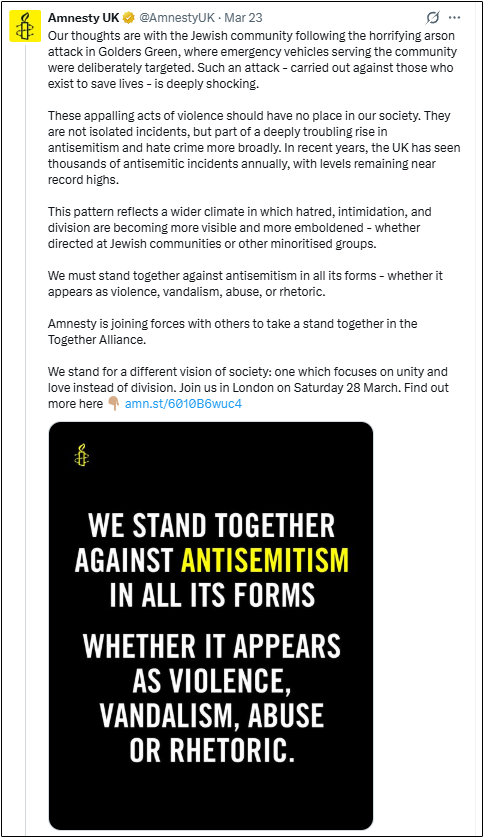
I was reminded of the perfidy of Amnesty by this recent post on X (formerly Twitter).

Amnesty post on X, starting with "Our thoughts are with the Jewish community following the horrifying arson attack in Golders Green..."

On the face of it, you couldn’t ask for more. However, it’s a sham.

Cast your mind back to 2015. At the Amnesty International UK’s Annual General Meeting that year, there were 17 resolutions up for adoption.

The 16 that were passed covered a range of international human rights issues and internal organizational matters.

The single resolution that was rejected was the one to “Campaign against anti-Semitism in the UK” and lobby the UK Government on this issue.

As reported by NGO Monitor here:

According to the motion, neither AIUK nor the [Amnesty] International Secretariat have undertaken research or campaigning work specifically on anti-Semitism in the UK.”

And

Nevertheless, an Amnesty-UK official offered a misleading technical justification, claiming that “our membership decided not to pass this resolution calling for a campaign with a single focus.” In fact, AIUK has initiated “single focus” campaigns frequently in the past, for instance, approving “overwhelmingly” a  2010 resolution on Sinti and Roma Communities, and stating: “Within the last year widespread discrimination and violence against Sinti and Roma communities has intensified in a number of European countries, which Amnesty International has published within respective country reports.” AIUK’s silence on antisemitism stands in sharp contrast.

There was an attempt on X to explain their stance:

We condemn all forms of hate crime and discrimination. Unfortunately we can’t campaign on everything.

They do campaign about lots of issues, but not about antisemitism.

Even Wikipedia, no friend to the Jews, has material about Amnesty’s bigotry.

WikiPedia content about Amnesty and antisemitism. (27 March 2026)

Agnes Callamard has been the Secretary General of Amnesty International since 2021. Wikipedia – perhaps unsurprisingly – doesn’t find space for mention of her blind spot towards the Jews. For example, when British-Egyptian activist Alaa Abd el-Fattah was released, this was her post on X and a sample of the unanswered criticism it triggered.

Post by Agnes Callamard on X. It says "Alaa is in the UK, reunited with his son and family. I am so so happy for them all." User @HarryJonesOz posted "Once many years ago Amnesty would not engage with a person who advocated or engaged in violence. Now here you are pouring out your love for a person who advocates openly on record for killing Jews. Did you ever stop to think?"

In other words, she celebrated the release of a man who called for Jews to be killed. For the complete extent of Alaa’s bigotry, he also called for the death of homosexuals and “whites”.

There are plenty more examples of Callamard’s bigotry and bias. Grokipedia has some material here. But these are truly the tip of the iceberg. Given her position, there’s little likelihood of Amnesty’s stance changing.

In short, for Amnesty, Jews don’t count. That new post about the incident in Golders Green is a sham. Don’t trust Amnesty.

Strategy & Tactics 47

Cover of issue 47 of S&T magazine with an image of the tower of a WW2 German submarine on the surface, with two officers using binoculars

Date of publication (as given): November/December 1974

Context

  • November 1974: Lord Lucan disappears, never to be seen again. The John Lennon single Whatever Gets You Through the Night goes to #1 in the USA. MLB Commissioner Bowie Kuhn suspends George Steinbrenner (New York Yankees owner) for two years after his conviction for illegal contributions to political campaigns.
  • December 1974: Jean-Paul Sartre visits Andreas Baader (Baader–Meinhof Gang leader) in prison. The Towering Inferno movie, starring Paul Newman and Steve McQueen, is released. Australian Evonne Goolagong Cawley beats Martina Navratilova of Czechoslovakia 6-3, 6-2 at the Australian Open Women’s Tennis to retain her title.

Game Included

Wolfpack by James F. Dunnigan is a solitaire game about the submarine campaign in the North Atlantic from 1942-44. The player, as the German U-boat commander, is trying to sink the maximum number of Allied merchant ships while trying to conserve the U-boat forces.

For my take on the game, see here.

For more information about the game, see here.

Articles

  • Outgoing Mail – editors

Coming:… in S$T 50, a game called Twentieth Century…The exact design parameters for The Twentieth Century game are still up in the air. In all probabibility, it will be a two-player game with a Multi-Player option. We have a rather novel game system in mind, but, since nothing is firm yet, we will wait until the next issue of S&T to give further details.

  • Wolfpack; The German Submarine War in the Atlantic, 1939-43 – Frank Davis

With a little help from their Italian allies, the Germans lost over 800 submarines during the six year war against Allied shipping. About 15,000 tons of Allied shipping was sunk for each U-boat lost. This is approximately two merhcant ships lost for every U-boat lost. While the Allies were able to absorb such losses, the U-boat losses proved too severe for the Germans.

  • World War 3; Potential for Conflict in the 70s – Stephen B. Patrick

…the Middle East. Here we have everybody else in the area arrayed against Israel. Israel easily outnumbers (in terms of ground combat strength) her immediate neighbors and enemies, Egypt, Syria and Jordan. The element that gives Israel a decisive edge is the qualitative superiority of her soldiers and their equipment, particularly tanks and aircraft. While the main confrontation is between Israel and all of the other Middle Eastern and North African states, one must not forget that between these states there are also long standing animosities which have only been temporarily put aside due to the confrontation with Israel. Once the Israeli issue has been settled, it is entirely likely that certain Middle Eastern and North African nations will turn their armed forces on each other to settle old (or new) grievances.

  • Footnotes – everybody
  • Sackson on Games – Sid Sackson

SPI Games Advertised

On a Personal Note

The Sackson on Games article featured some games newly introduced to the USA – including Election, and The Game of Nations – which I had been playing extensively and enthusiastically before starting my S&T subscription. After then, I barely played them again.

Threat Environment

As the foul Iranian regime is discovering, repeatedly threatening ‘Death to Israel’ and ‘Death to America’ has consequences. And the bill is due for payment now.