The Tainted Cup

Robert Jackson Bennett
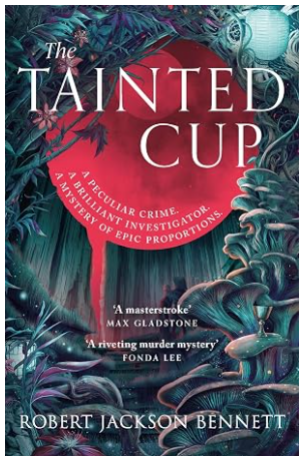
Cover of The Tainted Cup featuring many dark, strange, and poisonous looking plants.

Note: this is a spoiler-free zone!

The setting is the Khanum Empire, a collection of cantons protected by huge walls from the seas and the leviathans — huge whale-like monsters with some land-walking ability — that periodically try to breach the walls and bring death and destruction to the land.

The Empire has mastered many technologies that allow them to create and change citizens to fulfil specific functions. For example:

  • Cracklers who grow to eight feet tall and double or triple the size of ordinary humans, so named because their reinforced bones and joints make a distinct clicking or crackling noise whenever they move. They are used for very hard work duties like hauling heavy gear and servicing the massive sea walls. However, the biological modifications strain the human body, significantly shortening their lifespans.
  • Engravers who are living recorders for the Iudex, the Empire’s investigators. They have a flawless photographic memory. They can perfectly record scenes and play them back later for analysis. They are easily identified by their gray-tinted skin. To calm their altered brains they develop grounding techniques such as smoking herbs.
  • Apothetikals (known as Apoths) who are the Empire’s biotech scientists. Their job is to manage contagions — of which there seem to be a lot —and to engineer living infrastructure. (For example, fretvine, used for walls, towers, and gates and fernpaper, used for internal walls.) Apoths are physically modified to detect micro-scents, chemical compounds, and biological pathogens by smell. Their modifications cause parts of their faces to display a distinct purple discoloration

The plot involves the investigation of the gruesome murder of a high-ranking imperial official — killed by a tree that sprouted from his body — by Ana Dolabra, an eccentric investigator and her assistant, the engraver Dinios Kol.

In a way this is a fantasy reworking of the Sherlock Holmes and Doctor Watson relationship. Dolabra is the one who is a bit footloose and fancy free with the law, seeing everything faster than others and Kol is the one, sticking to the rules and doing the hard slog on the ground. However, this observation is not a criticism. Their relationship is well done, carefully developed, and taking everything into account, believable. It’s a solid foundation for this excellent novel. These two main characters are well supported by a range of other personalities.

And all the characters are, in turn, supported by a masterclass in worldbuilding. Architecture responds to the weather. Alchemy manipulates biology. There seem to be more modified humans than the regular kind! What others have described as ‘biopunk’, I found thoroughly enjoyable. It’s strange, but it’s clear the author has put a lot of work in making it hang together and you do get used to it.

The plot is reasonably well crafted, the twists are sufficient, and the pacing is just about right. If there were any patches of self-indulgent overwriting, they passed me by. To nitpick, the one minor part that grated was a certain love interest. It didn’t work for me. YMMV.

I read this immediately after Halcyon Years. In both novels, the setting is key. In Halcyon Years, the setting is refreshingly different and presents a puzzle that isn’t initially revealed: why is the technology limited? It’s an open question if revealing the secret behind the limited technology means the setting won’t be as attractive in any future stories in the Halcyon.

By comparison, in this book, right from the first ‘biopunk’ reveal, you sort of know what’s going on and you’re keen to see what other weird and wonderful phenomena are there to discover. It’s also clear that there is lots more about this world to discover.

I can see why The Tainted Cup won a Hugo. It’s a delight.
Halcyon Years

Alastair Reynolds

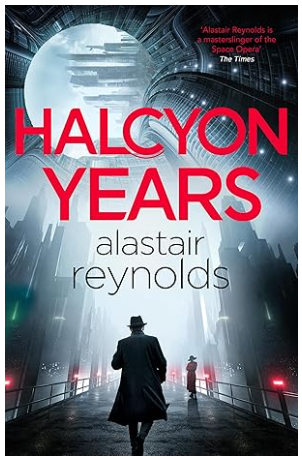
Front cover of Halcyon Years showing the silhouette of an old-fashioned private eye  walking along a promenade into a futuristic city.

Note: this is a spoiler-free zone!

The Halcyon is a huge generation ship taking its enormous load of humans off on a several-hundred-year journey to settle a faraway planet. Inside, it’s built like a small country with all that entails including two rival families that seem to be running the show. A young member of each family dies within two weeks of the other. Both are tragedies. Or are they? Yuri Gagarin (yes, that Yuri Gagarin) is a private eye. A mysterious client asks him to look into the deaths. Another mysterious person tries (unsuccessfully) to warn him off. From here on, the mystery unfolds.

One notable aspect is the strange technological situation: technology is limited almost exclusively to a mid-20th-century level. It reeks of the 1950s with add-ons. For example, people use wired telephones with dials, standard televisions, and real film cameras reminiscent of classic hardboiled detective stories. (The cover image reinforces the noir nature of the setting.) The modes of transport include simple electric vehicles. While robots were once in abundance, now they are few and far between with limited capabilities. The major add-on is that the ship features advanced cryogenic chambers capable of preserving and successfully reviving human bodies (like Gagarin) decades or centuries later and repeating the process multiple times.

On the plus side:

  • Gagarin is supported in his endeavors by Lemmy Litz, a former policeman, whose contacts are a major help in the investigation. The interaction between Gagarin and Litz is entertaining with some laughs peppering the dialogue.
  • The setting is creative and fun. It’s a definite highlight.
  • All the oddities in the technology situation are explained reasonably well.
  • The plot does a good job of drawing in the reader and keeping up the tension.

On the down side:

  • Although the Litz and Gagarin encounters are entertaining, sometimes these characters came across as more cartoonish than believable.
  • At times, the setting impresses more than the plot.

Overall, I enjoyed Halcyon Years. The setting is a winner. I don’t think this particular story matches the quality of the setting. In other words, there are probably better stories to be told of life on board the Halcyon. In short, it’s a good book: not one of the best, but well worth reading.

George Cross

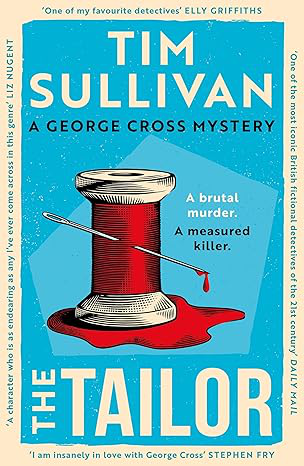
Front cover of The Tailor by Tim Sullivan sowing an image of a red reel of thread with a needle through it, the whole thing sitting on a puddle of blood.

Note: this is a spoiler-free zone!

The Book

The Tailor, by Tim Sullivan, is the eighth novel in the crime series starring Detective Sergeant George Cross.

The book starts with a shocking murder aboard the morning train from Bristol to London. William “Billy” Titcomb, a third-generation bespoke tailor, is found dead in a first-class train toilet before the train even reaches Bath. His throat has been savagely cut and a plastic bag placed over his head.

The British Transport Police call for help, bringing in the local force’s Major Crimes Unit (MCU), which is where George Cross works.

From here on, the investigation proceeds as our hero works to solve the crime. And that’s all I’m going to say about the plot.

The writing is crisp and packed with wisdom and humor. Much of this comes from the lead character, but the supporting cast have their moments. The plot is well put together, though of all the books to date this is the one which requires the most suspension of disbelief. And, as with all good books, I was disappointed on reaching the end as I wanted more.

This novel is a fine piece of crime fiction. I recommend it and the whole series. If you like this sort of thing, don’t start here. Read the books in order. (The first is The Dentist.) If you don’t normally like crime fiction, this might change your mind. Why? George Cross is a great character and that alone makes the books worth reading.

And so, let’s talk about the lead character.

The Character

Previously, I’ve referred to the oft-followed rule that police-based crime stories must feature a defective detective. The hero must be a drunk, a womanizer, a misogynist, a thoroughly unpleasant individual, a murderer, or be potentially fatally flawed in some other way.

George Cross is not the typical detective. He is on the autism spectrum and his neurodiversity is depicted not as a tragic burden or a magic gimmick, but as his primary investigative strength. This makes Cross a compelling and refreshing character. Here’s why.

No Hunches

Unlike standard fictional detectives who rely on hunches or emotional intuition, Cross works strictly through logic, evidence, and pattern recognition. He doesn’t form wild hypotheses. Instead, he systematically tracks patterns in human behavior and timing, seeing the breaks, and following these through.

Nothing But the Truth

Cross is completely unaffected by social status, office politics, or external pressure to close cases quickly. Whether questioning a powerful politician or advocating for a marginalized victim (such as an elderly homeless man in The Dentist), he treats every individual with the exact same literal, unvarnished objectivity. His motivation isn’t ambition. Indeed, he actively declines promotions to avoid managerial overhead. He wants to get to the truth. As he sees it, that’s how to maintain justice and order.

High Conviction Over High Speed

While many fictional policemen boast high arrest rates, Cross boasts a (frankly unbelievable) 97% conviction rate. How does he achieve this? Slowly. His meticulous adherence to protocol, a flawless chain of custody, and immaculate paperwork take time. He maintains a dogged, steady approach. And when a case reaches court, the prosecution’s evidence is practically bulletproof.

Total Social Literalism and Unintentional Wit

Cross does not grasp small talk, sarcasm, or social subtlety. His completely literal responses to everyday statements create natural humor throughout the books. He is never intentionally rude; he simply sees no point in polite dishonesty or beating around the bush.

Rich, Grounded Personal Dynamics

His character shines just as brightly outside the police station. His rigid daily routines (such as cycling to work and playing the organ at a local church) contrast with the messy human element of his personal life. His close bond with his elderly father, Raymond, along with his evolving professional dynamic with his practical partner Josie Ottey — who acts as his social translator and defender — gives the series genuine emotional warmth.

The Conclusion

George Cross is a great character. Don’t miss out!

The Wasp Trap

Mark Edwards

The front cover of The Wasp Trap by Mark Edwrads. It shows an image, in dark light, of a multi-storey house whose reflection is shown in the lake to the front of the building.

Note: this is a spoiler-free zone!

This is a contemporary, UK set, psychological thriller. The author presents a typical thriller buildup of friends — who for one reason or another haven’t met for several years — gathering for a dinner party. Once they were involved in an internet startup. What happened and why?

From the arrival of the first guest the tension mounts and the twists wait in ambush.

The evening is full of long-held secrets being revealed and the inevitable consequences as the friends learn all sorts of new stuff about each other and themselves.

The writing is taut with little flowery detours or other time-wasting. The core characters are all well done: they are human, believable, and interesting. I was less impressed by the supporting cast, but perhaps I gave them less attention while being carried along by the story and a more patient read might have meant they were more appreciated.

The plot unfolds at a decent pace and it’s not long before you realize you are engrossed in a real page-turner.

This is a fine, entertaining, exciting novel. It’s not going to feature as an award winner in the corridors of the literary establishment but it deserves recognition as a damn good piece of work.

If you like modern thrillers, you should not miss The Wasp Trap.

Shroud

Adrian Tchaikovsky

Cover of Shroud by Adrian Tchaikovsky showing a futuristic pod-shaped vehicle entrapped by many tentacles.

Note: once you know this book is about first contact with alien life, this is a spoiler-free zone!

Set in the far future, with humanity still on its own, trying to spread out far and wide across the universe, the story focuses on one particular colonial encounter.

In the Prospector413 system, the spaceship Garveneer approaches a moon that is always on the dark side of the planet.

Juna Ceelander and others are brought out of cold-storage to explore the planet to determine its suitability for exploitation by way of strip-mining. One irony is that Ceelander lives in a corporate world that exploits her and she has, it seems, no choice but to extend the influence and reach of her bosses and exploit the alien moon.

To put the plot at its simplest, Ceelander and company encounter alien life. The book describes this from the perspective of the humans — driven on by corporate budgets, goals, timetables, and internal politics — and the aliens. The communications gulf and the consequential challenges are patiently and logically shown. The writing is evocative and engrossing as you are drawn in to the struggle for comprehension. The human characters are well drawn. Their interactions are meaninful and authentic. The alien parts are outstanding — fresh, new, and challenging. The backdrop is as much a character in the drama as anyone else. The pacing is just right, maintaining the tension without overdoing things.

This is the best science-fiction book I have read in a long, long time. To keep the review spoiler free, it’s short. But don’t let that fool you. There is a lot packed into Shroud and you will be missing out if you don’t read it. I have had some misses in the past with this author, however Shroud is definitely a hit. Highly recommended.

Big Read, Small Read

Note: this is a spoiler-free zone!

When I was younger, my main reading interest was science fiction. In the last couple of decades, I’ve been less successful in finding sci-fi that I wanted to read. I have a subscription to Locus to keep me up to date. In essence, most of the reviews convince me that the book under review is not for me. But, every so often, I pick up a couple of hints and take the plunge.

The first book I’ll mention is a Locus find: Murder by Memory by Olivia Waite. This is a novella (101 pages) containing a comfy murder-mystery set in space.

Cover of the book Murder by Memory, written by Olivia Wait. The cover shows a seated figure in a library of some sort, possible memories.

The action takes place on an interstellar generation ship. One of the ship’s detectives, Dorothy Gentleman, wakes up in someone else’s body just as a murder takes place. The important detail is that the passengers can avail themselves of a storage facility for their minds between awakenings. However, it seems that not only has there been a physical murder, but also someone is deleting minds from the storage.

I say it’s a comfy story because it’s reminiscent of one of those TV mysteries where the violence is largely subdued and although a murder has occurred, people are polite, chilled, and going on with their regular lives. That’s the score here.

The writing is pitched well as it tells the story without too much unnecessary embellishment and presents the neat solution with confidence and style. In short, I liked it. However, while I knew beforehand it was a short read, near the end I was frustrated that there wasn’t more. Some of the ideas presented have great potential for lengthier, more detailed tales and I hope the author returns to the setting again. I would recommend this if you like short, straightforward stories and can handle a science-fiction setting.

That was the small read.

The big read is To Sleep in a Sea of Stars by Christopher Paolini. This is an 800+ page doorstop of a space opera novel. It’s at the opposite end of the scale to the small read. It didn’t come to my attention because of a Locus review. I saw it in a bookshop in London last year and liked what I saw.

Cover of the book To Sleep in a Sea of Stars by Christopher Paolini. It shows a female silhouette  surrounded by lots of stars.

The story revolves around a female character, Kira Navárez who finds an alien relic on an uncolonized planet and all that happens after that encounter. The mix includes aliens, battles, war, and politics. There’s also a love story or two and a veritable feast of future technology and cracking ideas, most of which are really cool and interesting. To put it another way, the book is packed with good stuff.

Another positive is that the main character is sympathetically drawn and believable, doesn’t totally hog the spotlight, and is aided by several good quality supporting members of the cast.

On the other side of the coin, while there’s no doubt this author can write beautifully, sometimes there was just too much description and a hint of repetition, none of which seemed to me to bring anything of great value to the story. Given the history of how the book was created (told in an afterword) I wonder if the editorial team were told to go easy on the writing. If so, that was a mistake.

It’s a good book, but not great. It cannot match Banks, but it suggests the author might achieve that in the future, if guided appropriately. It’s worth reading, especially if space opera is your thing.

Dominion

Tom Holland

Front cover of Dominion by Tom Holland featuring images of people and places mentioned in the book.

Dominion is a book about Christianity and its impact on aspects of the modern world. It’s not a comprehensive history, instead focusing on what the author sees as the key moments in its development and spread. The author’s main message is to promote the idea that Christianity’s influence has been revolutionary throughout history. Indeed, the front cover of the paperback version has the subtitle The Making of the Western Mind. That’s quite a claim. I’ll come back to it.

To make his point, the author delivers a compelling narrative. It starts, not with the birth of Christ, but 500 years before in Greece. The story continues with that civilization’s clashes with Persia and then the Kingdom of Israel’s defeat at the hands of the Romans before Jesus makes his brief appearance followed by Paul and the rest of his disciples. This scene setting is one of the book’s strengths because comparing the world before and after Christianity highlights — thanks to the author’s commentary — the diverse impact it had and why.

Holland deftly weaves multiple strands together to form an interesting, engrossing, and informative read as he tells the story puctuated with terrific bits of trivia and nuggets that only a true master of the topic could know in such depth.

I have always been impressed by Holland’s grasp of the material he tackles, but reading this book increased my admiration for his ability and the depth of his knowledge. To give just one example, the following quote is from the part of the book where he discusses persecution of the Jews by the Christians.

Yet the backwardness of the Jews was not quite as manifest as the Church authorities liked to pretend. Unlike the Waldemsiand, they had a degree of erudition that put most Christians to shame. Aquinas was not alone in admiring the achievements of their scholarship. Even the pope’s own household had long been managed by Jewish administrators. As a pupil of Abelard had freely acknowledged. ‘A Jew, however poor, if he had ten sons, would put them all to letters, not for gain as the Christians do, but for the understanding of God’s law — and not only his sons, but his daughters.’

Now back to the claims about Christianity’s significance. Of course, I don’t have Holland’s expertise and I am nowhere near as well read. Therefore my opinion is of little value. But, for that little it’s worth, I wasn’t completely persuaded by his arguments. Almost, but not quite. However, that didn’t stop me enjoying every minute I spent in the company of his writing. It truly is a joy to behold and read.

This is an excellent book. Even though it’s not a detailed history, it thoroughly covers the elements that are included. (In other words, there are still plenty of details in the book.) So, it’s not a light read. On the other hand, the author does a great job of making his argument without — metaphorically — trying to bash the reader over the head multiple times to pay attention to the author’s message. In this regard it’s as much show as tell. You will find a lot to inform and enlighten you. Highly recommended.

Stories About Borders

Once upon a time, I was in Heathrow before a flight home, and my Kindle had died. I needed to have something to read on the plane.

I found a history book whose introduction appealed to me. The author – an academic holding a position at one of the Oxbridge Universities, an expert in their chosen field – had decided to write a book that would be accessible to all and not just history buffs interested in that area. It sounded great.

It was turgid. The writer repeatedly displayed an amazing depth of detailed (far-too detailed) knowledge about the subject. But the writing was plodding, slow, and lacked even a hint of humor or meaningful analysis. The writer could not tell a story. Sad.

A History of the World in 47 Borders, by Jonn Elledge, is the polar opposite: it’s well written, entertaining, and has a decent dose of humor throughout. It’s also packed with glorious nuggets, like noting the connection between Catherine the Great and the Polish King, Stanislaw II August, and what happened to the first (unsuccessful) Black Hand assassin who tried to kill Archduke Franz Ferdinand.

Front cover of a History of the World in 47 Borders, displaying an image of a map of part of Europe and a pen drawing a border.

Every chapter delivers something interesting, even when covering well-treaded territory.

I do have one quibble. The (inevitable) chapter about Israel (The Uncertain Borders Between Israel and Palestine) includes this:

…in October 2023, just as this book was going to press, the Hamas terrorists who control the Gaza strip launched the largest attack on Israel in the country’s history, and the Israeli government responded with one of the most vicious attacks in Palestine’s history in response.

I offer the following observations:

  1. So the attack from Gaza’s distinguishing feature is that it was the largest? It was the worst single day loss of Jewish life since the Holocaust. Describing it as ‘the largest’ is, to put it mildly, disappointing.
  2. So Israel’s response was vicious? There are many wars and conflicts mentioned in the book. So far as I can recall, the only one that apparently merited a nasty adjective was Israel’s answer to October 7. Perhaps the author would have preferred if we had invited Hamas round for tea and crumpets first?
  3. It appears to me that this nugget has not been well edited. The sentence features both ‘responded’ and ‘response’ and one is redundant. The sentence could have stopped after ‘history’ with no loss of meaning. I’m going to go into amateur psychologist mode here and suggest the editor (not the author) was so happy at seeing Israel being criticized, they quickly moved onto the next sentence.
  4. There’s a hint in the author’s background (he’s a New Statesman columnist) that he’s unlikely to be pro-Israel. The sources quoted for this part include – of course! – Haaretz articles.
  5. To be fair, the rest of the chapter was a reasonable and fair overview of the situation (though, to be comprehensive, it should have also dealt with the creation of Jordan), even if I didn’t agree with it all. And, to give credit where it’s due, check out the following quote from early in the chapter.

I’m going to confess something at this point:I’ve been dreading this bit. More than any of the chapters about European colonialism messing up the world, more than any of the other chapters at all.

It’s probably my own bias and perspective, but I cannot reconcile that quote, suggesting care and consideration, with a casually dropped insult about Israel’s response to October 7.

My minor irritation should not put you off buying the book. I highly recommend it. Even if history is not usually of any interest, anyone with the slightest curiosity about how the world got to be the way it is today, will find many answers here. Beg, borrow, or steal a copy. You won’t be sorry.

Good Reading

I’m just back from a quick trip to the UK. One of the things I miss most from that place is being able to go to a decent bookshop. There are plenty of bookshops in Israel, but none that are English language only and come anywhere close to matching the extensive stock of any half-decent Waterstones’ branch or, certainly, Foyles. Ra’anana does have the excellent ESRA second-hand bookstore, though, and I have been known to add to its stock from time to time!

On any trips to the English-speaking world there’s always at least one bookshop trip scheduled, even if most of my purchases are ahead of time from Amazon. I love browsing a bookshop. It’s a great way of discovering new authors and books. It’s a real bonus if the store has – like the outstanding Foyles – a cafe to round out the experience.

Here are the (real) books I bought on this trip to join the to-be-read pile. (Simultaneously, based on my browsing, I added several books to my Kindle library and Amazon Wish List.)

A stack of books: A History of the World in 47 Borders by John Elledge, Strangers in Time by David Baldacci, The House of Burning Bones by Stuart MacBride, Half a King by Joe Abercrombie, Daughter's War by Christopher Buehlman, Dominion by Tom Holland, How to Win the Premier League by Ian Graham, Grimm Fate by Jason D. Mark, The Panzers of Prokhorovka by Ben Wheatley, Post Mortem by Richard Brooks, Sparks Song by Song by Ruud Swart, Leuktra 371 BCE by Nic Fields, The Army of Alexander the Great by Richard Taylor, and The Private Eye Annual 2025.

I’m looking forward to reading each and every one. Now, where to start…

As a Jew

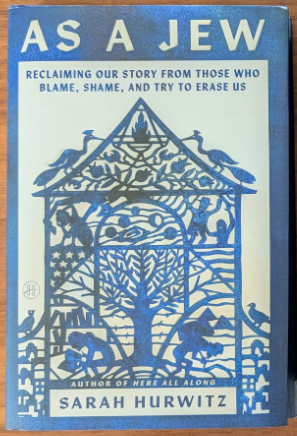
Sarah Hurwitz, Harvard Law Scool graduate and former speechwriter for the Obamas and Hillary Clinton, has written an interesting book about her personal journey from “a typical lapsed Jew” to someone who puts Judaism front and center of her life.

Cover of 'As a Jew' by Sarah Hurwitz with subtitle: Reclaiming our story from those who blame, shame, and try to erase us.'

From my perspective, it was fascinating to read her description and tales from the heart of assimilated Jewry in the USA, a body of people I know very little about. Hurwitz paints a sad portrait – well, it was sad to me – of a people with no connection to their birthright and no serious prospect of ever reclaiming it. Given the stark background, Hurwitz’s tale is that more remarkable. Bear in mind, she was someone who felt uncomfortable when she encountered students at university who knew how to celebrate Shabbat in all its glory. (This refreshingly honest self-appraisal runs throughout the book and makes the path that more engrossing and involving.)

The author makes a point of highlighting how antisemitism has had, arguably, more of an impact on Jewish identity than any other factor, and her growing anger with that state of affairs. She takes on the onerous task of educating herself about myriad aspects of Judaism – yes, including Israel – and she finds the hard work rewarding because it brings inner strength and conviction resulting in a whole new approach and a desire to spread the message by lecturing and writing this book.

While I don’t agree with all that she says, it’s all worth reading. Instead of the social media characters who post ‘As a Jew’, here is a real, connected Jew, speaking from the heart with pride and purpose.

Highly recommended.