It’s noteworthy that China and Russian did not walk out, but Lebanon and Syria did.
Apparently the walkout was heavily promoted by the PA who asked delegations to beef up their numbers so the participation looked larger than it would otherwise have been.
As Uri also said on X:
This list includes some of the worst countries in the world by any objective metric. Makes one wonder why do some European states wish to be in the company of absolute, backwater shitholes?
This is an excellent point. What the hell, for example, are Spain playing at? One possible explanation is that Spanish Prime Minister Pedro Sánchez is trying to divert attention away from the corruption crisis in the country. Part of the crisis is close to home for him as his wife, Begoña Gómez, is facing charges of public embezzlement and is being investigated for other potential offenses: influence peddling, business corruption, trademark misappropriation, and intrusion. While she’s innocent till proven guilty, the pressure on the couple must be horrendous. How they must enjoy taking a free swing at Israel!
As for the Irish, well, frankly they have form. Their President has behaved in a foul manner towards Israel.
The states participating in the walkout behaved like student activists trying to make a cheap point. It was not a mature act. It was an act of weakness. It was not an act that helped anyone, Palestinian or otherwise.
Arguably, the walkout nations showed the world they are afraid of Bibi, or at least afraid of what he would say to them. So, I’d describe them as cowardly. As many of these nations are tinpot dictatorships who behave like bullies, at least their cowardly act was consistent!
Also, the walkout proved (yet again) the validity of Israel’s persistent and accurate complaint that the UN is biased against Israel. Are you aware of a similar boycott of anyone else’s speech? As far as I can see, those fine upstanding libertarians Idi Amin, Muammar Gaddafi, Ayatollah Khomeini, Fidel Castro, Vladimir Putin, and Mahmoud Abbas (to name a few) were not greeted by any similar display of petulance. Only the Jew among the nations deserves such treatment it seems.
Closer to home, at least one Israeli commentator said Bibi’s speech was directed to the Israeli electorate and not the UN delegations. I think that’s unfair. Sure, part of his thinking would have been how it would be received in Israel, but the focus seemed to me to be firmly on making Israel’s case and chiding the weak ‘allies’ we are supposed to have.
I am no fan of Bibi, but I thought his speech was a good one. He was more polite than I would have been though and that’s one reason why I never went into politics!
Note: I published the following post on my Facebook page on October 11 2023. I am reposting it here, unedited.
We are the people of the Jewish State. We have been demonized. We have been delegitimized. We have been defamed. We have been denounced. We have been subjected to double standards.
But all of that is so much sticks and stones in the face of Saturday’s brutal terror attack. Now we have been slaughtered, brutalized, raped, and taken hostage.
To add insult to deep injury there are people out there who celebrate the atrocities committed against us. Or, if they don’t celebrate the atrocities, they offer excuses and justification. Or, if they neither celebrate nor justify the atrocities, they are silent.
It should not be difficult to know which side of the fence to stand on: on the side of evil with those committing the atrocities or on the side of good with those against whom the atrocities were perpetrated. If you’re not standing on the side of good, you’re part of the problem.
It should not be difficult to know that there is no justification or excuse for these atrocities. Every murderer in so-called civil society seeks to excuse his actions and those excuses are rightfully rejected. That is what you should be doing. If you’re not, you’re part of the problem. It should not be difficult to know that silence and inaction can be deadly. As the famous quote (edited) say: “The only thing necessary for the triumph of evil is for good men and women to do nothing.” So, if you’re doing nothing, you’re part of the problem.
And the problem? See the first paragraph. The Guardian is part of the problem. Almost every story about Israel and Jews is designed to show the Jewish State in a bad light. Many events that would highlight the bloodthirsty immorality of our terrorist neighbors are ignored or excused. Like the BBC – also part of the problem – it offers a platform for antisemites and Israel haters to freely express their venom. The New York Times is part of the problem. When’s the last time you saw these outlets cover Arab antisemitism? When’s the last time you saw these outlets feature articles that explained where Hamas got all its rockets from? When’s the last time you saw these outlets acknowledge that the IDF takes more care than any other army on the planet to avoid unnecessary civilian casualties? This unholy trinity are only the most obvious examples that spring to mind, and they are all similar. Piece by piece, bit by bit, byte by byte, they cast Israel as the source of all evil and the only one to blame.
Which brings me to another part of the problem: the UN. In a world where only Israel features as a permanent item on the Human Right’s Council agenda, perhaps it’s understandable that people think everything bad that happens in the world is Israel’s fault. The truth? Well, if you have half a brain you will appreciate that the Chinese might have something to answer for if only there was anyone brave enough to stand up to them. Certainly if you’re Ukrainian you will (rightfully) believe that Putin’s Russia has got off lightly. What about Turkey’s invasion and illegal occupation of Northern Cyprus? Why did Assad get free rein to murder his own people and thousands of Palestinians? Life’s a bundle of laughs for the people living under the rule of the oppressive regimes in Burma, Cuba, Iran, and many more. (Where are the BDS movements about these countries?) Despite all of this, the UN disproportionately targets Israel. The central problem with the UN is it gives a vote to every country, even those who do not give the vote to their citizens. And dictatorships support one another.
Now for the so-called Human Rights organizations. What are they doing? Once, Amnesty International, Human Rights Watch (HRW), and the like did a good job. But at a certain moment, many of them cottoned on to the fact that there is so much hatred for the Jewish State (or maybe just Jews?) that so long as they focused on Israel, the money would roll in. That, for example, at least in part explains the obscene Amnesty allegation of apartheid against Israel. What you may not realize is that, not for the first time, Amnesty had to create new law (applicable only to Israel) and a brand new definition of apartheid to make it fit. What kind of hateful people do these things? As for HRW, their Israel coverage became laughable. They were leading lights in the world of double standards, going through contortions to avoid naming the real culprits. For example, when “collaborators” were being executed in Gaza, HRW couldn’t name Hamas as being the perpetrators! As one commentator noted, “You limit your criticism of the Hamas terror group as much as you can, only condemning what cannot possibly be denied and interpreting international humanitarian law in the most conservative way possible for them. You do the exact opposite for Israel. That’s how we know you are biased.” Even the original founder of HRW called them out for their bias. For Amnesty and HRW, money talks and Jews suffer.
For the avoidance of doubt, I neither pretend nor believe that Israel is perfect. (I wish it were otherwise.) People are entitled to criticize us, but using double standards or invented international law or deliberate misrepresentations of legal principles like proportionality highlight how much of that criticism is simply disguised hate.
I ask you to bear all of this in mind when, sadly but inevitably, civilian casualties in Gaza pile up and there are pleas for a cease-fire or humanitarian aid. Unfortunately, war is not a video game and there will be innocent casualties. Israel’s record in minimizing civilian casualties, compared to every other army, is second to none. This, despite facing an inhuman and evil foe that relishes the deaths of its own people whether as human shields or otherwise. Nobody in Israel wants innocent civilians to die. But our military forces must be free to hunt down every member of Hamas. You don’t get to commit an atrocity and then hide behind the skirts of western apologists and peacemakers. Every pause benefits Hamas. Every penny in aid benefits Hamas. Save your charity and save your pleas because, unless I am sadly mistaken, this will not be over until Hamas are removed.
If you want to campaign to improve the lives of Palestinians, may I humbly suggest that you join groups that fight for women’s rights, gay rights, freedom of assembly, freedom of speech, freedom of worship, and democracy for Palestinians. I’ll back you all the way.
For my penultimate point, I want to address the bystanders who have done nothing. If you have reached out to people in Israel, that’s something and it’s appreciated. If you haven’t reached out yet, it’s not too late to do so. Another thing you can do is call out or report antisemitism and Jew hatred when you see it. Also, take everything about Israel that you read in the world media with a huge pinch of salt. For an alternative – one that is genuinely free thinking and not afraid to call a spade a spade – see The Times of Israel. And if you want to challenge yourself, bookmark the Elder of Ziyon blog site and visit every day. This site is a phenomenon. I don’t agree with everything he posts, but it’s a far better and more informative and insightful read than anything you will see on the Guardian, BBC, or New York Times. Haaretz? Keep well away. It’s the Guardian in disguise, but worse. In short, be truly informed so you know what’s really happening. If you want to be more active in your support, consider donating to Magen David Adom, United Hatzalah, IDF Soldiers’ Fund, or Zaka.
Finally, be assured that we will endure, we will survive, and then we will thrive. And in the face of all those engaging in the acts outlined in paragraph one, that will be our greatest victory.
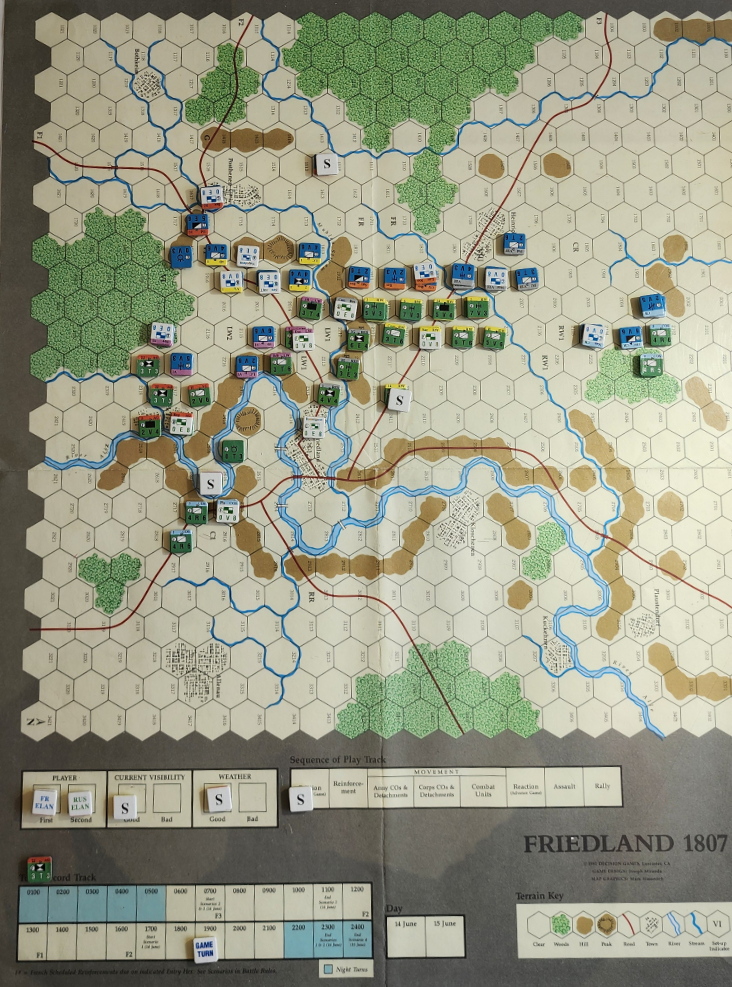
On my game table now is Friedland 1807, a division level game about Napoleon’s defeat of the Russians on 14 June 1807. No ground scale is given, but it appears to be about 4-500 yards per hex. Turns are one hour.
Designed by Joseph Miranda, this was the first (and only) of his Napoleonic Battles System games. The natural reaction might be to assume the short-lived series was due to Friedland being a bad game, but I don’t think that’s accurate. The first strike against the game was probably that it was published in Strategy & Tactics 151 alongside Vittoria resulting in the rules and charts for both games being intertwined. That made each game less accessible. The second strike against the game was that it uses some novel techniques, many of which reduce player control. In other words, the soldiers of your army don’t always do what you want them to do. The challenge of new systems and disobedient soldiers is a hard one for gamers to overcome! To add insult to injury, the rules were presented in a basic and advanced version. It would have been better to combine them into one standard system.
Let’s step back a moment and look afresh at the game. My thoughts are based on using the advanced rules apart from Fog of War. (More on that later.)
Each side’s game turn consists of:
Friction
Reinforcements
Command Control and Movement
Reaction
Assault
Rally
Before looking at the game turn sequence, some preliminary points:
Each army has a disintegration limit which, if matched or exceeded, causes bad things to happen. The disintegration level goes up with casualties and can be reduced by staying out of action for a complete turn.
Units have Engagement Zones (EZ) which seem to be Zones of Control, renamed. EZ are sticky, meaning that once in an EZ, getting out of it requires undergoing an attack from the enemy projecting the EZ.
A common result of combat is disorder, causing a unit to flip to its reverse side. This makes it slower and less effective in combat.
Now, let’s look at each part of the game turn sequence.
Friction
You roll 1d10 and refer to the appropriate table to find out if any random event has occured. This may be a temporary ammunition shortage (which magically affects the whole army) a change to army morale, bad weather, and so on.
Reinforcements
Self-explanatory. Note that certain Friction results can bring on reinforcements one turn earlier.
Command Control and Movement
This is one of the core parts of the system. Each leader, from the army commander down, is rated as to his leadership: (A) Genius, (B) Good, (C) Standard, (D) Aggressive, and (F) Lethargic. To get a leadership result, starting with the army commander, you roll 1d10 on the Leadership Table and determine if the commanded leaders and soldiers do what you want (a Command result) or not (an Out of Command or Impetuous result).
For example, the French player starts with Napoleon. Being a Genius, he is going to give you a Command result 80% of the time. On that basis, he and all the French leaders within his command control range are good to go. Then, the French player rolls for any leaders outside Napoleon’s range and then any individual combat units out of any leader’s range.
This system highlights the difference in the quality of the leaders on each side. It also shows how dangerous Aggressive leaders can be as an Impetuous result forces the involved combat units to move adjacent to the enemy. Once adjacent, it’s not so easy to get free.
Reaction
This is where the opposing side gets to go. There’s lots of neat stuff here. First, reaction is subject to a roll on the Leadership Table. Second, there’s a neat optional rule that make Reaction checks mandatory. Why? It allows those Aggressive leaders and Impetuous results to throw a spanner in the works of both players.
Assault
There’s more innovation here. There are six combat results tables: one for artillery, two for cavalry (probe and charge) and three for infantry (skirmish, linear, and column). Combat is, generally, driven by the strength of the attacking force and the terrain, with many of the results requiring a morale check. Combat units are rated, in decreasing order of quality, as one of elite, veteran, trained, or rabble with a matching decrease in the chance to pass a morale check. The results are not your typical DR, DE, and EX. Instead, you get an alphabet soup of results including C (counterattack), P (pursuit – when cavalry can be deadly), and H (heavy cavalry charge). After a few combats, they are easily assimilated.
Note:
Out of command units can assault. I assume that’s to avoid even more die rolls, but if you think it’s more realistic to require them, it’s an easy fix.
Only light infantry may use the skirmish combat results table (CRT). However, there’s no restriction on the use of linear or column CRT. So, every gamer is going to pick the CRT which gives him the best chance of success. In reality, much would be dictated by doctrine. As a generalization, that means the French attacking using the column CRT. But the game gives them complete freedom which may be unrealistic.
The system includes Elan counters which each side can spend to speed a unit’s movement or enhance a combat. The French do better when using Elan for the column CRT, so maybe that goes part of the way to counter my criticisms about doctrine.
Artillery can blow away entire divisions, even at long range – up to three hexes. This may happen too often for comfort. I implemented a house rule which restricted such results to point-blank combat only.
Rally
In this part, you get to try and rally your disordered or shattered units.
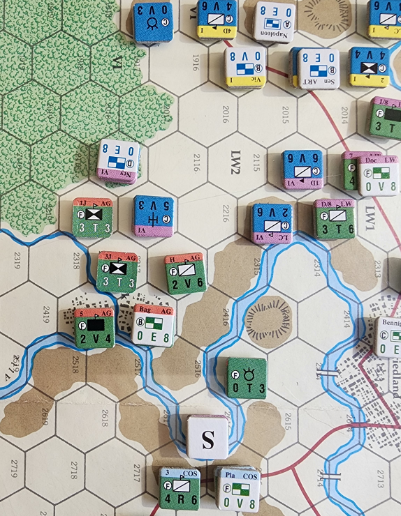
It’s 14:00 on 14 June 1807 and the French VI Corps are driving a wedge between the Russian Left Wing and Advanced Guard forces, pinned against the Alle River. Will the Russian engineers get a pontoon in place quickly enough to allow a retreat?
So, how does it play?
My overall conclusion is that this game is a wee cracker – something of an overlooked gem. Like all games, it has its faults, and the packaging alongside Vittoria surely doesn’t help, but perseverance brings good rewards.
I should also say that the rules are in better condition than I initially thought. There are some rough edges, but nothing critical. For example, it appears each side is supposed to have the possibility of gaining more Elan markers from the Friction Table, but the results are silent on this. As another example, engineers can put up pontoon bridges, but the rules are silent as to whether the engineer can move in the turn of creation. I don’t like how artillery all on its own imperiously defends against waves of cavalry charge. Also, the ability to (apparently) rally while still in an EZ doesn’t ring true. Even at this scale, I would expect some units to need to withdraw to recover. A house rule could fix that.
The command and control system, albeit there’s a lot of die rolling going on, does a pretty impressive job of replicating many of the issues the real combatants faced. The French are swift and decisive, but every so often, things go awry. In reverse, the Russians are unreliable, but can often spring a surprise. The lack of player control is good.
The combat system is unlike anything I have ever seen before. The absence of any combat ratios sure takes some getting used to. My hesitation in accepting the whole shebang is because my play generated one or two unusual results. Overall, the design for effect approach works reasonably. But I cannot help feeling that a 2d6 version of the combat results table would be an improvement. Also, while there is a rule about artillery fire being more effective against infantry if the artillery is stacked with cavalry, I’m not convinced the full scissors-rock-paper interaction of the three combat arms of Napoleonic times is shown here. Quite how that could be done at this scale is not obvious to me. At least you get some of the flavor.
So far as I can tell, the Friedland map scale is about 4-500 yards per hex. The closest development of the system seems to have been to treble the scale and go forward into the later part of the 19th century. The games Empires at War (here) and Chancellorsville (here) use much of the core command ideas. That makes them appeal to me. (I only have Chancellorsville & Plevna.) However, the combat system in these games is very old school and that is a big turnoff. One detail: the Empires at War command rules introduced an ‘F’ result meaning that the affected units had to fall back. That, I very much like. However, fitting it into the current 1d10 structure would be a struggle because it would probably happen too often to be realistic.
Summary: I have enjoyed my time with Friedland.
Fog of War
I am playing solo, so I didn’t attempt the fog of war rules. However, they look like they could be fun. Units are stored on a display off-map. Each counter on the map may represent a major force or a detachment. Depending on the visibility, you may try and see what is out there. When seen, the combat units are deployed on the map.
Dreams
If I ever get to meet Joseph Miranda, I would want to ask him why this series wasn’t continued. And, I’d love to understand the logic behind the different combat results tables. It will never happen, but I would love to create a new game using a 2d6 version of the tables – both CRT and command. I wonder if this would work for the American Civil War…
Why Now?
Why am I playing and writing about a game that is over 30 years old? Having retired, I now have a bit of time to scratch my gaming itch by playing some of the games in my collection that I have either never or barely played. (I won’t be able to play them all. Too many games. Not enough time!) I am also giving particular emphasis to looking back at my Strategy & Tactics magazines, but in no particular order) knowing that many of the games there got short thrift for one reason or another. SPI games should get some coverage to as befitting the S&T publishers. If I can keep going, there will be more of this type of blog post in the future.
Tip of the Hat
My thanks to fellow gamer John Forgy. John supplied me with a scan of the rules that allowed me to put together a set without any Vittoria material. That made assimilating thge rules easier. And our email exchanges helped me to focus my thinking about the game, play it extensively, and write about it.
Some context. In that month: a Provisional Irish Republican Army bomb in Omagh, County Tyrone killed five British Army soldiers. U.S. President Nixon confessed his role in the Watergate cover-up. Ajax won the European Cup in 1973, defeating Juventus 1-0 in the final held in Belgrade, Yugoslavia. Chicago Cubs managerr Whitey Lockman was ejected during the game and replaced by Ernie Banks who, by doing so, technically became baseball’s 1st African American manager.
Game included
CA by James F. Dunnignan. CA is a game about naval combat in the Pacific from 1941-43. For more information about the game, see here.
This was the first issue of my S&T subscription. CA was my first ever proper wargame. It was my first exposure to the concept that history and games could be fused together, and it was a combination I found exhilarating and addictive.
I’ve always had a particular interest in the battle of Gettysburg and I suspect that Al Nofi’s article in S&T 38 was at least partly responsible for this.
Some context. In that month: Oakland outfielder Ricky Henderson stole his 1,000th MLB career base in the A’s 7-6 win at Detroit. The Yugoslav Army captured Bosnian President Alija Izetbegovic. The US Army and Marine Corps were deployed in Los Angeles to end rioting following the acquittal of four police officers over the Rodney King beating. Linda Martin from Ireland won the Eurovision Song Contest in Malmo with “Why Me?”.
Games included:
The Battle of Vittoria by Vance von Borries. Vittoria is a simple, brigade-level game about Wellington’s victory against the French in Spain on 21 June 1813. For more information about the game, see here.
The Battle of Friedland 1807 by Joseph Miranda. Friedland is a division level game about Napoleon’s defeat of the Russians on 14 June 1807. Touted as the first of Miranda’s Napoleonic Battles System games, it was the only one produced. The system was novel and it suffered from having its rules and charts mixed in with those of Vittoria. For my look at the game, see here. For more information about the game, see here.
Articles:
The Napoleonic Revolution in Battle – Joseph Miranda
Raphia and the Militray System of Alexander’s Successors – Anthony Shaun Howarth
When asked, I tell people that Advanced Squad Leader (ASL) is my favorite game of all time. In brief, it’s a highly-detailed game about tactical level combat in World War 2 and Korea. The counters represent squads of soldiers plus leaders, heroes, heavy weapons, guns, and individual tanks and vehicles. Each game turn represents about two minutes of combat.
To give you some context, the rules come in a three-ring binder and the core content you need to master to play the game runs to about 160 pages.
Variety of theaters. You can fight actions from every WW2 theater.
Variety of encounters. You can fight with just infantry or have guns, tanks, artillery, attack aircraft, gliders, and landing boats. (Not in the same scenario…I think.)
Variety of conditions. You can fight in day, night, summer, winter, good weather, or bad weather.
Variety of scenarios. I will never run out of scenarios to play. There must be over a thousand, and the majority have high replayability.
Each scenario is a challenge. You cannot just push around the pieces and see what happens. Or rather, you can, but you’ll lose. You have to have a plan, it has to be a good one, and you have to know how to tweak it in the face of enemy action.
Swings and roundabouts. Fate plays a part and you have to be able to take the highs and the lows. For example, in one turn, your sniper might eliminate the top enemy leader. In the next, your tank’s main gun may malfunction just as an enemy tank appears in its sights.
It’s tactical level combat. I love games at this level. I’m addicted to them.
What I dislike about ASL:
I’m not very good at it.
It doesn’t represent command and control very well.
There are too many gamey tactics that have no relation to real-life combat.
Despite these dislikes, ASL is still my favorite.
For many ASL gamers, it’s the only game they play. Given the commitment to be any good at ASL, this is understandable. I could probably improve my gameplay if I restricted my gaming time to only ASL, but I’m not prepared to give up the other games that I enjoy playing.
Finally, the rulebook. It’s a monster. It’s hard to read. It’s so tough to learn the game via the rulebook, the publishers put out Starter Kit versions with cut-down rules. That having been said, the rulebook is an amazing piece of technical writing. It operates very well as a reference meaning that, generally, you can find the answer to your query quickly.
At the beginning of September 2025, Susan and I had the opportunity for a first-time visit to Berlin. I’ve been to Germany several times before, so there was none of the hesitation that some Jews have about going to the birthplace of the Holocaust. It was Susan’s first trip there, and she felt differently.
Before the journey, my thoughts were focused on how to get the most out of the time we were there, without overdoing it. Looking back, I think we did pretty well.
After the world’s worst passport control experience – 90 minutes to complete it! – we dumped our luggage at the hotel, and headed out.
Day 1
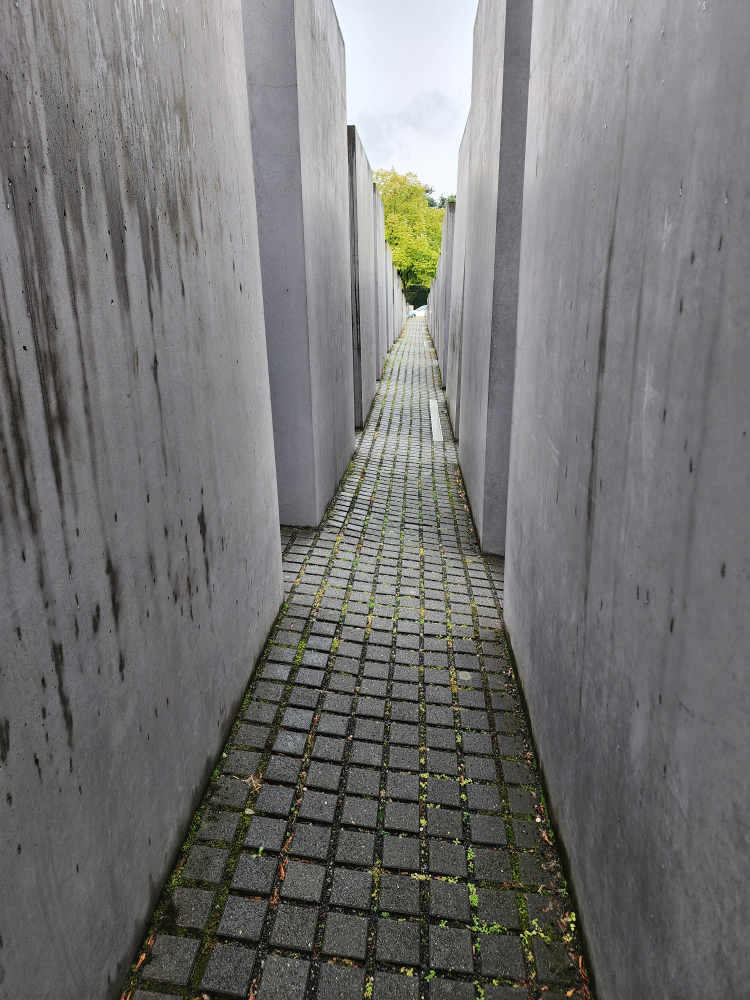
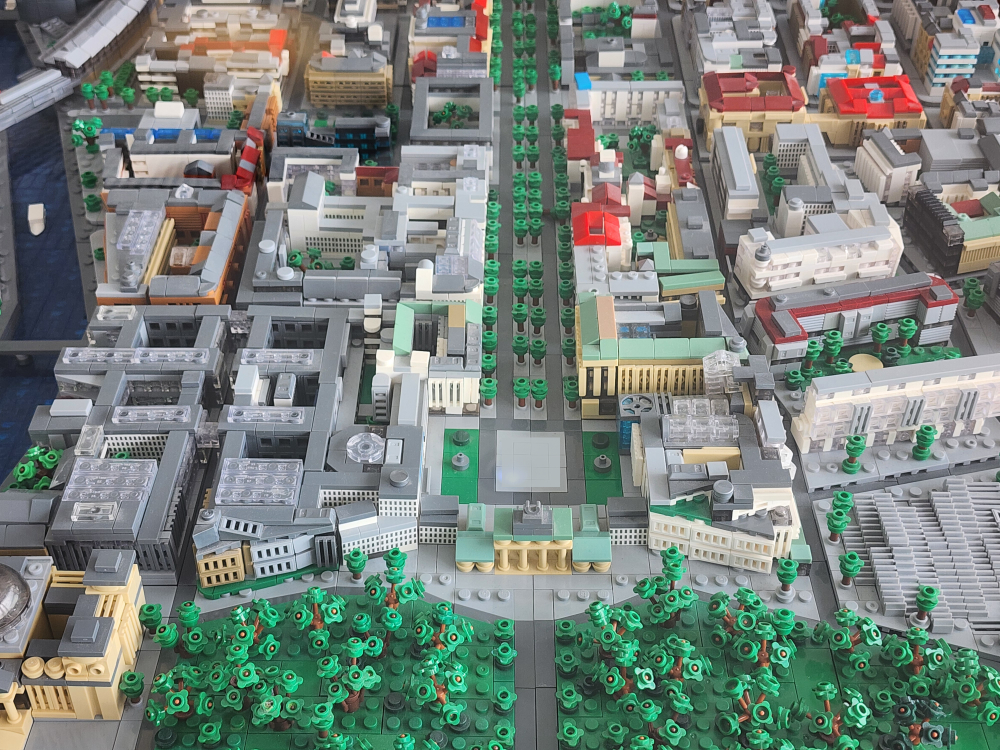
First off, we did a wee scout around the Brandenburg Gate. Then, to get it over and done with, we visited the Memorial to the Murdered Jews of Europe, what is colloquially called the Holocaust Memorial. The upper part is an array of 2,711 blocks (one for each page in the Talmud) in a grid formation. Each block is unique in size. The arrangement encourages you to walk through. It’s unsettling. There are no hints as to what you are supposed to think, so everyone has their own experience to relay.
There’s an excellent information center underneath the stones. It does a magnificent job of describing the horrors in a steady, neutral language, but makes it personal and shocking by telling the stories of several families from throughout Europe and how the Holocaust tore through their world.
There’s one thread that runs through all the WW2 stuff in Berlin and it started here: the Germans are not hiding their dark past. It’s there, bare and exposed for all to see. No excuses. No equivocation.
After that, we felt pretty drained. A light supper and early to bed.
Day 2
The next day started with a veritable highlight: a multi-hour bike tour of Berlin. This gave us a quick introduction to some of the key sites: Rotes Rathaus, St. Mary’s Church, Humboldt University, Cathedral of St. Hedwig, Unter den Linden, the book-burning memorial at Bebelplatz, Altes Museum, the French Embassy, the Reichstag, the TV tower, and the Fuhrerbunker. Whew! I’m sure I missed stuff.
In the afternoon we visited some of the museums on Museum Island. (A theme that runs through German name places is that they are straightforward.) If you like ancient history, you will have a great time here. The bust of Nefertiti – in the New Museum – is a must. Go see it. You will not be disappointed. To add some detail to the bit about German naming protocols, the New Museum is beside the Old Museum. Ahem.
In the evening, we went to an icebar to enjoy – I’m sure that’s what the blurb said – a few shots consumed at sub zero temperatures drinking out of glasses made of ice. Cool!
Day 3
This time we started the day with a multi-hour walking tour of Berlin. We covered some of the same sites as the bike tour, inevitably, but there was also time spent at new locations such as Checkpoint Charlie with more emphasis on the Cold War.
After a short break, we went off to Kurfürstendamm to do some browsing and shopping. Sold as Oxford Street done right, or the German version of the Champs-Élysées, this was underwhelming compared to my expectations. We did spend a long time there, mostly browsing. There’s plenty fine shopping and prices to match, but it’s not quite the top site it’s made out to be.
After our efforts so far, we were tired enough to be happy to head for the hotel and a few drinks in the bar before bed.
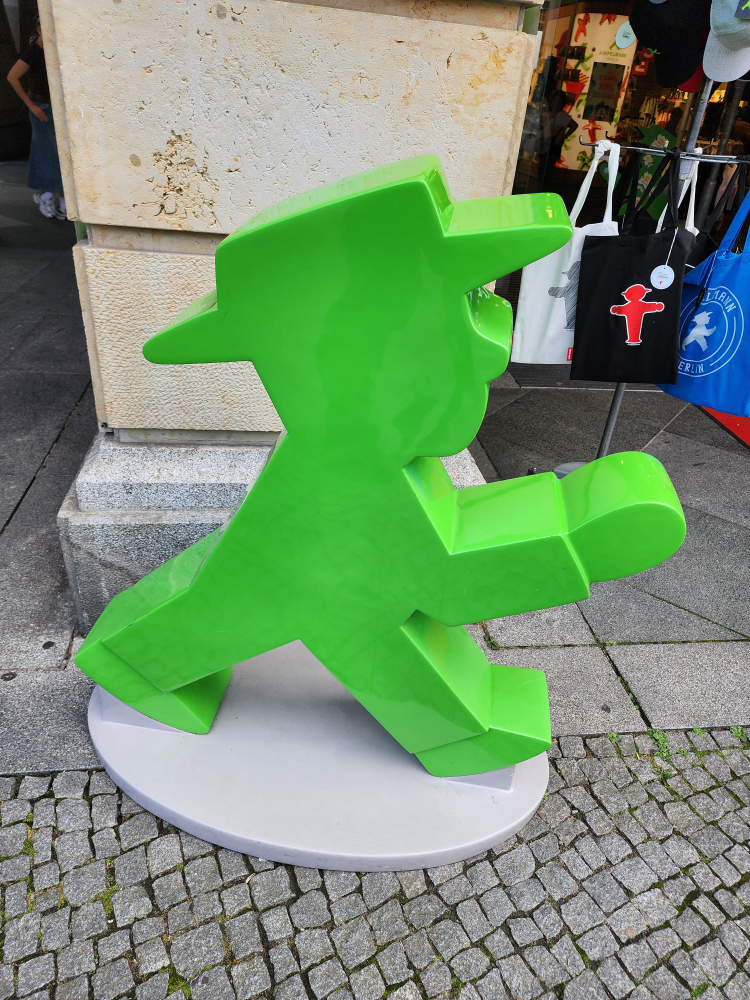
Interlude – Ampelmann
The following image is one of the historical curiosities of Berlin. How did the city end up with different types of ‘little green men’ on their traffic lights. Check out the story here.
Day 4
By now, we were slowing down. The day’s main activity was a lengthy stop at the Topography of Terror Museum, This soberly tells about the SS and police in the Third Reich and the crimes they committed across Europe. It starts with showing how the Nazis took power and then describes what these evil institutions did with the power they had seized.
In addition to this, there was an external exhibition about Berlin from 1933-1945.
To repeat what I said upstream: the Germans are not hiding their dark past.
We finished our footslogging with a visit to the Berlin TV tower, riding up the lift to the viewing gallery on what we were told is Europe’s highest building. The view is superb.
Time to head back to the hotel bar…
Day 5
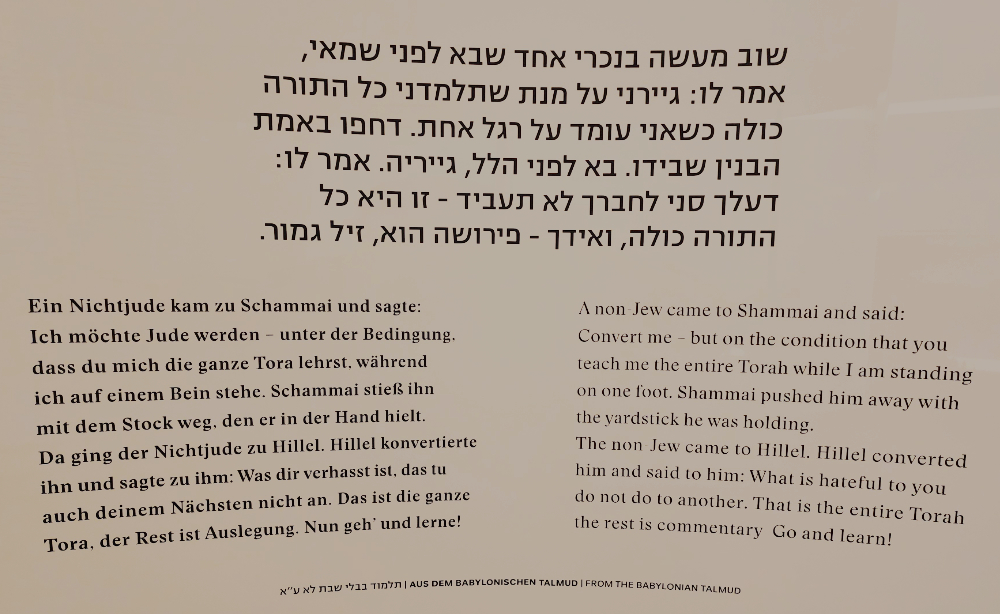
Before our flight home, we were able to squeeze in a visit to the Jewish Museum. It was an interesting experience to see how somebody – or a group of somebodies – is trying to explain to non-Jews what Judaism means, what being Jewish means. There’s a lot of stuff here that isn’t what I would put in a Jewish museum, but that just goes to show how little I know, because the material does work. It tells a story, or rather several stories. The views of German Jews and the Jews who went to Berlin after the fall of the USSR I found particularly poignant. I was impressed by the museum, but I’m curious as to who the intentional audience is. There seemed to be a few youth (school?) groups doing the rounds of Berlin and there were a couple in this museum. Do they need to go to a museum in Berlin to find out about Jews? I’m not criticizing; I’m curious.
Back Home
I’m ready to go back tomorrow. The place oozes history, the architecture is stunning, and the public transport is first class. It’s also a good city to walk (or ride) about and you can easily get your daily 10,000 steps in. Highly recommended.
Over Rosh Hashanah, I used the Koren machzor. Of the many outstanding commentaries by the late Rabbi Jonathan Sacks, this stood out:
The Rabbi of Klausenberg, Rabbi Yekutiel Yehuda Halberstam, who survived Auschwitz and lost his wife and eleven children in the Holocaust, once said: “The biggest miracle is that we, the survivors of the Holocaust, after all that we witnessed and lived through, still believe and have faith in the Almighty G-d, may His name be blessed. This, my friends, is the miracle of miracles, the greatest miracle ever to have taken place.” As he said these words, he wept. But still he believed.
Set in a fantasy world where, in the 19th century, magical artifacts are behind the projection of (especially) Britain’s colonial power, this thinly disguised polemic is also an entertaining and sometimes thoughtful novel.
It starts with the adoption of a Chinese orphan by one of the professors at Babel (the nickname of Oxford University’s Royal Institute of Translation). That orphan, renamed Robin Swift, is forced by his adopted father to devotedly study languages with a view to him gaining entry to Babel as a student. At Babel, they research and produce the special pairs of words from different languages that, when engraved on silver bars, produce magical effects. The magical process behind these matching pairs of words is explained in the book and whether you accept it so as to enjoy the rest of the novel will depend on your ability to suspend disbelief. (It was a tough ask for me.)
Swift gets into Babel and meets up with three other students – Ramy, Letty, and Victoire – who will accompany him on his scholastic journey.
To avoid giving any spoilers, let’s just say that Robin has a challenging relationship with the professor who adopted him and, apart from that, the bulk of the plot focuses on these students gradually learning and understanding the real-world effects of the work they do and its importance to the British Empire. In their lives, they encounter at first hand, racism, naked imperialism, and see how far those in power will go to hold onto and even extend their dominion. Violence is never far away.
The author’s message is delivered in a slightly heavy-handed manner. Occasionally, the narrative is over-the-top and the image it inspired in me was a lecturer shouting at an audience ‘You must believe this!’ I am not attempting to excuse colonialism and imperialism, but the world is rarely black and white, and there is little nuance to be found here.
Despite this, on the whole I enjoyed the book. There are several well-drawn, well-rounded and believable characters. Away from the politics, the writing is generally a pleasure to read with only rare times when there’s a feeling that some parts are overwritten. The Oxford backdrop is wonderfully portrayed with nugget after nugget of tempting detail – whether real or not, I have no idea. The plot is solid. The build up to the final, terrible scene is pitched at just the right tempo and contains some of the sharpest writing. Finally, the lingusitic elements – as the matching pairs are explained – are an impressive labor of love. The magic rationale may not survive vigorous examination, but there’s clearly a ton of knowledge and hard work that has been crammed into this book to give it – with a pinch of suspended disbelief – a well deserved aura of mystical wonder.
One of the best fantasy books I’ve read in a while.
This book recounts the experiences of Tuvia Tenenbom in a trip across the USA (sometime around 2015) as he tried to find out more about his adopted homeplace and its people. The man, who was born to be a rabbi and, instead, became a journalist and dramatist, displays all three career traits with a narrative full of morality, insight, humor, and theater.
Be warned. Some of the people he meets are not people you would want as your friends, or anywhere near you. But our intrepid interviewer somehow navigates peacefully (in the main) and largely succeeds in getting them to open up to him and display their inner character. There are a couple of occasions where individuals spout forth some racist poison directed at him and when Tuvia asks them to repeat it so he can record them, they refuse, turning into innocent bystanders. Sometimes, the people he talks to are just plain racists who don’t know who or what Tuvia is.
Indeed, much of his encounters have an unpleasant element – at least to this reader – as many of the interviewees display shocking ignorance, hypocrisy, and hate. It will not be a surprise that many who fall into these categories are pro-Palestinian. Don’t worry, though. For balance, there are a couple of Jewish shmucks.
Here’s one snippet for example.
While visiting Aspen, he goes to a Yom Kippur service, held by the largest Jewish congregation there. In his words, the service sucks.
All in all, this is a perfect funeral service for America’s Judaism. I watch this service, which contains very few Jewish motifs, and wonder why these old people bothered to come here. There’s very little of anything “Jewish” to this service. Like the Indians, very few here know their ancestors’ language, in this case Hebrew, and the whole thing is so melted down that there is nothing to see and very little to hear. It’s all empty of meaning.
Also while in Aspen, he notes that the magazine Salon that day published an article accusing the Israeli army of “cowardly brutality” claiming that “an Israeli sodier squashed a Palestinian kid, and then it [Salon] goes on to compare Israel to Nazi Germany in all but name.”
He continues:
At this particular date in history, when every day thousands of Arabs are murdered, violated, lose their homes and are abused by other Arabs in the ever-turbulent Middle East, it is interesting to read this story of one Arab kid supposedly suffering at the hands of one Jew. Ten, twenty years ago an article like this would have been published in a KKK magazine.
Remember, this is from 2015.
Though it’s not all a procession of bad people, the few examples of good humanity he reports on are not enough to completely remove the overwhelming stench of stupidity on display. However, lest you think things cannot get worse, they can and they do. For Tuvia’s travels take him into the dreadful duo that are the USA’s core social battlefields. No, not Republicans and Democrats. No, not pro or anti-gun control. He exposes instead, the sickening poverty and racism. Tuvia’s brief peaks at the real world of the poor Blacks and Indians (Native Indians) are shocking and an indictment of the USA that cannot and should not be excused. The political hypocrisy is sickening.
The latter horrors almost make the ever-present antisemitism he meets seem like a minor irritant. Of course, it’s not and Tuvia often royally skewers the bigots using just the words out of their mouths.
The even sadder discovery, though, is how much of so-called American Jewry dedicates its time to help other communities who fail, in any meaningful shape or form, to reciprocate.
For example, of his visit to Montgomery, he says this:
Who knows everything about black history? …The locals who know everything about voting rights, King, Parks, and the rest of this country’s black-white history, the locals who tell me all about it, are the local Jews and their leaders. These Jews support the blacks and have dedicated their time to helping them. How many blacks are on the side of Jews in their struggles against anti-Semitism? I ask them.They can’t name one.
“He also meets Jews intent on criticizing (actually defaming and libelling) Jews and Israel. It’s a form of supercharged suicidial wokeism, and it’s repugnant. Ten years on, it’s even worse.
This is a depressing book to read. Nevertheless, it’s an important to book read if you want to better understand the state of the USA and the crumbling of many – not all – Jewish communities there.