Games Played — July 2026

The games I played included the following:

A Victory Awaits

This is an MMP publication of what was originally three separate Japanese designed and published games about Operation Barbarossa (the 1941 invasion of Russia by the Germans).

Roy and I played the shorter (6-turn) scenario on the Smolensk map. (Even though I knew we wouldn’t get to finish it, it was the best way to get us both up-to-speed on the rules, the situation, and some of the strategic and tactical options.)

Roy’s German forces inevitably wiped out the frontline Russians, most of whom died in a pocket. The German panzer forces pushed on like the proverbial hot knife through butter. However, the task for the Germans is demanding, requiring a lot of terrain to be captured in the face of an ever increasing supply of defending Russians.

At the end, the Germans were threatening in the center but well out of reach of the key victory point cities. It was fun, though playing the Russians you have to recognize you cannot go toe-to-toe with the Germans; it’s a waiting game.

We need to work out how to do a complete game. Perhaps we’ll use Vassal next time around.

Sniper!

This is an old (1986) update of an even older SPI game about man-to-man combat in WW2. Each hex is 2 yards and each turn a few seconds.

Roy and I played a 1943 encounter between a German squad (with 3 machine guns!) and a USA squad, in the Naples countryside. It was a meeting of patrols.

When I was preparing the game, I realized why I hadn’t played it more before: the rules are not that long, but there are lots of exceptions and a few loose ends. I applied some house rules to make sure we could get through the session without any major problems.

The two squads bumped into one another and there was an exchange of fire. Down went one of the Americans, wounded.

The Americans took cover in the heavy terrain, seeking to advance slowly into firing positions. The Germans threw a couple of grenades and kept up their defensive fire, wounding another American. The Americans moved deeper into better cover.

The game ended in a sort of stalemate. Although the Germans were well ahead in victory points, neither side was budging from its positions, so we called the game.

While this was fun, the game’s poor ergonomics made play a bit of a drag. Each soldier has several ratings — initiative, panic, and combat skills and deficiencies — which you track on a roster, so there’s a constant switch between map and roster. In this way, as Roy pointed out, it’s like a miniatures game. It would be much easier with all the ratings on the counters.

The activation system is interesting. Each soldier has an initiative rating and activates if his side draws a chit that’s equal to or greater than the initiative. Also, each side may get multiple rounds of activation per game turn, depending on the activation chits drawn. In this way, you might get an advantage of seeing your opponent running out of activations. That having been said, if you keep your soldiers within sight of the squad leader, and that soldier has an initiative rating of 1, you’re going to be less restricted. That part needs work.

I doubt we’ll play this again, though if I could ever summon up the perseverance to create my own counters with all the information on them, and redo the activation, leadership, and panic rules, there could be a good game here. On the other hand, there are all these other games…

Barbarossa: Army Group North, 1941

This is one of a series (East Front series) of monster games at the operational level scale (5 miles per hex, each turn is 2 days, and units are divisions, brigades, and regiments) about the WW2 campaign in Russia.

The first scenario — neatly presented in a standalone card with combined map and setup details — is a solitaire training exercise to get you up to speed on the game’s basics: movement and combat. It does a good job. Also, the Playbook includes a detailed play through of that first scenario so you can see exactly how the game is played and check your rules understanding.

The second scenario, which I played twice covers the opening ten days of the campaign from the border to the capture of Daugavpils.
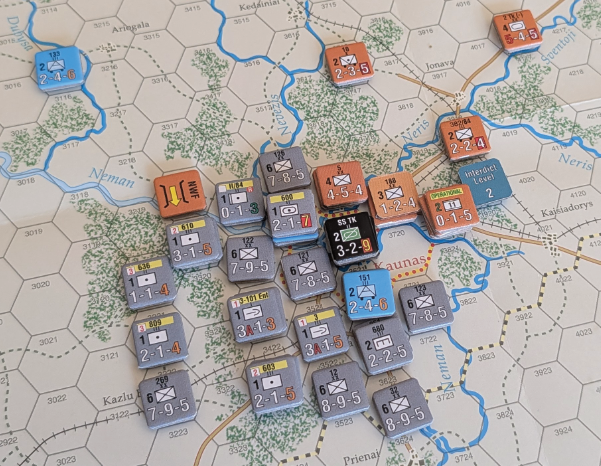
The game map around Kaunas showing many German units opposed by fewer Soviet units.
The Axis have taken Kaunas

I would summarize the experience as follows:

  • The rules are well written and comprehensive but they are long and detailed. There are many exceptions. You need to have the time to invest in learning the system.
  • The example play through is a big help.
  • The maps are gorgeous.
  • The counters are clean, crisp, and easy to read.
  • The player aids are excellent. However, I would have preferred the terrain effects chart to be on two pages with a larger font.
  • There are lots of tricks and tips that experienced players will have picked up. So, my play will not have been optimal.
  • The many scenarios are a blessing. You don’t need to play the campaign!
  • The supply rules are so much easier than OCS. The airpower stuff doesn’t convince me it’s at the right level of complexity or decision making. The play, once you get the rules into your brain, is engrossing. The sequence of play is not symmetrical so you have to play differently according to which side you have.
  • If you have the time and like the topic, this is highly recommended. This (or one of the other games in the series) will be on my table again.

Advanced Squad Leader

I played The Vital Hours (WO37), a September 1944 encounter near Arnhem in the Netherlands between British parachute forces aiming to force their way to their destination through a motley crew of second-rate SS soldiers.

The British inevitably ground their way forward but took casualties and couldn’t get to the exit point in time, giving me and my defending Germans a rare victory.

I also played Burnt, Blue and Gray (WP15), a July 1944 scenario set in France. I led a force of German Fallschirmjagers, backed by three StuG IIG vehicles, in a counterattack on bocage territory held by Ran’s forces (infantry, machine guns, and a couple of bazookas) from the USA 1st Battalion, 116th Infantry Regiment.
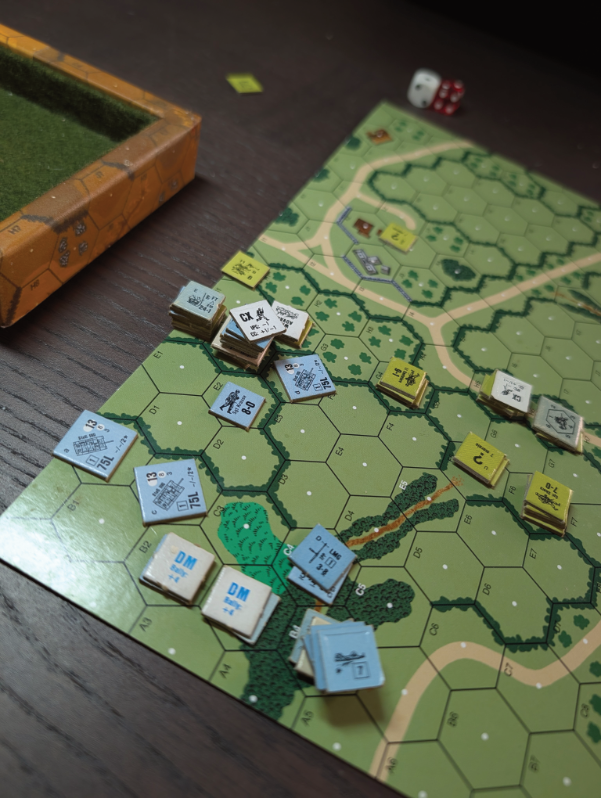
German and American forces coming to blows among the hedgerows.
Action from WP 15 with the German attack about to be ground to a halt.

The short version of the story is that I focused my attack on one wing and didn’t make enough ground. This allowed Ran to bring all his previously strung out defenders into play and bottle up my spearhead. We called it ahead of time as it was plain the defenders would easily hold the line.

Next time around I am hoping Ran will agree to play this again and switch sides so he can show me how I should have played it.

As I have said before, all part of my continuing (and losing) ASL education.

Games Played — June 2026

The games I played included the following:

Old School Tactical: Battle for France 1940

I’m a sucker for WW2 tactical level games. This is the latest series I have started playing, though I am still committed to ASL.

I played the first scenario in the French 1940 expansion, primarily to familiarize myself with the rules again. Although the system is quite solitaire friendly, I dislike playing tactical games solitaire unless they are specifically designed to be played that way.

Overall, I like the system, but there are a number of house rules that I am trying out as sometimes the design doesn’t deliver as well as I think it can, even if the emphasis is on game ahead of simulation.

Commands and Colors: Ancients

I played the Piraeus — 403 BC scenario from Expansion Pack #6 which has an Athenian force (whose forward line is atop hills) facing a slightly bigger Spartan force (14 units to 13).

The Spartan advantage is that their hoplite units are 5 blocks (as opposed to 4) so are more durable. The Athenian advantages include the terrain and a superiority in missile units.

This was one of the classic battles as it went down to the wire, victory being attained (by a one point margin) on the last combat. A thoroughly enjoyable experience.

Advanced Squad Leader

I played Curries Favor (AP141), an August 1944 encounter in France between Commonwealth (Canadian) tanks and infantry tasked with seizing strategic points from a small German infantry force stiffened by an 88 gun and an 81mm mortar and set up in good defensive terrain.

I was the Canadians. I probably chose the wrong entry point but I got through the first turn without casualties and my forces in semi-decent threatening positions. At the start of turn 2, my key tank (with an armor leader) was perfectly positioned to place smoke to cover my advance. Unfortunately, I rolled a 12 which meant no smoke, no main gun, and no cover for the advancing forces.

Things went downhill from there and I conceded the game half way through. Although I could blame my luck, not choosing the best entry point didn’t help. All part of the continuing (and losing) ASL education.

Combat!

After playing the introductory scenarios a few times, to get the rules clear in my mind, I moved onto the regular scenarios. The first involves attacking a farmhouse. I played it twice as the first time I made a mess of too many rules. The second scenario is about defending the farmhouse. This one I managed to complete without screwing up the rules. I won both scenarios.

The rules, as mentioned before, are lacking. I secured a copy of the newest rules which helped a fair bit, though there are still gaps. I have yet to make time to gather all the queries and submit them to one of the online forums for clarifications.

Seapower and the State

This WW3 naval game has been on my radar for a long time. It’s a strategic (i.e. broad-brush) view of what might have happened had WW3 broken out in 1984, 1989, or 1994. The system seems to pack a lot into a system that isn’t complex, as you might expect, and offers plenty of opportunity for house rules to tweak the parts that may not suit you. For example, BGG has a great suggestion about alternative targeting rules.

I have only managed to set the game up and try out some combats. It’s going to be a long game and I need to be in the right state of mind to start playing it.

Memoir ’44

Breakthrough is one of the expansions for Memoir ’44, a WW2 game in the Commands and Colors family. The expansion includes a double-sided hex game board for both beach landings and countryside combat and 15 scenarios. I played the Operation Crusader scenario as the Germans and was crushed 12-4.

I started with enough cards to get my key units moving, but then went through about six or seven turns with the wrong cards and being unable to get my units into combat. That was probably the tipping point.

The dice weren’t exactly helping, though my trusty opponent also had a couple of encounters on the fringes of the probability graph.

A couple of things to stress.

  • Despite the one-sided result, it was great fun. This is a game that never forgets its mission is to entertain and it does that repeatedly.
  • Of all the Commands and Colors type games, this is probably my least favorite and yet I love playing it! See the preceding paragraph.

Games Played — May 2026

The games I played included the following:

Commands and Colors: Ancients

I played The Middle Gate (Thermopylae) scenario from Expansion Pack #6 which presents an overwhelming Persian force with about half the number of opposing Spartans, behind ramparts, featuring a vulnerable flank that can be marched around.

The Persians did the flank march and, despite suffering high casualties, secured the flags (victory points) needed for the win. The final score was 10-6 so the Spartans were well out of touch.

It’s difficult to see how the Spartans can hold out here, especially if the cards aren’t there for the required counterattacks. Both sides had turns where the available cards were useless. I’m thinking of using a house rule to overcome this, such as allowing each player to be able to use any one card as a single unit activation (anywhere on the board) instead of whatever it says on the card.

All of that having been said, it’s a long time since I’d played the system and I enjoyed it much more than I remember.

Fields of Fire

I continued playing the Naktong River Campaign from the Korean War in this top-quality solitaire game system. I completed missions 4 and 5 successfully.

Advanced Squad Leader

I played First Dance (AP228) again, an early war encounter in Belgium between French and German mixed forces of infantry and tanks. The French enter and set up a defense line. The Germans enter and try to break the line.

The Germans lost two key carriers and troops in the first turn and that decided the game, although we kept playing. The Germans made progress but they no longer had the troops required to capture the objectives. The French tank reinforcements are virtyually invulnerable.

A difficult scenario for the Germans, but that maybe only because it was me!

The White Castle Duel

A sophisticated, two-player, worker-placement euro game with a theme about two clans vying for supremacy in technology and trade as the Portugese bring western ideas into Japan.

You play your workers to choose actions and some actions generate more actions or resources which you can use to generate more actions or resources and so on, each player vying for the best victory point score. Of course, there are multiple ways to attain (and calculate!) victory points.

It was too complicated for my taste. (I don’t mind complicated games but in an abstract game the complication has to bring something to my enjoyment. If not, as is the case here, it feels like complication just for the sake of it.)

The game uses a lot of icons to avoid language and eventually I became familiar enough with them, so it gets a pass there.

However, there’s one nuclear option that allows the opponent to screw with the available actions. I seriously doubt the play-balance of the game because of this.

I also didn’t like the use of color: there were 1,001 colors in use, or so it seemed, creating an obstacle to understanding the game.

In short, although I played it twice and tried hard, I didn’t like it. YMMV.

Combat!

Part of a series of solitaire games, this one features US (player) versus German (system) soldiers battling it out in WW2 over a range of scenarios. The rules were lacking, but eventually I cracked the code.

The graphics put walls and hedges in the middle of hexes and that doesn’t work for me. It’s like a perversion of Schrödinger’s cat where the soldier in a wall hex gets the benefit of the wall no matter from which side he is attacked! I applied my own house rule to put the soldier on one side of the wall or hedge.

I don’t think it compares favorably with Ambush because of the design decisions, but it’s a brave try and I’m probably going to invest some serious time in exploring the system and scenarios.

One main criticism is that, for the most part, the system gives the German soldiers orders without any regard as to whether they can see the enemy. Orders are, instead, given based on the soldier’s morale. This can produce surprises as well as strange results. And that may be a fair reflection of the chaos of combat. Alternatively, it may be that more logical action choices should sometimes be taken.

I am still enjoying the game because it does generate a decent narrative. However, because of the stated issues, I am thinking about creating my own version of the solitaire system. There is an updated version that has allegedly made some improvements, and I’ll try and get a look at that.

Games Played — April 2026

This month, the games I played included:

  • Wurzburg — I played scenario one of this classic Modern Battles system from SPI. It went down to the last turn.
  • Advanced Squad Leader — The first scenario was Courage of Cowan (J242) set in December 1944, featuring SS infantry and tanks trying to break through American lines. The Americans held the line for four out of six turns, but the SS broke through on turn five to make the last turn a formality. The second scenario was First Dance (AP228), an early war encounter in Belgium between French and German mixed forces of infantry and tanks. The French first turn saw them enter the map and set up a strong defensive line which hammered the Germans as they tried to break through and that was that.
  • Fields of Fire — I went back to the Naktong River Campaign from the Korean War in this top-quality solitaire game system. I completed missions 1 to 3 successfully.
  • Undaunted: Normandy — A new game to me that combines card management with tactical movement of counters on a board. I had read some reviews but none had triggered a ‘must buy this’ response. After playing it, I know why. In short, it’s half a wargame and half a eurogame. So, it doesn’t fully satisfy on either account. There are a lot of cool ideas, but I won’t be rushing to play it again.

ASL

When asked, I tell people that Advanced Squad Leader (ASL) is my favorite game of all time. In brief, it’s a highly-detailed game about tactical level combat in World War 2 and Korea. The counters represent squads of soldiers plus leaders, heroes, heavy weapons, guns, and individual tanks and vehicles. Each game turn represents about two minutes of combat.

To give you some context, the rules come in a three-ring binder and the core content you need to master to play the game runs to about 160 pages.

For more information about the game, see here.

What I like about ASL:

  • Immersive game play. No other game comes close.
  • Components. The maps and counters are excellent.
  • Variety of theaters. You can fight actions from every WW2 theater.
  • Variety of encounters. You can fight with just infantry or have guns, tanks, artillery, attack aircraft, gliders, and landing boats. (Not in the same scenario…I think.)
  • Variety of conditions. You can fight in day, night, summer, winter, good weather, or bad weather.
  • Variety of scenarios. I will never run out of scenarios to play. There must be over a thousand, and the majority have high replayability.
  • Each scenario is a challenge. You cannot just push around the pieces and see what happens. Or rather, you can, but you’ll lose. You have to have a plan, it has to be a good one, and you have to know how to tweak it in the face of enemy action.
  • Swings and roundabouts. Fate plays a part and you have to be able to take the highs and the lows. For example, in one turn, your sniper might eliminate the top enemy leader. In the next, your tank’s main gun may malfunction just as an enemy tank appears in its sights.
  • It’s tactical level combat. I love games at this level. I’m addicted to them.

What I dislike about ASL:

  • I’m not very good at it.
  • It doesn’t represent command and control very well.
  • There are too many gamey tactics that have no relation to real-life combat.

Despite these dislikes, ASL is still my favorite.

For many ASL gamers, it’s the only game they play. Given the commitment to be any good at ASL, this is understandable. I could probably improve my gameplay if I restricted my gaming time to only ASL, but I’m not prepared to give up the other games that I enjoy playing.

Finally, the rulebook. It’s a monster. It’s hard to read. It’s so tough to learn the game via the rulebook, the publishers put out Starter Kit versions with cut-down rules. That having been said, the rulebook is an amazing piece of technical writing. It operates very well as a reference meaning that, generally, you can find the answer to your query quickly.