Games Played — August 2026

I was on a trip to the UK in August so gaming time was severely curtailed. (However, I did pick up fresh supplies of new games!) The games I did manage to play included the following:

Advanced Squad Leader

Ran and I played played Burnt, Blue and Gray (WP15) again. We played it last month when my Germans failed to crack the defending American line. This time I asked Ran to take the German side and show me how an expert would win as the attacker. And that’s what he promptly did. The fact that one of my key bazooka shots missed and another failed, amazingly, to penetrate — due to Schürzen — made it somewhat easier for the Germans. Anyway, I took notes after watching a master in action and we’ll see if that helps me improve my play.

Combat! Eastern Front

This is the solitaire WW2 skirmish game system whose first volume I have previously played. This is volume 4 and I primarily bought it because it looked as if the new designer was going to tackle some of the issues I had with the first volume, not least the rules. (Volumes 2-3 did not address the issues.) The new rules are much better. I still have some quibbles but this is a much more complete, enjoyable gaming experience.

I have been playing and replying the first scenario. It features a forest map. My forces are the Germans trying to eliminate and break through a line of Russian troops in the early days of the Eastern Front campaign. It’s hard to win the game — as it should be. I haven’t played it enough to be able to comment authoritatively on play balance, but so long as playing the game is fun and delivers an engrossing narrative, that’s enough for me. It delivers.

One of the nice features of the new game is that it has a rule for each side’s confidence. It’s a sort of morale tracker so that the more losses each side takes, the less keen they are to engage the enemy. Again, I have only scratched the surface here, but this addition is very welcome.

One other excellent change in this volume is now you can play either side in a scenario.

It also appears you can retrofit the rules to the earlier volumes though I have yet to try that.

In short, this is a much more mature product than the original Combat! and is likely to regularly appear on my gaming table.

Flying Colors

This is a game about fleet combat in the age of sail. Roy and I played the Cape Henry scenario, the 16 March 1781 encounter between British and French fleets near Cape Henry at the mouth of the Chesapeake.
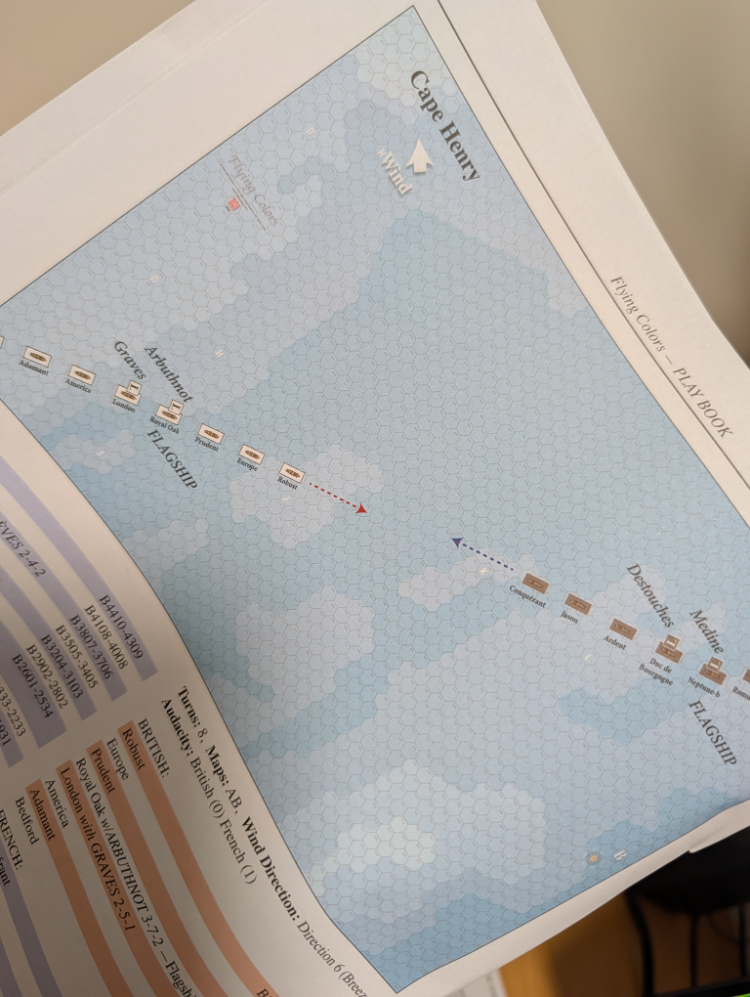
Part of the scenario for the Cape Henry battle in the Flying Colors game, featuring an illustrative setup with the two lines of ships sailing towards each other.

In our replay, the French won, primarily by doing a better job of staying downwind of the other fleet. In this scenario, ships firing with the wind are penalized to the weather conditions at the time.

The game lets a lot of criticism about, for example, its command system, the lack of simultaneous movement, the ability of ships to fire two broadsides a turn, and the very restricted defensive fire. The number of markers can be a bit of a turnoff. All these are fair points. On the other side of the balance sheet, however, the game is accessible, fast, and at the fleet level gives a decent enough representation of some of the real-life issues. And, many of the criticisms can be dealt with by using roster sheets and house rules, especially importing ideas from some of the other games on the topic.

Talking of which, I have my eye on Man of War by Stephen Newberg. Originally he published this via his Simulations Canada company, it’s due to be reprinted by Compass Games. This game has a simultaneous movement system that could easily be added to Flying Colors. Watch this space!

Finally, while this game was fun, it set me thinking that it’s a long time since I played Wooden Ships and Iron Men…

Games Played — June 2026

The games I played included the following:

Old School Tactical: Battle for France 1940

I’m a sucker for WW2 tactical level games. This is the latest series I have started playing, though I am still committed to ASL.

I played the first scenario in the French 1940 expansion, primarily to familiarize myself with the rules again. Although the system is quite solitaire friendly, I dislike playing tactical games solitaire unless they are specifically designed to be played that way.

Overall, I like the system, but there are a number of house rules that I am trying out as sometimes the design doesn’t deliver as well as I think it can, even if the emphasis is on game ahead of simulation.

Commands and Colors: Ancients

I played the Piraeus — 403 BC scenario from Expansion Pack #6 which has an Athenian force (whose forward line is atop hills) facing a slightly bigger Spartan force (14 units to 13).

The Spartan advantage is that their hoplite units are 5 blocks (as opposed to 4) so are more durable. The Athenian advantages include the terrain and a superiority in missile units.

This was one of the classic battles as it went down to the wire, victory being attained (by a one point margin) on the last combat. A thoroughly enjoyable experience.

Advanced Squad Leader

I played Curries Favor (AP141), an August 1944 encounter in France between Commonwealth (Canadian) tanks and infantry tasked with seizing strategic points from a small German infantry force stiffened by an 88 gun and an 81mm mortar and set up in good defensive terrain.

I was the Canadians. I probably chose the wrong entry point but I got through the first turn without casualties and my forces in semi-decent threatening positions. At the start of turn 2, my key tank (with an armor leader) was perfectly positioned to place smoke to cover my advance. Unfortunately, I rolled a 12 which meant no smoke, no main gun, and no cover for the advancing forces.

Things went downhill from there and I conceded the game half way through. Although I could blame my luck, not choosing the best entry point didn’t help. All part of the continuing (and losing) ASL education.

Combat!

After playing the introductory scenarios a few times, to get the rules clear in my mind, I moved onto the regular scenarios. The first involves attacking a farmhouse. I played it twice as the first time I made a mess of too many rules. The second scenario is about defending the farmhouse. This one I managed to complete without screwing up the rules. I won both scenarios.

The rules, as mentioned before, are lacking. I secured a copy of the newest rules which helped a fair bit, though there are still gaps. I have yet to make time to gather all the queries and submit them to one of the online forums for clarifications.

Seapower and the State

This WW3 naval game has been on my radar for a long time. It’s a strategic (i.e. broad-brush) view of what might have happened had WW3 broken out in 1984, 1989, or 1994. The system seems to pack a lot into a system that isn’t complex, as you might expect, and offers plenty of opportunity for house rules to tweak the parts that may not suit you. For example, BGG has a great suggestion about alternative targeting rules.

I have only managed to set the game up and try out some combats. It’s going to be a long game and I need to be in the right state of mind to start playing it.

Memoir ’44

Breakthrough is one of the expansions for Memoir ’44, a WW2 game in the Commands and Colors family. The expansion includes a double-sided hex game board for both beach landings and countryside combat and 15 scenarios. I played the Operation Crusader scenario as the Germans and was crushed 12-4.

I started with enough cards to get my key units moving, but then went through about six or seven turns with the wrong cards and being unable to get my units into combat. That was probably the tipping point.

The dice weren’t exactly helping, though my trusty opponent also had a couple of encounters on the fringes of the probability graph.

A couple of things to stress.

  • Despite the one-sided result, it was great fun. This is a game that never forgets its mission is to entertain and it does that repeatedly.
  • Of all the Commands and Colors type games, this is probably my least favorite and yet I love playing it! See the preceding paragraph.

Games Played — May 2026

The games I played included the following:

Commands and Colors: Ancients

I played The Middle Gate (Thermopylae) scenario from Expansion Pack #6 which presents an overwhelming Persian force with about half the number of opposing Spartans, behind ramparts, featuring a vulnerable flank that can be marched around.

The Persians did the flank march and, despite suffering high casualties, secured the flags (victory points) needed for the win. The final score was 10-6 so the Spartans were well out of touch.

It’s difficult to see how the Spartans can hold out here, especially if the cards aren’t there for the required counterattacks. Both sides had turns where the available cards were useless. I’m thinking of using a house rule to overcome this, such as allowing each player to be able to use any one card as a single unit activation (anywhere on the board) instead of whatever it says on the card.

All of that having been said, it’s a long time since I’d played the system and I enjoyed it much more than I remember.

Fields of Fire

I continued playing the Naktong River Campaign from the Korean War in this top-quality solitaire game system. I completed missions 4 and 5 successfully.

Advanced Squad Leader

I played First Dance (AP228) again, an early war encounter in Belgium between French and German mixed forces of infantry and tanks. The French enter and set up a defense line. The Germans enter and try to break the line.

The Germans lost two key carriers and troops in the first turn and that decided the game, although we kept playing. The Germans made progress but they no longer had the troops required to capture the objectives. The French tank reinforcements are virtyually invulnerable.

A difficult scenario for the Germans, but that maybe only because it was me!

The White Castle Duel

A sophisticated, two-player, worker-placement euro game with a theme about two clans vying for supremacy in technology and trade as the Portugese bring western ideas into Japan.

You play your workers to choose actions and some actions generate more actions or resources which you can use to generate more actions or resources and so on, each player vying for the best victory point score. Of course, there are multiple ways to attain (and calculate!) victory points.

It was too complicated for my taste. (I don’t mind complicated games but in an abstract game the complication has to bring something to my enjoyment. If not, as is the case here, it feels like complication just for the sake of it.)

The game uses a lot of icons to avoid language and eventually I became familiar enough with them, so it gets a pass there.

However, there’s one nuclear option that allows the opponent to screw with the available actions. I seriously doubt the play-balance of the game because of this.

I also didn’t like the use of color: there were 1,001 colors in use, or so it seemed, creating an obstacle to understanding the game.

In short, although I played it twice and tried hard, I didn’t like it. YMMV.

Combat!

Part of a series of solitaire games, this one features US (player) versus German (system) soldiers battling it out in WW2 over a range of scenarios. The rules were lacking, but eventually I cracked the code.

The graphics put walls and hedges in the middle of hexes and that doesn’t work for me. It’s like a perversion of Schrödinger’s cat where the soldier in a wall hex gets the benefit of the wall no matter from which side he is attacked! I applied my own house rule to put the soldier on one side of the wall or hedge.

I don’t think it compares favorably with Ambush because of the design decisions, but it’s a brave try and I’m probably going to invest some serious time in exploring the system and scenarios.

One main criticism is that, for the most part, the system gives the German soldiers orders without any regard as to whether they can see the enemy. Orders are, instead, given based on the soldier’s morale. This can produce surprises as well as strange results. And that may be a fair reflection of the chaos of combat. Alternatively, it may be that more logical action choices should sometimes be taken.

I am still enjoying the game because it does generate a decent narrative. However, because of the stated issues, I am thinking about creating my own version of the solitaire system. There is an updated version that has allegedly made some improvements, and I’ll try and get a look at that.