In Scotland, New Year’s Eve was a big deal, often the social highlight of the year. In Israel, it passes almost without comment. And while I am relaxed about the change, it’s inevitable that the advent of a new year triggers some wistful looking back and curiosity about the future.
2025 was a bit of a difficult year for me due to various health issues, and I’m hoping that 2026 will be much better. (To get me in the right mood, I might even have a wee refreshment.)
I spent some time fiddling around – and largely enjoying – Gettysburg: The First Day, designed by Steve Carey and published by Revolution Games. That game uses the Blind Swords system, meaning formations are activated by chit draws and some of these trigger random events that the players can use to interfere with each side’s plans.
There’s a lot to like: the rules are refreshingly short, the physical production is outstanding, and the game plays quickly enough. The two areas that give me cause for concern are (a) how the players are able to game the random events by sometimes deciding when and where fate strikes the enemy; and (b) how each brigade is automatically able to choose its orders every turn. I don’t know an easy way to fix these, so I need to have a think.
While pondering, I moved on to Last Chance for Victory, the massive game designed by the late Dean Essig and published by MMP about the complete battle of Gettysburg. There’s also a lot to like here: the system – called Line of Battle, now at version 2.0 – has a ton of detail, but once learned goes quite quickly. There are 20+ scenarios in the box ranging from small introductory encounters to teach you the basics of fire and movement, to multi-map campaign scenarios of the whole battle. What’s especially nice is that there are separate 1st day and 2nd/3rd day maps that mean if you are short of space you can still have a go at the bigger scenarios.
The physical production standards here are also good, albeit with one annoying defect: the maps faithfully (I assume) portray the slopes and elevation changes of the battlefield, with each height level represented by a different color. There is a color key, but it does not quite match the on-map colors. Sometimes, it’s hard to work out what level units are on, and what level intervening terrain is. The Blind Swords game by Revolution mentioned above does this much better with the simple addition of a number matching the height on parts of the slope line. It also doesn’t help that the line of sight rules are less than crystal clear. I think I am doing line of sight correctly, but I’m not sure…
Previously I have played the training scenario – Dogs of War – to start me off and then got stuck into the first day of the battle as it begins small and grows and the situation remains – despite me having gamed this situation hundreds of times in different systems – one of my favorites. I have read and reread Pfanz (Gettysburg: The First Day), Martin (Gettysburg July 1) and Gottfried (The Maps of Gettysburg) and am probably nowhere near a complete understanding of what happened all those years ago.
Fighting the first day of the battle has its advantages and disadvantages. On the plus side, you get to see the command system work because things will never go according to plan. However, to maintain a historical encounter, there are quite a few special rules to add to your load. It’s bearable, but if you prefer to avoid these, tackle the second or third day scenarios.
This time around, I redid the Dogs of War scenario to make sure I had the basics well assimilated, then decided to try the Flying Dutchmen scenario which deals with the CSA attack on 11th Corps north of Gettysburg town. The victory conditions demand that within the seven turns the CSA break through the Union defenses and exit 45 strength points of units from the brigades of Hays and Gordon. Breaking through is straightforward enough – the CSA have superior numbers and quality – but doing so fast enough and with low casualties is very challenging. It’s fun for the CSA player whose entertainment includes getting to use some cool sharpshooter units and beating up many low-morale Union units. The Union player has to skilfully defend, knowing that it’s unlikely the line will hold.
Hoke has taken Blocher’s Knoll while Hays and Gordon try to force a final breakthrough. Doles has departed, wounded.
I have played it through to a completion twice, but have yet to get a CSA win. The last occasion, I was a single strength point short of victory. Damn! I may try again.
One of the reasons I have this on the table is that there’s a version 3.0 of the Line of Battle system on the way and I wanted to remind myself of the strengths and weaknesses of the system. I am intrigued to see what will change. Meantime, if serious ACW tactical-level gaming is your thing, I recommend the system wholeheartedly.
I wanted to post something about the dreadful Chanukah attack in Bondi Beach, Australia. But as the Elder of Ziyon‘s post exactly matches my thoughts and perspective (and since reading through the reports and some of the social media responses has been so exhausting) I will take the easy option and simply direct you there.
I also want to repeat his concluding words.
The calls to “Globalize the Intifada” and “By Any Means Necessary” are exactly as offensive, exactly as disgusting and exactly as inciteful as “Gas the Jews.” There is no difference. Yet the tolerance of the “pro-Palestinian” phrases is exactly what leads to the horrific events of today in Bondi Beach.
It is long past time for the media and political class to confront reality: these protests are not about peace, human rights, or justice. They function as permission structures, inciting people to attack Jews while cloaking themselves in moral language.
The film Nuremberg is based on the book by Jack El-Hai, The Nazi and the Psychiatrist, telling the true story of American Army psychiatrist Dr. Douglas Kelley, who evaluated the mental states of Hermann Göring and other high-ranking Nazis (exploring the psychology behind their atrocities) in the run up to the post WW2 Nuremberg trials.
The film opens with the arrest of Göring, spends some time telling the story of how the Nuremberg trials came to be, and then drills down into more detail about some of the accused and their time on remand, the trial, and the executions.
The key encounters in the film are between Kelley (Rami Malek) and Göring (Russell Crowe). Both give fine performances, though Crowe’s comes out on top primarily due to the barely repressed venom that lurks beneath his verbal jousting with the doctor.
As a story – focusing on the interaction between Kelley and Göring – there’s really not much to tell and at times the script reflects this with a near absence of pace or tension. Compare and contrast with the actual concentration camp footage the film uses which delivers shock upon shock. When we get back to the cinema production, there are lots of fine pictures but nothing that endures. I can think of one or two scenes that, at the time, stood out. To avoid spoilers, I won’t mention them. However, on leaving the cinema, the scenes and the film were all quickly forgotten.
That having been said, the film covers material about which I am well read and decently educated. But for today’s youth, this stuff is ancient history and therefore rarely, if ever, encountered. Therefore, while it might well miss its target with me, it may be more effective with a younger audience. Maybe.
I cannot recommend the film as one you should go out of your way to watch. I suspect the book may be a better investment of time, but too late for me.
An Aside
The Allies put the Nazi leadership on trial. They charged them with, among other things, crimes against humanity. Significantly, they did not separate out their Holocaust against the Jews. Why? It depends who’s doing the explaining. Suffice it to say, there’s more than a whiff of antisemitism lingering behind the expressed rationale. But at least they put them on trial, right? Sort of. In one of the more extreme examples of realpolitik, those who could be put to good use by the Allies tended to escape the hangman’s noose. And, in the early decades after the war, many who were imprisoned were given early release because of all sorts of limp reasons. This mixed fate excluded, of course, those who had managed to escape (with the assistance of too many) to places like Argentina and live out their years free from any form of accountability. (Other than that dramatic kidnap, trial, and execution of Adolf Eichmann that Israel perpetrated. Naughty Israel. Imagine upsetting the apple-cart like that!)
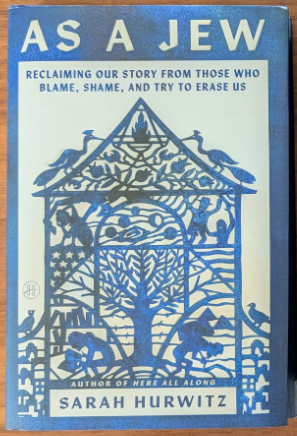
Sarah Hurwitz, Harvard Law Scool graduate and former speechwriter for the Obamas and Hillary Clinton, has written an interesting book about her personal journey from “a typical lapsed Jew” to someone who puts Judaism front and center of her life.
From my perspective, it was fascinating to read her description and tales from the heart of assimilated Jewry in the USA, a body of people I know very little about. Hurwitz paints a sad portrait – well, it was sad to me – of a people with no connection to their birthright and no serious prospect of ever reclaiming it. Given the stark background, Hurwitz’s tale is that more remarkable. Bear in mind, she was someone who felt uncomfortable when she encountered students at university who knew how to celebrate Shabbat in all its glory. (This refreshingly honest self-appraisal runs throughout the book and makes the path that more engrossing and involving.)
The author makes a point of highlighting how antisemitism has had, arguably, more of an impact on Jewish identity than any other factor, and her growing anger with that state of affairs. She takes on the onerous task of educating herself about myriad aspects of Judaism – yes, including Israel – and she finds the hard work rewarding because it brings inner strength and conviction resulting in a whole new approach and a desire to spread the message by lecturing and writing this book.
While I don’t agree with all that she says, it’s all worth reading. Instead of the social media characters who post ‘As a Jew’, here is a real, connected Jew, speaking from the heart with pride and purpose.