One of the results of retiral, is that I now have more free time. And I have used part of that time to revisit some of the many (unfinished) gaming ideas I have had. One trigger was me finally getting around to acquiring a 6′ x 4′ table for my games room that I considered was big enough to host some figure gaming if I wanted. The challenge, of course, was deciding what type of game.
I have always been a sucker for tactical level boardgames. By ‘tactical’, I mean games where the basic unit is an individual soldier, or games where the basic unit is a squad (section), a platoon, or a company. However, my most commonly played tactical games are at the squad level. So, that’s what I’m going to do: create my own tactical, squad-level, wargame. It will start as a boardgame, but hopefully will convert to a miniatures format.
Of course, it’s going to be a long project and there’s no guarantee I will finish it. But the journey is part of the pleasure.
This time, instead of going straight to one of my old design ideas, it struck me that it would be helpful to do a bit more analysis of the reason for the project.
Given that I play and enjoy games at this level, why do I want to create my own?
Part of the answer is that each of the games I play and enjoy — to varying degrees — has something missing, or does something wrong, or has several things missing, or has several things wrong. In this context ‘missing’ and ‘wrong’ are used according to my understanding and perspective.
So, instead of kicking things off with an idea for a game turn sequence or combat resolution or morale or fatigue, I plan on doing a series of short articles about tactical level games focusing on what I don’t like about them.
If I am able to realize the plan, I’ll update this post with links to each of the games covered.
This is a 1993 game, designed by Ed Wimble and published by Clash of Arms about the 1815 Waterloo campaign. There are three gorgeous, Rick Barber drawn maps, showing the area from Phillippeville in France up to Bruxelles in the north, with an overlay grid of hexes representing 700 meters across. Units are a mix of divisions and brigades with each strength point representing about 1,000 infantry, 500 cavalry, or one battery of artillery. These are commanded by leaders who are essential for getting troops to move and attack. Each turn is typically two hours of real time.
All quiet, but not for long…
The game is a basic “I go, you go” system with a range-based command and control framework and odds- based combat. Cavalry charges are done slightly differently — there is a separate combat results table and morale plays a significant role — and striking with them at the right time can be decisive. Combat losses tend to be retreats (some errata adds back in actual losses) so at the micro level you are trying to get your opponent’s units trapped so they have to retreat through a zone of control and thus be eliminated. There are rules for combined arms, formation morale, and an excellent and easy to use off-board movement system that really comes to the fore in face-to-face play as you don’t know where and when enemy reinforcements will arrive.
Out of the box, the game heavily favors Napoleon. The French are able to break out of France before the Allies can muster a defensive line of note at Quatre Bras. Meanwhile, the Prussians are no match for the French on their own and Ligny can become a bloody overrun. A long time ago, Charles Vasey cobbled together a set of fixes that did a nice job of rescuing the game and making it a decent historical simulation. In passing, this is not a game for competitive types; the French are still favored. But, if you are at all interested in the campaign, this is probably as good as it gets. Over the years I have dabbled with my own house rules. These have tended to use written orders with fog of war to replicate lost couriers, slowly implemented orders, and the other friction that accompanies such endeavors in real life.
In summary, this is one of those games that will probably be back on my table in the near future. It’s also set off a desire to reread the Waterloo campaign histories I have kicking about here, somewhere.
Ran and I played played two scenarios. The first was Hell for the Holidays (WO7). This is a December 1944 encounter between a mixed back of German tanks and halftracks with soldiers from Panzergrenadier Lehr Regiment 901 trying to take ground held by a rag-tag force of American infantry backed up by four M5A1 tanks. The German forces got bogged down too early and the American tanks shot up the German halftracks and infantry. It was an easy American victory.
The second was Viking Surprise (AP221) a longer, bigger scenario taking the opportunity offered by the Sukkot holiday to tackle something meatier. The historical setting is Hungary, January 1945, with the SS Panzer Division Wiking trying to slip around Russian units from the 41st Guards Rifle Division and 110th Tank Brigade. The Russians are the defenders. The Germans win by getting to twelve victory points through any combination of eliminating key Russian assets and exiting tanks with working guns off the Russian’s friendly map edge.
The Russians have roadblocks and mines. The Germans can bypass some of the expected chokepoints, and if they are successful with enough material, they’ll win. That’s what happened in our game.
My setup wasn’t as good as it needed to be. (A perennial problem.) However, a mortar failing a key roll for smoke didn’t help. Oh, and I counted eight failed morale checks in a row as well. I had six sniper attack opportunities (maybe more) but only one was successful. When you’re down, ASL has the capacity to keep kicking you, hard. It wasn’t the dice that beat me, but they sure didn’t help. Ran had bad luck with a couple of his tank guns breaking down. However, that was only after they had killed one of mine.
I was on a trip to the UK in August so gaming time was severely curtailed. (However, I did pick up fresh supplies of new games!) The games I did manage to play included the following:
Ran and I played played Burnt, Blue and Gray (WP15) again. We played it last month when my Germans failed to crack the defending American line. This time I asked Ran to take the German side and show me how an expert would win as the attacker. And that’s what he promptly did. The fact that one of my key bazooka shots missed and another failed, amazingly, to penetrate — due to Schürzen — made it somewhat easier for the Germans. Anyway, I took notes after watching a master in action and we’ll see if that helps me improve my play.
This is the solitaire WW2 skirmish game system whose first volume I have previously played. This is volume 4 and I primarily bought it because it looked as if the new designer was going to tackle some of the issues I had with the first volume, not least the rules. (Volumes 2-3 did not address the issues.) The new rules are much better. I still have some quibbles but this is a much more complete, enjoyable gaming experience.
I have been playing and replying the first scenario. It features a forest map. My forces are the Germans trying to eliminate and break through a line of Russian troops in the early days of the Eastern Front campaign. It’s hard to win the game — as it should be. I haven’t played it enough to be able to comment authoritatively on play balance, but so long as playing the game is fun and delivers an engrossing narrative, that’s enough for me. It delivers.
One of the nice features of the new game is that it has a rule for each side’s confidence. It’s a sort of morale tracker so that the more losses each side takes, the less keen they are to engage the enemy. Again, I have only scratched the surface here, but this addition is very welcome.
One other excellent change in this volume is now you can play either side in a scenario.
It also appears you can retrofit the rules to the earlier volumes though I have yet to try that.
In short, this is a much more mature product than the original Combat! and is likely to regularly appear on my gaming table.
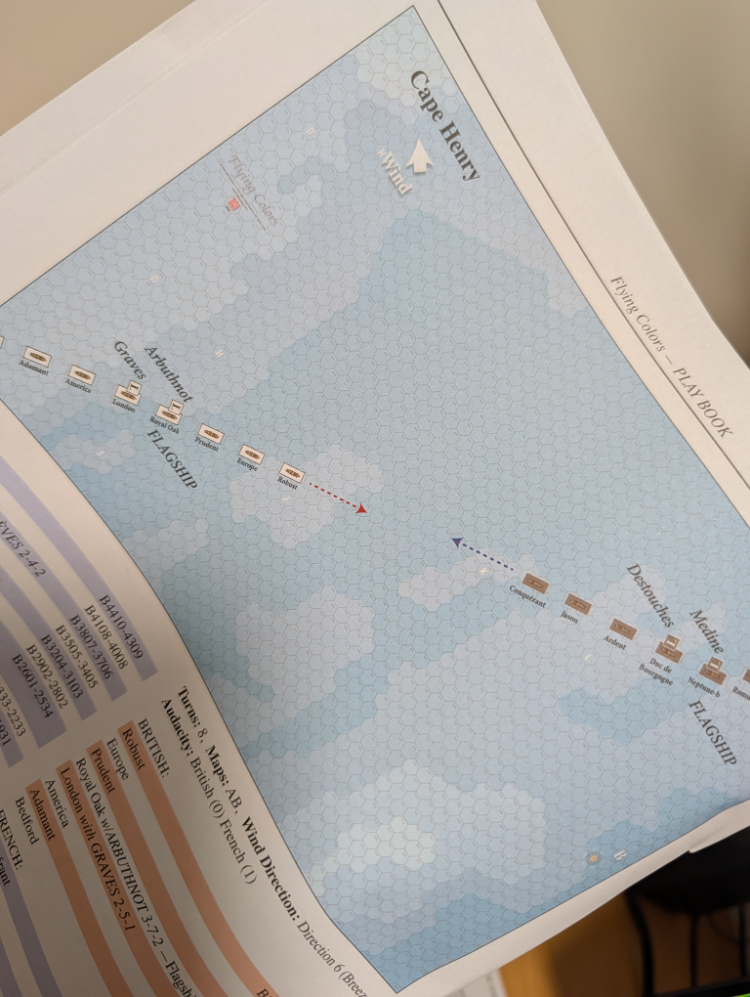
This is a game about fleet combat in the age of sail. Roy and I played the Cape Henry scenario, the 16 March 1781 encounter between British and French fleets near Cape Henry at the mouth of the Chesapeake.
In our replay, the French won, primarily by doing a better job of staying downwind of the other fleet. In this scenario, ships firing with the wind are penalized to the weather conditions at the time.
The game lets a lot of criticism about, for example, its command system, the lack of simultaneous movement, the ability of ships to fire two broadsides a turn, and the very restricted defensive fire. The number of markers can be a bit of a turnoff. All these are fair points. On the other side of the balance sheet, however, the game is accessible, fast, and at the fleet level gives a decent enough representation of some of the real-life issues. And, many of the criticisms can be dealt with by using roster sheets and house rules, especially importing ideas from some of the other games on the topic.
Talking of which, I have my eye on Man of War by Stephen Newberg. Originally he published this via his Simulations Canada company, it’s due to be reprinted by Compass Games. This game has a simultaneous movement system that could easily be added to Flying Colors. Watch this space!
Finally, while this game was fun, it set me thinking that it’s a long time since I played Wooden Ships and Iron Men…
This is an MMP publication of what was originally three separate Japanese designed and published games about Operation Barbarossa (the 1941 invasion of Russia by the Germans).
Roy and I played the shorter (6-turn) scenario on the Smolensk map. (Even though I knew we wouldn’t get to finish it, it was the best way to get us both up-to-speed on the rules, the situation, and some of the strategic and tactical options.)
Roy’s German forces inevitably wiped out the frontline Russians, most of whom died in a pocket. The German panzer forces pushed on like the proverbial hot knife through butter. However, the task for the Germans is demanding, requiring a lot of terrain to be captured in the face of an ever increasing supply of defending Russians.
At the end, the Germans were threatening in the center but well out of reach of the key victory point cities. It was fun, though playing the Russians you have to recognize you cannot go toe-to-toe with the Germans; it’s a waiting game.
We need to work out how to do a complete game. Perhaps we’ll use Vassal next time around.
This is an old (1986) update of an even older SPI game about man-to-man combat in WW2. Each hex is 2 yards and each turn a few seconds.
Roy and I played a 1943 encounter between a German squad (with 3 machine guns!) and a USA squad, in the Naples countryside. It was a meeting of patrols.
When I was preparing the game, I realized why I hadn’t played it more before: the rules are not that long, but there are lots of exceptions and a few loose ends. I applied some house rules to make sure we could get through the session without any major problems.
The two squads bumped into one another and there was an exchange of fire. Down went one of the Americans, wounded.
The Americans took cover in the heavy terrain, seeking to advance slowly into firing positions. The Germans threw a couple of grenades and kept up their defensive fire, wounding another American. The Americans moved deeper into better cover.
The game ended in a sort of stalemate. Although the Germans were well ahead in victory points, neither side was budging from its positions, so we called the game.
While this was fun, the game’s poor ergonomics made play a bit of a drag. Each soldier has several ratings — initiative, panic, and combat skills and deficiencies — which you track on a roster, so there’s a constant switch between map and roster. In this way, as Roy pointed out, it’s like a miniatures game. It would be much easier with all the ratings on the counters.
The activation system is interesting. Each soldier has an initiative rating and activates if his side draws a chit that’s equal to or greater than the initiative. Also, each side may get multiple rounds of activation per game turn, depending on the activation chits drawn. In this way, you might get an advantage of seeing your opponent running out of activations. That having been said, if you keep your soldiers within sight of the squad leader, and that soldier has an initiative rating of 1, you’re going to be less restricted. That part needs work.
I doubt we’ll play this again, though if I could ever summon up the perseverance to create my own counters with all the information on them, and redo the activation, leadership, and panic rules, there could be a good game here. On the other hand, there are all these other games…
This is one of a series (East Front series) of monster games at the operational level scale (5 miles per hex, each turn is 2 days, and units are divisions, brigades, and regiments) about the WW2 campaign in Russia.
The first scenario — neatly presented in a standalone card with combined map and setup details — is a solitaire training exercise to get you up to speed on the game’s basics: movement and combat. It does a good job. Also, the Playbook includes a detailed play through of that first scenario so you can see exactly how the game is played and check your rules understanding.
The second scenario, which I played twice covers the opening ten days of the campaign from the border to the capture of Daugavpils.
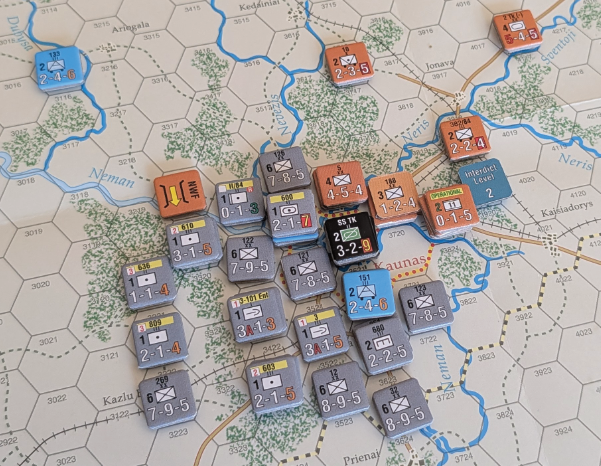
The Axis have taken Kaunas
I would summarize the experience as follows:
The rules are well written and comprehensive but they are long and detailed. There are many exceptions. You need to have the time to invest in learning the system.
The example play through is a big help.
The maps are gorgeous.
The counters are clean, crisp, and easy to read.
The player aids are excellent. However, I would have preferred the terrain effects chart to be on two pages with a larger font.
There are lots of tricks and tips that experienced players will have picked up. So, my play will not have been optimal.
The many scenarios are a blessing. You don’t need to play the campaign!
The supply rules are so much easier than OCS. The airpower stuff doesn’t convince me it’s at the right level of complexity or decision making. The play, once you get the rules into your brain, is engrossing. The sequence of play is not symmetrical so you have to play differently according to which side you have.
If you have the time and like the topic, this is highly recommended. This (or one of the other games in the series) will be on my table again.
I played The Vital Hours (WO37), a September 1944 encounter near Arnhem in the Netherlands between British parachute forces aiming to force their way to their destination through a motley crew of second-rate SS soldiers.
The British inevitably ground their way forward but took casualties and couldn’t get to the exit point in time, giving me and my defending Germans a rare victory.
I also played Burnt, Blue and Gray (WP15), a July 1944 scenario set in France. I led a force of German Fallschirmjagers, backed by three StuG IIG vehicles, in a counterattack on bocage territory held by Ran’s forces (infantry, machine guns, and a couple of bazookas) from the USA 1st Battalion, 116th Infantry Regiment.
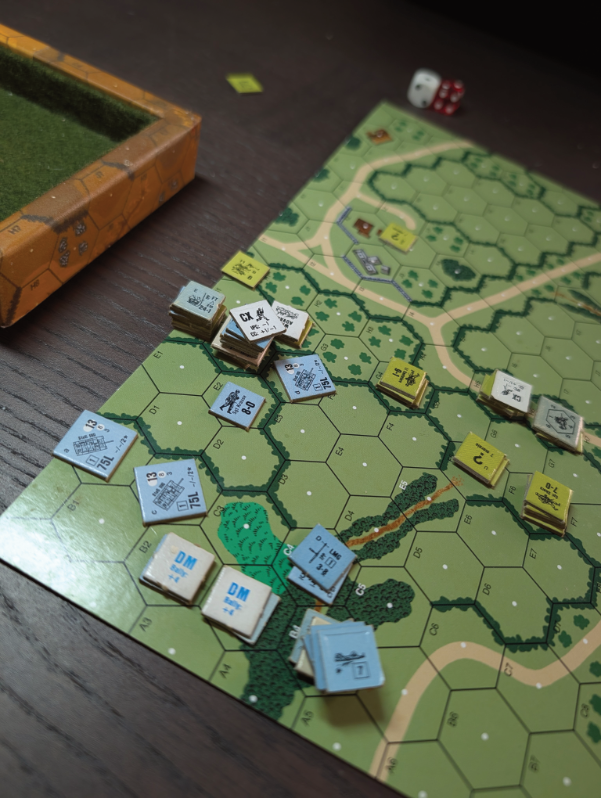
Action from WP 15 with the German attack about to be ground to a halt.
The short version of the story is that I focused my attack on one wing and didn’t make enough ground. This allowed Ran to bring all his previously strung out defenders into play and bottle up my spearhead. We called it ahead of time as it was plain the defenders would easily hold the line.
Next time around I am hoping Ran will agree to play this again and switch sides so he can show me how I should have played it.
As I have said before, all part of my continuing (and losing) ASL education.
March 1975: a world record attendance (104,000) at Murrayfield Stadium, Edinburgh see Scotland defeat Wales 12:10 in the Five Nations Rugby Championship. David Bowie’s Young Americans album, with John Lennon appearing on two tracks, is released. Construction of the Trans-Alaska Pipeline System begins.
April 1975: FIDE strip Bobby Fischer of the world chess title (because he refused to defend it) and award it to Anatoly Karpov. Bill Gates and Paul Allen form Microsoft. After the 1974 Carnation Revolution, Portugal’s first free election since 1925 sees the Socialist Party win.
Game Included
Frederick the Great by Frank Davis and Edward Curran is an operational level game about the campaigns of the Seven Years War (1756-163) with four scenarios covering (separately) 1756, 1757, 1758, and 1759.
The game was sufficiently impressive — it featured a number of then revolutionary ideas — that it was bought, repackaged, and republished by Avalon Hill. As far as I recall, there were no material changes to the system, but the new version included more scenarios. I’ve played this game fairly recently and it’s lasted well.
For more about the game (albeit it’s the Avalon Hill version) see here.
Articles
Outgoing Mail — editors
And then there was the oddest mass interest game of them all: War in the East. Why, we don’t know. It just sold a lot of games…
Generally, wherever you find large concentrations of college educated males between the ages of 18 and 35, you will find high concentrations of gamers.
Frederick the Great — Frank Davis
Quantitively, the 85,000 man army which Frederick II inherited in 1740 was the fourth largest in Europe. Quality wise, it was already the most formidable army in existence.
Blue & Gray — David C. Isby
In the years 1861-1865, Americans slaughtered their fellow countrymen with an expertise that no foreign nation, either before or since, has been able to approach.
This was a classic S&T encounter for me: the magazine arrived and introduced a whole new era of history that previously I had known nothing about. I devoured the covering articles and was hooked. Although it’s never been one of my most favorite periods, I keep my hand in with the occasional book and game purchase, all because of the Frederick the Great game.
I remember being impressed by many of the systems in the game and playing it fairly extensively, mostly solitaire. It was fascinating to compare the history as portrayed in the game with how books presented it.
I’m a sucker for WW2 tactical level games. This is the latest series I have started playing, though I am still committed to ASL.
I played the first scenario in the French 1940 expansion, primarily to familiarize myself with the rules again. Although the system is quite solitaire friendly, I dislike playing tactical games solitaire unless they are specifically designed to be played that way.
Overall, I like the system, but there are a number of house rules that I am trying out as sometimes the design doesn’t deliver as well as I think it can, even if the emphasis is on game ahead of simulation.
I played the Piraeus — 403 BC scenario from Expansion Pack #6 which has an Athenian force (whose forward line is atop hills) facing a slightly bigger Spartan force (14 units to 13).
The Spartan advantage is that their hoplite units are 5 blocks (as opposed to 4) so are more durable. The Athenian advantages include the terrain and a superiority in missile units.
This was one of the classic battles as it went down to the wire, victory being attained (by a one point margin) on the last combat. A thoroughly enjoyable experience.
I played Curries Favor (AP141), an August 1944 encounter in France between Commonwealth (Canadian) tanks and infantry tasked with seizing strategic points from a small German infantry force stiffened by an 88 gun and an 81mm mortar and set up in good defensive terrain.
I was the Canadians. I probably chose the wrong entry point but I got through the first turn without casualties and my forces in semi-decent threatening positions. At the start of turn 2, my key tank (with an armor leader) was perfectly positioned to place smoke to cover my advance. Unfortunately, I rolled a 12 which meant no smoke, no main gun, and no cover for the advancing forces.
Things went downhill from there and I conceded the game half way through. Although I could blame my luck, not choosing the best entry point didn’t help. All part of the continuing (and losing) ASL education.
After playing the introductory scenarios a few times, to get the rules clear in my mind, I moved onto the regular scenarios. The first involves attacking a farmhouse. I played it twice as the first time I made a mess of too many rules. The second scenario is about defending the farmhouse. This one I managed to complete without screwing up the rules. I won both scenarios.
The rules, as mentioned before, are lacking. I secured a copy of the newest rules which helped a fair bit, though there are still gaps. I have yet to make time to gather all the queries and submit them to one of the online forums for clarifications.
This WW3 naval game has been on my radar for a long time. It’s a strategic (i.e. broad-brush) view of what might have happened had WW3 broken out in 1984, 1989, or 1994. The system seems to pack a lot into a system that isn’t complex, as you might expect, and offers plenty of opportunity for house rules to tweak the parts that may not suit you. For example, BGG has a great suggestion about alternative targeting rules.
I have only managed to set the game up and try out some combats. It’s going to be a long game and I need to be in the right state of mind to start playing it.
Breakthrough is one of the expansions for Memoir ’44, a WW2 game in the Commands and Colors family. The expansion includes a double-sided hex game board for both beach landings and countryside combat and 15 scenarios. I played the Operation Crusader scenario as the Germans and was crushed 12-4.
I started with enough cards to get my key units moving, but then went through about six or seven turns with the wrong cards and being unable to get my units into combat. That was probably the tipping point.
The dice weren’t exactly helping, though my trusty opponent also had a couple of encounters on the fringes of the probability graph.
A couple of things to stress.
Despite the one-sided result, it was great fun. This is a game that never forgets its mission is to entertain and it does that repeatedly.
Of all the Commands and Colors type games, this is probably my least favorite and yet I love playing it! See the preceding paragraph.
I played The Middle Gate (Thermopylae) scenario from Expansion Pack #6 which presents an overwhelming Persian force with about half the number of opposing Spartans, behind ramparts, featuring a vulnerable flank that can be marched around.
The Persians did the flank march and, despite suffering high casualties, secured the flags (victory points) needed for the win. The final score was 10-6 so the Spartans were well out of touch.
It’s difficult to see how the Spartans can hold out here, especially if the cards aren’t there for the required counterattacks. Both sides had turns where the available cards were useless. I’m thinking of using a house rule to overcome this, such as allowing each player to be able to use any one card as a single unit activation (anywhere on the board) instead of whatever it says on the card.
All of that having been said, it’s a long time since I’d played the system and I enjoyed it much more than I remember.
I continued playing the Naktong River Campaign from the Korean War in this top-quality solitaire game system. I completed missions 4 and 5 successfully.
I played First Dance (AP228) again, an early war encounter in Belgium between French and German mixed forces of infantry and tanks. The French enter and set up a defense line. The Germans enter and try to break the line.
The Germans lost two key carriers and troops in the first turn and that decided the game, although we kept playing. The Germans made progress but they no longer had the troops required to capture the objectives. The French tank reinforcements are virtyually invulnerable.
A difficult scenario for the Germans, but that maybe only because it was me!
A sophisticated, two-player, worker-placement euro game with a theme about two clans vying for supremacy in technology and trade as the Portugese bring western ideas into Japan.
You play your workers to choose actions and some actions generate more actions or resources which you can use to generate more actions or resources and so on, each player vying for the best victory point score. Of course, there are multiple ways to attain (and calculate!) victory points.
It was too complicated for my taste. (I don’t mind complicated games but in an abstract game the complication has to bring something to my enjoyment. If not, as is the case here, it feels like complication just for the sake of it.)
The game uses a lot of icons to avoid language and eventually I became familiar enough with them, so it gets a pass there.
However, there’s one nuclear option that allows the opponent to screw with the available actions. I seriously doubt the play-balance of the game because of this.
I also didn’t like the use of color: there were 1,001 colors in use, or so it seemed, creating an obstacle to understanding the game.
In short, although I played it twice and tried hard, I didn’t like it. YMMV.
Part of a series of solitaire games, this one features US (player) versus German (system) soldiers battling it out in WW2 over a range of scenarios. The rules were lacking, but eventually I cracked the code.
The graphics put walls and hedges in the middle of hexes and that doesn’t work for me. It’s like a perversion of Schrödinger’s cat where the soldier in a wall hex gets the benefit of the wall no matter from which side he is attacked! I applied my own house rule to put the soldier on one side of the wall or hedge.
I don’t think it compares favorably with Ambush because of the design decisions, but it’s a brave try and I’m probably going to invest some serious time in exploring the system and scenarios.
One main criticism is that, for the most part, the system gives the German soldiers orders without any regard as to whether they can see the enemy. Orders are, instead, given based on the soldier’s morale. This can produce surprises as well as strange results. And that may be a fair reflection of the chaos of combat. Alternatively, it may be that more logical action choices should sometimes be taken.
I am still enjoying the game because it does generate a decent narrative. However, because of the stated issues, I am thinking about creating my own version of the solitaire system. There is an updated version that has allegedly made some improvements, and I’ll try and get a look at that.
Wurzburg — I played scenario one of this classic Modern Battles system from SPI. It went down to the last turn.
Advanced Squad Leader — The first scenario was Courage of Cowan (J242) set in December 1944, featuring SS infantry and tanks trying to break through American lines. The Americans held the line for four out of six turns, but the SS broke through on turn five to make the last turn a formality. The second scenario was First Dance (AP228), an early war encounter in Belgium between French and German mixed forces of infantry and tanks. The French first turn saw them enter the map and set up a strong defensive line which hammered the Germans as they tried to break through and that was that.
Fields of Fire — I went back to the Naktong River Campaign from the Korean War in this top-quality solitaire game system. I completed missions 1 to 3 successfully.
Undaunted: Normandy — A new game to me that combines card management with tactical movement of counters on a board. I had read some reviews but none had triggered a ‘must buy this’ response. After playing it, I know why. In short, it’s half a wargame and half a eurogame. So, it doesn’t fully satisfy on either account. There are a lot of cool ideas, but I won’t be rushing to play it again.
Date of publication (as given): January/February 1975
Context
January 1975: John Ehrlichman, John Mitchell, and Robert Mardian are convicted of Watergate crimes. The Pittsburgh Steelers beat Minnesota Vikings 16-6 in Super Bowl IX at Tulane Stadium, New Orleans. The musical Over Here! by Richard and Robert Sherman closes at the Shubert Theatre in New York City after 341 performances.
February 1975: Billy Herman, Earl Averill, and Bucky Harris are inducted into the Baseball Hall of Fame. Edward Heath is beaten by Margaret Thatcher in the leadership contest for the British Conservative Party. Linda Ronstadt tops both the US singles chart (You’re No Good) and the US album chart (Heart Like A Wheel).
Game Included
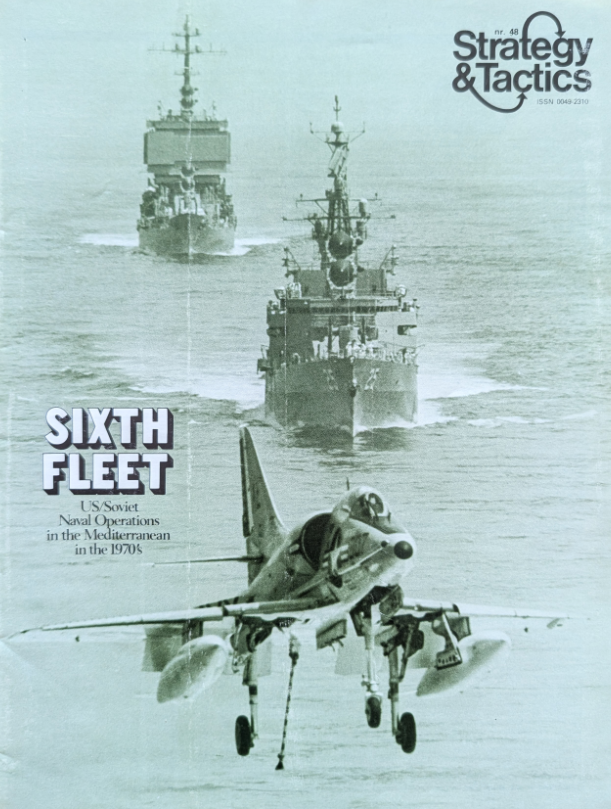
Sixth Fleet by James F. Dunnigan is an operational level game about naval warfare in the Mediterranean Sea in a hypothetical scenario in which the Cold War goes hot in the late 1970s, pitting the forces of the NATO Alliance against those of the Soviet Union.
Ever since we’ve been conducting Feedback surveys, we have found about 1% of our subscribers are women. Additionally, from time to time, we have had women gamers come by SPI. Usually just to buy games. In addition, one of our female staff members is a gamer. There are any number of reasons put forward as to why the composition of historical gamers is 99% male and 1% female. We would like to hear the viewpoint of the women gamers. We appreciate hearing from women gamers, either in writing or, if you’re in the New York area, in person. Since the subject matter of historical games affects all people, male and female, we would like to explore ways in which we can make historical gaming more accessible to women.
Sixth Fleet; US/Soviet Naval Operations in the Mediterranean in the 1970’s — David C. Isby and James F. Dunnigan
One thing that is certain about any future naval struggle in the Mediterranean is that the main destroyer of ships will not be other ships, but aircraft. As in the Second World War, ship-to-ship combat will only take place when environmental or tactical conditions prevent one side from placing aircraft in the area. The fact that airpower controls the seas was demonstrated in 1939-1945 and it is even more decisive today.
Global War; The War against Germany and Japan 1939-1945 — Martin Campion
There is no telling what Germany might have produced if it had not been for the Allied strategic bombing campaign. Speer guessed that, while the damage done by bombing in 1943 was nil, the loss in 1944 was in the neighborhood of 30 to 40%. In spite of this, while the Allied bombers wrecked more and more factories, German war production went up. In July, 1944, when nearly 100,000 tons of bombs were dropped on German-held territory by Allied strategic bombers, German war production hit its peak at a level that was more than three times the rate of production in 1941. Even at the end of 1944, armaments production was still at a level higher than it had been at the beginning of the same year. Strategic bombing dealt a death blow to the Geramn war effort, not by destroying the ability to produce weapons, but by wrecking Germany’s transportation system and ability to produce synthetic oil. So, the tanks and planes that were still coming out of the factories at the end of 1944 could not be delivered to the troops and could not be run very much anyway.
This issue was the first advert for the PRESTAGS (pre-seventeenth century tactical game) series: Chariot, Spartan, Legion, Viking, and Yeoman. I cannot remember why, but this generated no interest with me. Like 95% of the times when I decided to pass on a game, it was a mistake.
Wolfpack is a solitaire game in which the player takes the role of the WW2 Germans trying to have their U-boats sink as much Allied merchant shipping in the North Atlantic as possible. Despite the game’s subtitle – Submarine Warfare in the North Atlantic, 1942-44 – the four scenarios provided cover February, March, April and May all in 1943.
The game, designed by James F. Dunnigan, is a high-level, low-complexity treatment of the subject, much of the action being abstracted, though it does enough to reflect some of the real-life challenges and decision making. It was published with S&T 47.
Scale
Each game turn is 24 hours, each hex is 43 nautical miles, and each counter represents individual U-boats or packs of U-boats, a convoy, a group of escort ships, or an unknown number of aircraft. Each scenario is 15 game turns. The game map displays part of the North Atlantic from Britain to Newfoundland.
Sequence of Play
Convoy Initial Placement
You put the next convoy on the map. Convoys appear in numerical order, alternating from eastern to western-bound, and with a hidden escort. The escort may be a dummy or a real one with a combat strength from 1 to 3.
Weather Phase
In this phase, existing foggy weather is removed, then existing storms randomly move on the map. Convoys that are touched by a storm may straggle making them more vulnerable to U-boat attack. You also randomly determine whether another storm or fogged-in-zone appears.
Air Phase
First, you allocate air units as escort to qualifying convoys. Then you conduct searches for U-boats with remaining air units. Air units may then attack any U-boats they have found. These procedures are programmed into the rules so you cannot cheat the system.
Naval Phase
In this phase, you move each convoy according to a random movement procedure. You may find that a juicy target has moved in a most inconvenient direction! Convoys will move to avoid U-boats spotted in the Air phase. Also in this phase, escorts may search for and attack U-boats they find and U-boats may try and locate convoys that enter one of their search zones. A single U-boat has a single-hex search zone. A wolfpack has a three-hex search zone. If the search turns up a dummy, that convoy is removed from the map.
U-Boat Operations Phase
First, you may freely organize your U-boats that are stacked. A single U-boat has a combat strength of 1 and 8 movement points. A pack of 6 U-boats has a combat strength of 7 and 6 movement points. A pack of 12 U-boats has a combat strength of 15 and 6 movement points, and so on. A pack of 30 U-boats has a combat strength of 40, but only 4 movement points. In this way, the game models the clash between concentration – good for combat, but reducing search capability – and dispersal – good for widening the search, but reducing combat ability.
Next, you may move your U-boats. If there’s a spotted convoy, you need to move adjacent to be able to attack it. On the other hand, you might try and put your U-boats where you anticipate convoys may sail so you can try and spot them and make them targets.
Combat Phase
Here, U-boats may attack adjacent located convoys. Escorts get to counterattack. Finally straggling – which comes in 2 strengths – is reduced from 2 to 1 or 1 to none.
Game Turn Indication Phase
The almost universal administrative requirement to move on the game turn counter!
Game Play
The first thing to note is that I had no problem with the rules. Indeed, a search for errata was unsuccessful. It appears that SPI learned some lessons from the Fall of Rome game.
The second thing worthy of comment is that the game is easy to play. There are one or two details that are hidden away – like the effects of straggling – which would have been best added to the tables printed on the map. However, this minor issue aside, the game flows well. The sequence of play is straightforward and the game mechanics are logical, well-explained, and easy to do. After the first couple of turns I rarely had to go back to the rule book.
It plays quite quickly though this is dependent on how active you are with your U-boats. For example, if you have widely dispersed your forces and there are lots of searches to do, things will take longer. I finished some game turns in under 10 minutes and I think the longest was about double that.
I managed a German Substantive Victory in my game. This suggests it is too easy to win. However, I wouldn’t take a single game experience as definitive. Further, for some strange reason, I seemed to remember some of the tips and tricks I discovered all those years ago that helped maximize my score. This doesn’t always happen!
Be warned that this game has a lot of luck. You can have a good search result only to find the convoy is a dummy. You can mass your U-boats for an attack only to roll poorly and squander the opportunity. And, as mentioned above, convoys don’t always go where you expect them to.
History
As a high-level look at the topic, the game does a reasonable job of imparting some useful historical patterns. For example, it quickly becomes apparent how important airpower was. Also, weather is a fickle beast that can make convoys more vulnerable but also slow down your U-boats and make discovery harder. The whole convoy movement seems a fiction as in reality the convoys had a route that they followed and it didn’t typically include sudden drastic changes of direction as may occur in the game. The abstraction seems to be design for effect and if you suspend your disbelief a little it makes sense. The game’s optional rules give you added insight to some of the key elements of the historical campaign.
Overall
The physical components are fine: the map and counters are clear and the rules are well done. Given the limitations in place, it’s a fine looking game.
It was fun playing Wolfpack. It wasn’t the toughest challenge, but it was quite quick and provided decent entrtainment. It’s held up reasonably well. It’s not a game you absolutely have to play, but if you get the opportunity it probably deserves some of your time. If you do try it, check out the supporting article in S&T 47 first.