March 1975: a world record attendance (104,000) at Murrayfield Stadium, Edinburgh see Scotland defeat Wales 12:10 in the Five Nations Rugby Championship. David Bowie’s Young Americans album, with John Lennon appearing on two tracks, is released. Construction of the Trans-Alaska Pipeline System begins.
April 1975: FIDE strip Bobby Fischer of the world chess title (because he refused to defend it) and award it to Anatoly Karpov. Bill Gates and Paul Allen form Microsoft. After the 1974 Carnation Revolution, Portugal’s first free election since 1925 sees the Socialist Party win.
Game Included
Frederick the Great by Frank Davis and Edward Curran is an operational level game about the campaigns of the Seven Years War (1756-163) with four scenarios covering (separately) 1756, 1757, 1758, and 1759.
The game was sufficiently impressive — it featured a number of then revolutionary ideas — that it was bought, repackaged, and republished by Avalon Hill. As far as I recall, there were no material changes to the system, but the new version included more scenarios. I’ve played this game fairly recently and it’s lasted well.
For more about the game (albeit it’s the Avalon Hill version) see here.
Articles
Outgoing Mail — editors
And then there was the oddest mass interest game of them all: War in the East. Why, we don’t know. It just sold a lot of games…
Generally, wherever you find large concentrations of college educated males between the ages of 18 and 35, you will find high concentrations of gamers.
Frederick the Great — Frank Davis
Quantitively, the 85,000 man army which Frederick II inherited in 1740 was the fourth largest in Europe. Quality wise, it was already the most formidable army in existence.
Blue & Gray — David C. Isby
In the years 1861-1865, Americans slaughtered their fellow countrymen with an expertise that no foreign nation, either before or since, has been able to approach.
This was a classic S&T encounter for me: the magazine arrived and introduced a whole new era of history that previously I had known nothing about. I devoured the covering articles and was hooked. Although it’s never been one of my most favorite periods, I keep my hand in with the occasional book and game purchase, all because of the Frederick the Great game.
I remember being impressed by many of the systems in the game and playing it fairly extensively, mostly solitaire. It was fascinating to compare the history as portrayed in the game with how books presented it.
Date of publication (as given): January/February 1975
Context
January 1975: John Ehrlichman, John Mitchell, and Robert Mardian are convicted of Watergate crimes. The Pittsburgh Steelers beat Minnesota Vikings 16-6 in Super Bowl IX at Tulane Stadium, New Orleans. The musical Over Here! by Richard and Robert Sherman closes at the Shubert Theatre in New York City after 341 performances.
February 1975: Billy Herman, Earl Averill, and Bucky Harris are inducted into the Baseball Hall of Fame. Edward Heath is beaten by Margaret Thatcher in the leadership contest for the British Conservative Party. Linda Ronstadt tops both the US singles chart (You’re No Good) and the US album chart (Heart Like A Wheel).
Game Included
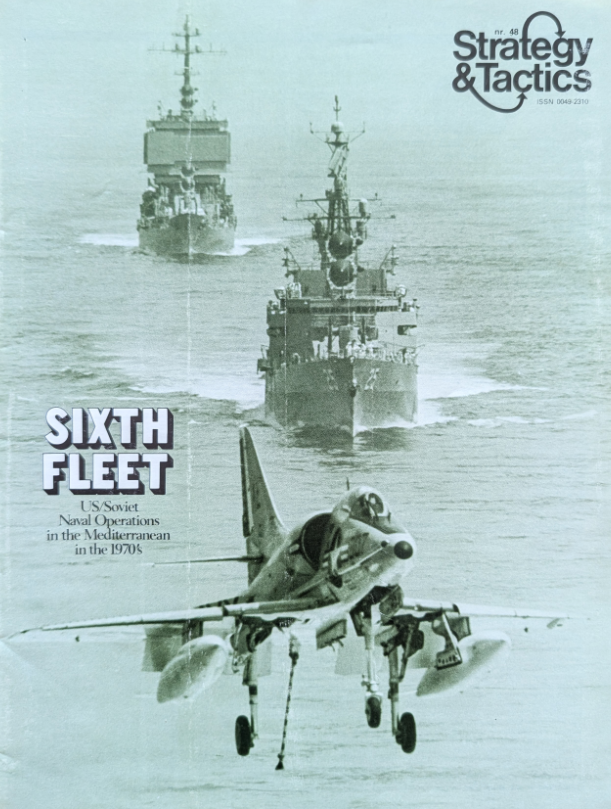
Sixth Fleet by James F. Dunnigan is an operational level game about naval warfare in the Mediterranean Sea in a hypothetical scenario in which the Cold War goes hot in the late 1970s, pitting the forces of the NATO Alliance against those of the Soviet Union.
Ever since we’ve been conducting Feedback surveys, we have found about 1% of our subscribers are women. Additionally, from time to time, we have had women gamers come by SPI. Usually just to buy games. In addition, one of our female staff members is a gamer. There are any number of reasons put forward as to why the composition of historical gamers is 99% male and 1% female. We would like to hear the viewpoint of the women gamers. We appreciate hearing from women gamers, either in writing or, if you’re in the New York area, in person. Since the subject matter of historical games affects all people, male and female, we would like to explore ways in which we can make historical gaming more accessible to women.
Sixth Fleet; US/Soviet Naval Operations in the Mediterranean in the 1970’s — David C. Isby and James F. Dunnigan
One thing that is certain about any future naval struggle in the Mediterranean is that the main destroyer of ships will not be other ships, but aircraft. As in the Second World War, ship-to-ship combat will only take place when environmental or tactical conditions prevent one side from placing aircraft in the area. The fact that airpower controls the seas was demonstrated in 1939-1945 and it is even more decisive today.
Global War; The War against Germany and Japan 1939-1945 — Martin Campion
There is no telling what Germany might have produced if it had not been for the Allied strategic bombing campaign. Speer guessed that, while the damage done by bombing in 1943 was nil, the loss in 1944 was in the neighborhood of 30 to 40%. In spite of this, while the Allied bombers wrecked more and more factories, German war production went up. In July, 1944, when nearly 100,000 tons of bombs were dropped on German-held territory by Allied strategic bombers, German war production hit its peak at a level that was more than three times the rate of production in 1941. Even at the end of 1944, armaments production was still at a level higher than it had been at the beginning of the same year. Strategic bombing dealt a death blow to the Geramn war effort, not by destroying the ability to produce weapons, but by wrecking Germany’s transportation system and ability to produce synthetic oil. So, the tanks and planes that were still coming out of the factories at the end of 1944 could not be delivered to the troops and could not be run very much anyway.
This issue was the first advert for the PRESTAGS (pre-seventeenth century tactical game) series: Chariot, Spartan, Legion, Viking, and Yeoman. I cannot remember why, but this generated no interest with me. Like 95% of the times when I decided to pass on a game, it was a mistake.
Wolfpack is a solitaire game in which the player takes the role of the WW2 Germans trying to have their U-boats sink as much Allied merchant shipping in the North Atlantic as possible. Despite the game’s subtitle – Submarine Warfare in the North Atlantic, 1942-44 – the four scenarios provided cover February, March, April and May all in 1943.
The game, designed by James F. Dunnigan, is a high-level, low-complexity treatment of the subject, much of the action being abstracted, though it does enough to reflect some of the real-life challenges and decision making. It was published with S&T 47.
Scale
Each game turn is 24 hours, each hex is 43 nautical miles, and each counter represents individual U-boats or packs of U-boats, a convoy, a group of escort ships, or an unknown number of aircraft. Each scenario is 15 game turns. The game map displays part of the North Atlantic from Britain to Newfoundland.
Sequence of Play
Convoy Initial Placement
You put the next convoy on the map. Convoys appear in numerical order, alternating from eastern to western-bound, and with a hidden escort. The escort may be a dummy or a real one with a combat strength from 1 to 3.
Weather Phase
In this phase, existing foggy weather is removed, then existing storms randomly move on the map. Convoys that are touched by a storm may straggle making them more vulnerable to U-boat attack. You also randomly determine whether another storm or fogged-in-zone appears.
Air Phase
First, you allocate air units as escort to qualifying convoys. Then you conduct searches for U-boats with remaining air units. Air units may then attack any U-boats they have found. These procedures are programmed into the rules so you cannot cheat the system.
Naval Phase
In this phase, you move each convoy according to a random movement procedure. You may find that a juicy target has moved in a most inconvenient direction! Convoys will move to avoid U-boats spotted in the Air phase. Also in this phase, escorts may search for and attack U-boats they find and U-boats may try and locate convoys that enter one of their search zones. A single U-boat has a single-hex search zone. A wolfpack has a three-hex search zone. If the search turns up a dummy, that convoy is removed from the map.
U-Boat Operations Phase
First, you may freely organize your U-boats that are stacked. A single U-boat has a combat strength of 1 and 8 movement points. A pack of 6 U-boats has a combat strength of 7 and 6 movement points. A pack of 12 U-boats has a combat strength of 15 and 6 movement points, and so on. A pack of 30 U-boats has a combat strength of 40, but only 4 movement points. In this way, the game models the clash between concentration – good for combat, but reducing search capability – and dispersal – good for widening the search, but reducing combat ability.
Next, you may move your U-boats. If there’s a spotted convoy, you need to move adjacent to be able to attack it. On the other hand, you might try and put your U-boats where you anticipate convoys may sail so you can try and spot them and make them targets.
Combat Phase
Here, U-boats may attack adjacent located convoys. Escorts get to counterattack. Finally straggling – which comes in 2 strengths – is reduced from 2 to 1 or 1 to none.
Game Turn Indication Phase
The almost universal administrative requirement to move on the game turn counter!
Game Play
The first thing to note is that I had no problem with the rules. Indeed, a search for errata was unsuccessful. It appears that SPI learned some lessons from the Fall of Rome game.
The second thing worthy of comment is that the game is easy to play. There are one or two details that are hidden away – like the effects of straggling – which would have been best added to the tables printed on the map. However, this minor issue aside, the game flows well. The sequence of play is straightforward and the game mechanics are logical, well-explained, and easy to do. After the first couple of turns I rarely had to go back to the rule book.
It plays quite quickly though this is dependent on how active you are with your U-boats. For example, if you have widely dispersed your forces and there are lots of searches to do, things will take longer. I finished some game turns in under 10 minutes and I think the longest was about double that.
I managed a German Substantive Victory in my game. This suggests it is too easy to win. However, I wouldn’t take a single game experience as definitive. Further, for some strange reason, I seemed to remember some of the tips and tricks I discovered all those years ago that helped maximize my score. This doesn’t always happen!
Be warned that this game has a lot of luck. You can have a good search result only to find the convoy is a dummy. You can mass your U-boats for an attack only to roll poorly and squander the opportunity. And, as mentioned above, convoys don’t always go where you expect them to.
History
As a high-level look at the topic, the game does a reasonable job of imparting some useful historical patterns. For example, it quickly becomes apparent how important airpower was. Also, weather is a fickle beast that can make convoys more vulnerable but also slow down your U-boats and make discovery harder. The whole convoy movement seems a fiction as in reality the convoys had a route that they followed and it didn’t typically include sudden drastic changes of direction as may occur in the game. The abstraction seems to be design for effect and if you suspend your disbelief a little it makes sense. The game’s optional rules give you added insight to some of the key elements of the historical campaign.
Overall
The physical components are fine: the map and counters are clear and the rules are well done. Given the limitations in place, it’s a fine looking game.
It was fun playing Wolfpack. It wasn’t the toughest challenge, but it was quite quick and provided decent entrtainment. It’s held up reasonably well. It’s not a game you absolutely have to play, but if you get the opportunity it probably deserves some of your time. If you do try it, check out the supporting article in S&T 47 first.
Date of publication (as given): November/December 1974
Context
November 1974: Lord Lucan disappears, never to be seen again. The John Lennon single Whatever Gets You Through the Night goes to #1 in the USA. MLB Commissioner Bowie Kuhn suspends George Steinbrenner (New York Yankees owner) for two years after his conviction for illegal contributions to political campaigns.
December 1974: Jean-Paul Sartre visits Andreas Baader (Baader–Meinhof Gang leader) in prison. The Towering Inferno movie, starring Paul Newman and Steve McQueen, is released. Australian Evonne Goolagong Cawley beats Martina Navratilova of Czechoslovakia 6-3, 6-2 at the Australian Open Women’s Tennis to retain her title.
Game Included
Wolfpack by James F. Dunnigan is a solitaire game about the submarine campaign in the North Atlantic from 1942-44. The player, as the German U-boat commander, is trying to sink the maximum number of Allied merchant ships while trying to conserve the U-boat forces.
Coming:… in S$T 50, a game called Twentieth Century…The exact design parameters for The Twentieth Century game are still up in the air. In all probabibility, it will be a two-player game with a Multi-Player option. We have a rather novel game system in mind, but, since nothing is firm yet, we will wait until the next issue of S&T to give further details.
Wolfpack; The German Submarine War in the Atlantic, 1939-43 – Frank Davis
With a little help from their Italian allies, the Germans lost over 800 submarines during the six year war against Allied shipping. About 15,000 tons of Allied shipping was sunk for each U-boat lost. This is approximately two merhcant ships lost for every U-boat lost. While the Allies were able to absorb such losses, the U-boat losses proved too severe for the Germans.
World War 3; Potential for Conflict in the 70s – Stephen B. Patrick
…the Middle East. Here we have everybody else in the area arrayed against Israel. Israel easily outnumbers (in terms of ground combat strength) her immediate neighbors and enemies, Egypt, Syria and Jordan. The element that gives Israel a decisive edge is the qualitative superiority of her soldiers and their equipment, particularly tanks and aircraft. While the main confrontation is between Israel and all of the other Middle Eastern and North African states, one must not forget that between these states there are also long standing animosities which have only been temporarily put aside due to the confrontation with Israel. Once the Israeli issue has been settled, it is entirely likely that certain Middle Eastern and North African nations will turn their armed forces on each other to settle old (or new) grievances.
The Sackson on Games article featured some games newly introduced to the USA – including Election, and The Game of Nations – which I had been playing extensively and enthusiastically before starting my S&T subscription. After then, I barely played them again.
Date of publication (as given): September/October 1974
Context
September 1974: first showing of The Rockford Files on NBC-TV. General Francisco da Costa Gomes succeeds General António de Spínola as President of Portugal. Scientists first report that freon gases from aerosol sprays are destroying the ozone layer.
October 1974: Frank Robinson becomes MLB’s first African-American manager, signing as player-manager for the Cleveland Indians. The Guildford pub bombing by the IRA leaves five dead and 65 injured. The Labour Party, led by Harold Wilson, wins the UK general election.
Game Included
Combined Arms by James F. Dunnigan is a game about combined arms land warfare from 1939-1970s. Each turn is an hour, each hex is 300m and units are companies and battalions. There are six scenarios running from Defense of the Vistula Bridges (1939) to the Battle of the Chinese Farm (1973).
Combined Arms; Combat Operations in the 20th Century – Stephen B. Patrick
Because of the need to be centrally located in order to take action, this meant that battalion commanders would often not see any of the fighting in a critical sector – the crisis would often be over for better or worse by the time he arrived. Consequently, reliance on radio messages became the rule rather than the exception.
Patrol; Modern Infantry Tactics, 1914-1974 – David C. Isby
In summation, one can say that the essence of infantry tactics is: stay under cover, dig in whenever possible, combine fire and movement to make effective use of terrain, advance from cover to cover. If possible, surprise the enemy, hit him where he is weakest, and shoot him in such a way that he cannot shoot you back.
Outgoing Mail – editors
Last year, more than half the historical games sold in this country were SPI games. In the first 6 months of 1974, we sold over 150,000 games. In each of the last three years, we have published more new games than were published by all other historical game companies combined in the past ten years.
Sackson on Games – Sid Sackson
Footnotes – everybody
Player’s Notes – Redmond A. Simonsen and John Michael Young
We also received an order from a prison administration a while back. They wanted a copy of Breakout & Pursuit. The request was legitimate, we sent off the game, but never heard what their reaction to it was, or in fact, why they wanted that particular game.
On a Personal Note
The information about SPI sales (see Outgoing Mail quote above) astonished me. The USA had to be full of gamers!
The game in this issue disappointed me. It may have been the decision to use generic counters – for example “Light Armor” units had different ratings (not printed on the counters) according to the scenario – or that I was growing tired of the cumulative disruption (D1, D2, D3, etc.) combat results system. However, over the years, it was also one of the few games I kept thinking about going back to.
The Moves advert on the back page of S&T 46 won me over. My subscription to that magazine followed shortly.
July 1974: West Germany wins the (Soccer) World Cup, defeating the Netherlands 2-1. Turkey invades Cyprus. The USA release of the film Death Wish (based on a novel by Brian Garfield) starring Charles Bronson and directed by Michael Winner.
August 1974: USA President Richard Nixon resigns and Vice President Gerald Ford takes the oath of office to become the 38th USA President. Zaheer Abbas scores 240 for Pakistan against England at The Oval. RCA releases in the USA Harry Nilsson’s tenth Album, Pussy Cats, produced by John Lennon.
Game Included
Operation Olympic by James F. Dunnigan is a solitaire game about the hypothetical USA invasion of Japan in 1945. Each turn is a week, each hex is 6.5km and units are regiments, brigades, and divisions. There is a two-player option.
During the last year of the war in which Japan lost one decisive battle after another, hundreds of thousands of Japanese had been sacrificed. If the Emperor prematurely agreed to surrender, these lives would appear all the more wasted. Thus, the war must be allowed to continue until Japan’s ruin became visible to all and the suffering caused by it had produced a popular clamoring for peace.
Science Fiction Futures – Stephen B. Patrick, John Boardman, and Redmond A. Simonsen
The real object is to reveal human behavior under stress – and the stranger the source of stress the better. The “weird” factor in science fiction is what lifts it above other genre writing in importance. It provides a unique esthetic distance from which the reader can appraise the characters and the situation. It enables the writer to arrange all of the background to focus attention on the main players. It can, and consistently does, carry the reader beyond the narrow defiles of his here-and-now reality set so that he can more successfully turn back and see his life. Science fiction is a way of looking at the past.
Outgoing Mail – editors
Footnotes – everybody
Sackson on Games – Sid Sackson
Pass in Review (book reviews) – Albert A. Nofi
Player’s Notes – Irad B. Hardy and John Michael Young
Just wanted to complain about Hardy’s (IBH) comments in the Civil War rules folder. Deesigner’s notes should explain the historical considerations utilized or reflected in the game system. However, Hardy’s suggestion that the Union player set up in odd-numbered hexes to minimize Command Control problems is an example of gamesmanship rather than historical accuracy.
On a Personal Note
My knowledge of the war in the Pacific was sketchy. I knew nothing about proposed plans for the invasion of Japan. This issue of S&T went some way to fill in in the gaps. Although the historical article’s focus was on the later stages, there was some useful material about how the participants got to that part. As for the invasion, while I was happy to play the game, I think I took it less seriously because – perhaps naively – I found it a highly unlikely scenario. No power could have resisted the force of the USA’s nuclear arsenal. Surrender was inevitable.
May 1974: Israel and Syria sign an agreement about the Golan Heights. In hockey’s Stanley Cup, the Philadelphia Flyers win the series 4-2, becoming the first “expansion” team to win the trophy, with Flyers’ goaltender Bernie Parent named playoff MVP. ABC Records releases Rikki Don’t Lose That Number from Steely Dan’s Pretzel Logic album.
June 1974: Yitzhak Rabin becomes Israeli Prime Minister, replacing Golda Meir. At the French Open, USA teenager Chris Evert beats Olga Morozova of Russia to win the Women’s title, the first of a record 7 French singles titles for her. Mean while, Sweden’s Börg beats Manuel Orantes of Spain to win the Men’s title, his first career Grand Slam title. The Provisional IRA bomb the Houses of Parliament in London, injuring 11 people, part of a renewed IRA campaign against targets in England.
Game Included
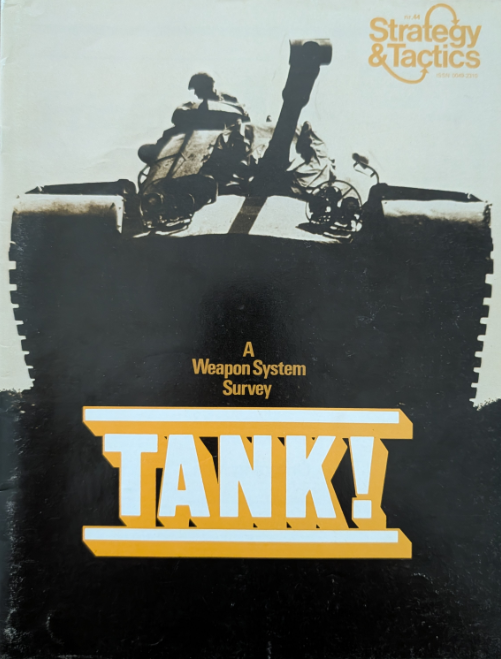
Tank! by James F. Dunnigan is a two-player game about armored combat in the 20th century with each unit representing an individual tank or vehicle or gun or infantry squad. Hexes represent 50 meters of real terrain and each game turn is “36 seconds to two minutes of real time depending upon the scenario played.” It uses pre-plotted simultaneous orders.
Oddly enough, if a tank was destroyed, the crew was not necessarily destroyed with it. In fact, the average deaths in the crew of a destroyed tank was only 1.3 men per tank for the war. Also, only 75% of all tank casualties occurred inside the tank. This goes to remind us that tank crews did not spend all of their time in the tank. In fact, they spent the majority of their time outside of the tank.
Sea War in the Age of Sail –David C. Isby
Throughout history, the sea has been the great thoroughfare for trade and communication. Small wonder that man, clever fellow that he is, took to fighting on the planetary sea not very long after he learned organized violence on land.
Shortly after the publication of The East is Red, we received a visit from a high-ranking Soviet diplomat, stationed in New York. He was interested in looking around, and also wanted to pick up a copy of War in the East. Unfortunately, War in the East was not yet ready, so we just showed him around. During the tour, we came across a copy of NATO, which was being played. We asked him if he’d like to get a copy of it, to which he replied, “No, I believe we already have that one.”
On a Personal Note
This was the first issue of my renewed subscription. The game had an expansion kit (more counters, rules, and scenarios) which subscribers had to apply for separately. I got mine from the UK distributor.
March 1974: 29 years after World War II ended, the last Japanese soldier, a guerrilla operating in the Philippines, surrenders. In China, farmers discover 8,000 clay warrior statues (The Terracotta Army) buried to guard the tomb of China’s first emperor Qin Shi Huang. At the Grammys, Roberta Flack’s “Killing Me Softly” wins the Best Record award.
April 1974: the Agranat Commission publishes its report on the Yom Kippur War. The Swedish Band Abba win Eurovision with their song “Waterloo”. Ray Kroc (San Diego Padres owner) tells fans “Ladies and gentlemen, I suffer with you… I’ve never seen such stupid ball playing in my life!”
Game Included
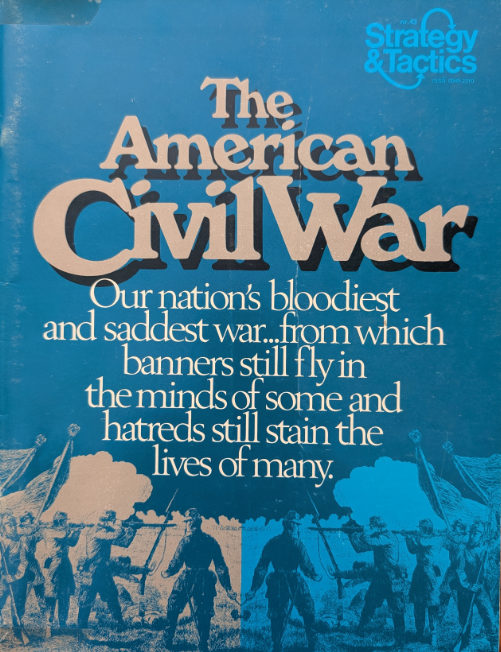
The American Civil War by James F. Dunnigan is a two-player strategic-level game about the whole civil war. There are ground and naval units backed up by forts and leaders. No unit nor ground scale is given. The map shows from New Jersey to the northern parts of Florida on the east coast and the southern part of Iowa down to Louisiana on the west coast. There are four turns in a year. One basic scenario covers the whole war with options available to adjust the historical setting to your tatste.
This game uses the (almost-standard) command control rule whereby certain of your units (occupying hexes whose last number matches a dice-generated number) will not contribute to the fight each turn. In this case, I would stick with the original rules as drafted. Why? Union reinforcements enter in Washington (6 Strength Points, hex 4507) , Cincinnati (3 Strength Points, hex 2607), and Cairo (2 Strength Points, hex 1513). While the Union Command Control Level is at 5 (which is where it starts), there is a 50% chance of Washington and Cincinnati being affected, and a 50% chance of Cairo being affected. It means the Union may struggle to get his troops into battle. It’s a nice wee design touch.
Between 1861 and 1865 the United States of America was almost torn apart in the bloodiest war in its history. In a strange conflict combining features of the Napoleonic Age with features of the Machine Age, fully 600,000 men perished fighting for sectional particularism, constitutional principle, economic self-interest and moral righteousness. And, in the end, vast changes were made in the nation, yet the nation remained unchanged. All with fateful implications for the present.
The Soldier Kings 1550-1770 – Frank Davis and Ron Toelke
But perhaps the best measure of the horror and cost of the Thirty Year’s War can be seen in the actions of the generations born soon after the conflict. For a century and a half following the Peace of Westphalia [24 October 1648], war was conducted with a degree of civility and restraint which is umatched in the entire length of the rest of history.
From page 42 of this issue’s Outgoing Mail referring to the then upcoming Tank! game:
Each tank is represented by two counters. A bottom one for the body of the tank and a top one representing the turret, which of course can be turned at various aspects.
On a Personal Note
This issue marked the end of my first year’s subscription. I remember looking back at the games received and thinking that renewing the subscription was a no-brainer.
The front page text is one of my favorite quotes. Perhaps that’s why this issue was also the tipping point for making the American Civil War one of my favorite historical periods – to read about and to game. The Gettysburg article in issue 38 was the spark and this issue converted it to a passion.
KampfPanzer by James F. Dunnigan is a two-player game about early tank warfare (1937-40) with each unit representing five tanks, a platoon of infantry, or a battery of guns. Hexes represent 100 meters of real terrain and each game turn is three minutes and forty seconds of real time. One of several distinctive features of the game is that it uses pre-plotted simultaneous orders.
Components
KampfPanzer was released with Strategy & Tactics 41. The counters (not backprinted) have silhouettes for vehicles and are pretty nifty. All are clear and easy to read.
The map is bare and dull. The rules are printed on one of the foldout pamphlets that were a regular feature of SPI’s output. (There’s a small amount of errata which you should track down if you want to play the game.) There’s also a separate sheet with scenarios, historical notes, and the charts and tables.
Game Turn Sequence
Each game turn includes the following:
Simultaneous Movement and Combat Plot Phase
Panic Determination Phase
Combat Execution Phase
Panicked Movement Plot Phase
Movement Execution Phase
Disruption Removal PhasePlaying the Game
Playing the Game
To get me in the right place to do this post, I chose Hannut from the nine available scenarios.
The game is not really suited for solitaire play given that you start each turn by writing out the detailed orders for each unit. The plotting system is well explained with plentiful examples, and in face-to-face play it adds a considerable amount of tension to the game play.
When playing this solitaire, I wrote out orders for one side first. Then, took a coffee break, returned and did the other side. To try and alleviate my knowledge of the other side’s orders, for the second side I tried to give each unit at least two sensible options and let the dice decide which one was selected.
Panic determination involves one die roll per side and a quick and easy process for finding out who has been affected. However, as with PanzerArmee Afrika, the system has its limits in that not every hex is equally at risk. For better play, I suggest using one of the options mentioned there.
Panic is a misleading term as it’s more to do with command and control. (And, in PanzerArmee Afrika, it was referred to as command control.) Units plotted to fire, don’t fire. Units plotted to move, do a random (die-roll determined) move. The latter was too chaotic and unrealistic for many players with several suggestions for house-rule replacements being touted. For sure, the result does give you a challenge because you cannot guarantee your units will do what you want them to do. In my opinion, that’s both a good thing and realistic.
Action from my replay of the Hannut scenario. The French, suffering from bad command and control, are outmanned.
The scenario runs for ten game turns. In the first game turn, both sides plot movement orders as each needs to head for the victory point area.
The French (with a Panic Level of 3) suffer a bad breakdown of command and control with several units going off in the wrong direction in the first turn. The Germans are untroubled. By the end of the turn, the French have a toehold on Hill 2, and the Germans are not quite there. Turn two sees the advance German forces start to arrive and turn three sees much combat. By the end of turn four, lots of damage has been down. Slowly, but surely, the German superiority in command and control tells – as does their superior firepower against the French infantry and anti-tank guns – and by the end of turn seven, it’s clear the Germans are going to win.
In this system, units take hits in terms of levels of disruption. There’s also a Pin result that prevents units with a move order from moving. You have to roll for recovery from disruption, so disrupted units are potentially out of the action forever if you roll badly. Pinned units automatically recover. I’ll admit the French recvovery rolls were awful. Such is war.
Good Stuff
The capability of the different types of unit (tank, infantry, guns) is portrayed well, as is the fact that the German tanks were not necessarily the best in the world.
This game is a great starting point for looking at creating your own game about tactical warfare in World War II. You get an impression – broad brush, to be sure – of what combat at the sharp end might have been like and a sure appreciation of the difference troop quality can make. It would be straighforward to replace the simultaneous plotting parts to make the game more solitaire friendly.
The simultaneous plotting adds to the tension.
Not So Good Stuff
This game doesn’t teach a lot about the tactics of armored combat of the time. You won’t see much of a difference between the German forces that were masters of the Blitzkrieg and for example the French forces that were, in general, swamped. The exception is that the German forces will have a better Panic Level and so be less prone to panic and not implementing your chosen orders. That’s a somewhat shallow differential, albeit it does highlight the advantages of (presumably) better command, control, communications, and troop quality. But the influence of artillery and air power, not forgetting radios, are sadly missing.
The unit ratings are a mystery to me. For example, the article in Strategy & Tactics gives armor thickness figures that don’t seem to directly relate to defense strength. The speeds given seem more closely related to each unit type’s movement points (MP). Here’s a sample of units with the armor thickness (as given in the article) and the defense strength in the game, then speed per the article and MP in the game.
*Note: there is no Pz IVD counter, only a PzIVE counter. The latter type wasn’t available till 1941 so I assume it’s a typo and is really the type D.
The numbers are close, but it appears there are other factors being taken into account when calculating defense strengths. There’s no hint what these might be – size, speed, metal quality – making it next to impossible to expand the unit coverage for DIY projects. At least speed and MP seem close enough.
The combat system has not aged well.
The scenarios are not especially engaging.
The map is drab and dreary, and looks unrepresentative of any real-life battlefield.
In Conclusion
KampfPanzer is an OK game and while I enjoyed my time playing it, this may well be the last time it hits the table, at least in its present format. Some people in the hobby developed the combat system for the related game Panzer 44 (though it has a different ground scale) and hopefully at some time I am going to try that out.
I remember being excited when this game originally arrived as part of my S&T subscription. Some 52 (!) years later, it’s less exciting, but I had some great times with KampfPanzer and I’m glad I got the opportunity to enjoy it.
Date of publication (as given): January/February 1974
Context
January 1974: Start of the three-day week in the UK due to the energy crisis. The Miami Dolphins beat Minnesota Vikings 24-7 in Super Bowl VIII, at Rice Stadium, Houston.The $6 Million Man starring Lee Majors premieres on ABC TV.
February 1974: Playmobil toys debut at the Nuremberg Toy Fair. A bomb, planted by the Provisional IRA, explodes on a bus in West Yorkshire, England, carrying British soldiers and family members. Blazing Saddles, the Mel Brooks western comedy, premieres in California.
Game Included
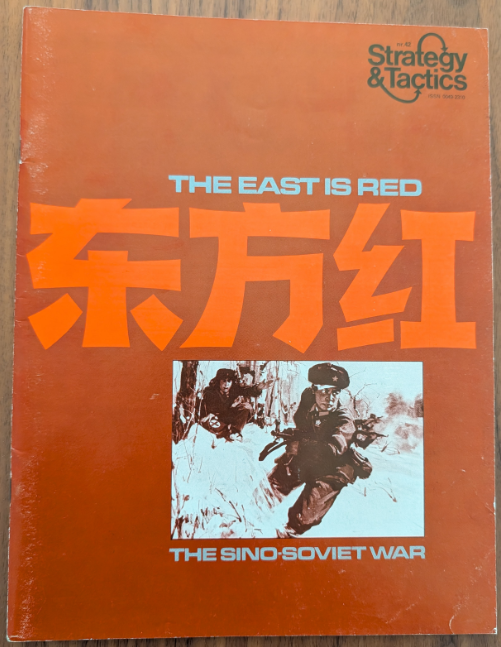
The East is Red by James F. Dunnigan is a two-player game about a hypothetical Soviet invasion of China in the 1970s. Units are at the division and corps level. Hexes represent 50km of real terrain and each game turn is one week of real time. One distinctive feature of the game is that it includes, as standard, rules for atomic warfare.
Within the theater of operations it is assumed that tactical nuclear weapons and atomic demolitions will be used.
The vulnerability of the Transsiberian Railway will pose a problem to the Soviet forces to permit them to actually wage prolonged war. However, the USSR is capable of using the seas, especially since China is not a sea power itself and cannot, therefore, threaten naval resupply except as the shipping gets close to port.
Napoleon at Waterloo – Albert A. Nofi
By 1800 the French had charged four times. Losses on both sides were extremely heavy, but at the end Napoleon’s cavalry was pretty much useless. Wellington’s cavalry was also more or less useless, having been expended in a series of countercharges, and his infantry was not in much better condition. Although no squares were reported broken, most were on the verge of collapse as a result of the heavy pounding they had received. The lack of horse artillery, beyond one battery which had somehow joined the charge, told on the French. With it, they might well have broken a number of squares. Without it, the cost of breaking squares became prohibitive.
The game in issue #44 will be Tank. This game will involve Tank-to-Tank combat during World War II…Tank, to give you fair warning, will probably be an unusual game. We are kicking around a number of rather radical game systems. The one that is currently a front runner for selection as the game system to be used relies upon a very different movement system. It is rather difficult to describe without actually showing it to you, but we’ll give it a try. Basically the one to five armored vehicles on each side will each occupy a hexagonal shaped area containing perhaps fifteen hexes across from one side to another. The actual playing board will be a much smaller area with each hexagon on the playing board representing one of the larger hexagons in which each side’s tanks actually maneuver. The actual playing board will be called the control board. The large hexagonal shape board will be the maneuvering board. A tank’s position will always be shown on the control board. That, in effect, will be its strategic position. Its tactical position will be shown on the manever board. We will have to use an as yet undefined system to show the terrain features on each of the many control board hexes. Each of the control board hexes, again, represents the much larger maneuver board hex. This system, hopefully, will allow for the sometimes substantial range differences between tanks, although we are aware of the fact that most tank battles occurred at under 500 meters range. The system just partially described makes use of control charts upon which each player keeps track of various mechanical functions for each of his tanks, such as current speed, position of turre[n]t, ammunition status, and the like. There is a lot more work yet to be done on the game Tank. In fact, it is not supposed to start, in theory, until January. But we usually get started on the design concepts far in advance of this.
Two points of interest. First, the version of Tank that was released bore no relation to the design described above. Second, note the emphasis on the design with no mention of scenarios.
On a Personal Note
This issue of S&T introduced me to the concept of gaming future, potential conflicts. The game, itself, was not of great interest and my recollection is that I hardly played it. The topic didn’t appeal to me. Also, the implementation – aside from the rules about nuclear weapons – had nothing novel.
I read the advert for War in the East knowing I had neither the funds to buy it nor the space to play it. By now I was realizing that if SPI kept up their output, I wasn’t going to have time to play all their games anyhow. As a gamer, that realization was depressing. I’m not sure I have ever recovered from it.