One of the results of retiral, is that I now have more free time. And I have used part of that time to revisit some of the many (unfinished) gaming ideas I have had. One trigger was me finally getting around to acquiring a 6′ x 4′ table for my games room that I considered was big enough to host some figure gaming if I wanted. The challenge, of course, was deciding what type of game.
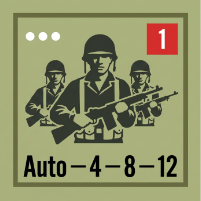
I have always been a sucker for tactical level boardgames. By ‘tactical’, I mean games where the basic unit is an individual soldier, or games where the basic unit is a squad (section), a platoon, or a company. However, my most commonly played tactical games are at the squad level. So, that’s what I’m going to do: create my own tactical, squad-level, wargame. It will start as a boardgame, but hopefully will convert to a miniatures format.
Of course, it’s going to be a long project and there’s no guarantee I will finish it. But the journey is part of the pleasure.
This time, instead of going straight to one of my old design ideas, it struck me that it would be helpful to do a bit more analysis of the reason for the project.
Given that I play and enjoy games at this level, why do I want to create my own?
Part of the answer is that each of the games I play and enjoy — to varying degrees — has something missing, or does something wrong, or has several things missing, or has several things wrong. In this context ‘missing’ and ‘wrong’ are used according to my understanding and perspective.
So, instead of kicking things off with an idea for a game turn sequence or combat resolution or morale or fatigue, I plan on doing a series of short articles about tactical level games focusing on what I don’t like about them.
If I am able to realize the plan, I’ll update this post with links to each of the games covered.
New year, new knee, new bike; the Winter 2026 biking season has officially started in the Simpson household!
Following on from the demise of my last (long-serving) bike, I finally bought a new (electric) bike. In between the holidays, I managed a couple of short runs to get more used to the bike and how it handles. This morning, I did what used to be my standard long run, from our place in Ra’anana to the port at Tel Aviv and back. It’s about 40km and is a mix of road, cycle path, and beachfront making for a good chunk of aerobic exercise. Of course, with the electric bike it’s far easier. I tried to keep the engine on eco setting as much as possible, though using the trail setting — especially on the return journey up the hills — is a joy.
After this, I’m hoping to fit in a weekly ride on some proper bike trails, though I might repeat the Tel Aviv run to build up my stamina.
I enjoy biking. Being able to do it, especially after the knee replacement I had last year and the prolonged recovery, is something to celebrate. Life is good.
[Note: apart from one major point in the Baldacci book, this is a spoiler free zone.]
I’m not going to make this a regular feature, but this month it suits me to wrap up all my fiction reading at one time. I use the goodreads site to keep track of fiction, primarily to try to avoid buying (or inadvertently reading) books I have already read.
Here’s what I finished in September:
Nash Falls — David Baldacci
Let’s get the spoiler out of the way, up front. This book is only half of the story. It appears that the next in the series — Hope Rises — finishes the loose ends left at the end of this book. Had I known that I might either have passed, or bought both volumes at once.
This is typical Baldacci fare — meant as a compliment — involving a man (Walter Nash) living his high-level but quite boring life without an apparent care in the world. But, of course, things are not all that they seem and Walsh is pitched, out of nowhere, into a crisis that threatens everything he has and has stood for. In the mix are the FBI, an estranged father, and a master criminal, among others.
Baldacci tells a good tale. It was entertaining without being too demanding. However, sometimes the suspension of disbelief required was a tad too much.
I gave it a 3/5 at goodreads.
King of Ashes — S. A. Cosby
Roman Carruthers is a financial adviser in Atlanta, doing well. His sister calls him to tell him their father is in a coma after a hit-and-run accident. Roman goes home to Jefferson Run, Virginia, to help his sister and brother and becomes embroiled in a situation much more complicated and dangerous than he anticipated. While that crisis blossoms, the disappearance of their mother when Roman and his brother and sister were kids, lingers in the background.
While I found some of the violence over the top — and maybe that was the point — the story rattles along with plenty of tension and twists and does a good job of making you want to turn the page. Unfortunately, I guessed the final showdown and that took a bit of the pleasure out of the book. Still, not bad at all.
I gave it a 3/5 at goodreads.
A Killer in Paradise — Tom Hindle
Once upon a time, a group of students went backpacking in Central America. The trip ended badly. So why, ten years later, does one of the group invite the others to a reunion at the launch of her luxury hotel project in the Costa Rican rainforest? Well, it seems, curiosity got the better of them, so off they jolly well went to the reunion and — with the inevitable body turning up at the scene — duly set up an almost cozy crime mystery. It’s sort of an Agatha Christie type crime novel, modernized, with more than enough twists to keep you entertained. Some are obvious, some are well hidden and neatly sprung.
On the plus side, the characters are, on the whole, well-drawn and credible. On the negative side, some of the interactions are less credible. At certain points in the plot I wanted to know why people mildly went along with whatever was suggested without asking obvious questions. In short, there was a wee bit of sheepish behavior. However, on balance, this was one of the better books I read this month.
I gave it a 4/5 at goodreads.
With a Mind to Kill — Anthony Horowitz
This is a James Bond tale, done very much in the style of Ian Fleming, incorporating much period detail to provide an authentic look and feel for this espionage adventure. While overall I enjoyed the experience, the plot wasn’t anything to write home about, and featured too many predictable developments. And you’re not going to find in-depth character creation on these pages. That having been said, it was a fine piece of entertainment. Not bad.
I gave it a 3/5 at goodreads.
Wolf Hour — Jo Nesbo
This is a twin-track story, both being set in Minneapolis. The original track, in 2016, essentially starts with the shooting of a local gun dealer. The initial suspect is a gang enforcer from the past who has vanished into thin air. Bob Oz, a typically defective detective is on the trail.
The second track, in 2022, starts with the arrival in the city of a crime writer who has come to research the 2016 events to write a book about it.
The 2016 track gets greater attention, but the suitably enigmatic 2022 track does add a bit of spice to what might have been a pretty ordinary tale.
Nesbo’s characters are top-notch. This heightens the tension as you cannot be certain who will survive, and in what state. Once again, Nesbo’s portrayal of alcoholics and alcoholism reeks of authenticity. I can only wonder why.
While I have said the 2022 track did add something, I also felt it wasn’t as fully developed as it could have been and that might have been the enhancement that turned it from a good book into a great book.
Well worth your time.
I gave it a 4/5 at goodreads.
Project Hail Mary — Andy Weir
This is the story of a man, Ryland Grace, who wakes up on a spaceship not knowing who he is or why he’s there.
The central character, and how we see the world through his eyes, has to carry a big chunk of the responsibility for keeping the reader engaged, interested and invested. In my view, this was done well. I also thought the pacing kept the tension taut without going over the top and the unfolding of the plot — as we learn more about how and why Ryland Grace ended up where he ended up — was a polished affair.
Sure, there were passages of (scientific) explanation that I didn’t always follow, but that took little away from the general pleasure.
It’s not one of those books I am likely to return to and read again — it’s a one-shot experience for me — but I’m glad I read it.
I thought about what to write to mark the three-year anniversary of October 7. In the end, I offer you a repost of an article I put up on Facebook on 11 October 2023.
We are the people of the Jewish State. We have been demonized. We have been delegitimized. We have been defamed. We have been denounced. We have been subjected to double standards.
But all of that is so much sticks and stones in the face of Saturday’s brutal terror attack. Now we have been slaughtered, brutalized, raped, and taken hostage.
To add insult to deep injury there are people out there who celebrate the atrocities committed against us. Or, if they don’t celebrate the atrocities, they offer excuses and justification. Or, if they neither celebrate nor justify the atrocities, they are silent.
It should not be difficult to know which side of the fence to stand on: on the side of evil with those committing the atrocities or on the side of good with those against whom the atrocities were perpetrated. If you’re not standing on the side of good, you’re part of the problem.
It should not be difficult to know that there is no justification or excuse for these atrocities. Every murderer in so-called civil society seeks to excuse his actions and those excuses are rightfully rejected. That is what you should be doing. If you’re not, you’re part of the problem.
It should not be difficult to know that silence and inaction can be deadly. As the famous quote (edited) say: “The only thing necessary for the triumph of evil is for good men and women to do nothing.” So, if you’re doing nothing, you’re part of the problem.
And the problem? See the first paragraph. The Guardian is part of the problem. Almost every story about Israel and Jews is designed to show the Jewish State in a bad light. Many events that would highlight the bloodthirsty immorality of our terrorist neighbors are ignored or excused. Like the BBC – also part of the problem – it offers a platform for antisemites and Israel haters to freely express their venom. The New York Times is part of the problem. When’s the last time you saw these outlets cover Arab antisemitism? When’s the last time you saw these outlets feature articles that explained where Hamas got all its rockets from? When’s the last time you saw these outlets acknowledge that the IDF takes more care than any other army on the planet to avoid unnecessary civilian casualties? This unholy trinity are only the most obvious examples that spring to mind, and they are all similar. Piece by piece, bit by bit, byte by byte, they cast Israel as the source of all evil and the only one to blame.
Which brings me to another part of the problem: the UN. In a world where only Israel features as a permanent item on the Human Right’s Council agenda, perhaps it’s understandable that people think everything bad that happens in the world is Israel’s fault. The truth? Well, if you have half a brain you will appreciate that the Chinese might have something to answer for if only there was anyone brave enough to stand up to them. Certainly if you’re Ukrainian you will (rightfully) believe that Putin’s Russia has got off lightly. What about Turkey’s invasion and illegal occupation of Northern Cyprus? Why did Assad get free rein to murder his own people and thousands of Palestinians? Life’s a bundle of laughs for the people living under the rule of the oppressive regimes in Burma, Cuba, Iran, and many more. (Where are the BDS movements about these countries?) Despite all of this, the UN disproportionately targets Israel. The central problem with the UN is it gives a vote to every country, even those who do not give the vote to their citizens. And dictatorships support one another.
Now for the so-called Human Rights organizations. What are they doing? Once, Amnesty International, Human Rights Watch (HRW), and the like did a good job. But at a certain moment, many of them cottoned on to the fact that there is so much hatred for the Jewish State (or maybe just Jews?) that so long as they focused on Israel, the money would roll in. That, for example, at least in part explains the obscene Amnesty allegation of apartheid against Israel. What you may not realize is that, not for the first time, Amnesty had to create new law (applicable only to Israel) and a brand new definition of apartheid to make it fit. What kind of hateful people do these things? As for HRW, their Israel coverage became laughable. They were leading lights in the world of double standards, going through contortions to avoid naming the real culprits. For example, when “collaborators” were being executed in Gaza, HRW couldn’t name Hamas as being the perpetrators! As one commentator noted, “You limit your criticism of the Hamas terror group as much as you can, only condemning what cannot possibly be denied and interpreting international humanitarian law in the most conservative way possible for them. You do the exact opposite for Israel. That’s how we know you are biased.” Even the original founder of HRW called them out for their bias. For Amnesty and HRW, money talks and Jews suffer.
For the avoidance of doubt, I neither pretend nor believe that Israel is perfect. (I wish it were otherwise.) People are entitled to criticize us, but using double standards or invented international law or deliberate misrepresentations of legal principles like proportionality highlight how much of that criticism is simply disguised hate.
I ask you to bear all of this in mind when, sadly but inevitably, civilian casualties in Gaza pile up and there are pleas for a cease-fire or humanitarian aid. Unfortunately, war is not a video game and there will be innocent casualties. Israel’s record in minimizing civilian casualties, compared to every other army, is second to none. This, despite facing an inhuman and evil foe that relishes the deaths of its own people whether as human shields or otherwise. Nobody in Israel wants innocent civilians to die. But our military forces must be free to hunt down every member of Hamas. You don’t get to commit an atrocity and then hide behind the skirts of western apologists and peacemakers. Every pause benefits Hamas. Every penny in aid benefits Hamas. Save your charity and save your pleas because, unless I am sadly mistaken, this will not be over until Hamas are removed.
If you want to campaign to improve the lives of Palestinians, may I humbly suggest that you join groups that fight for women’s rights, gay rights, freedom of assembly, freedom of speech, freedom of worship, and democracy for Palestinians. I’ll back you all the way.
For my penultimate point, I want to address the bystanders who have done nothing. If you have reached out to people in Israel, that’s something and it’s appreciated. If you haven’t reached out yet, it’s not too late to do so. Another thing you can do is call out or report antisemitism and Jew hatred when you see it. Also, take everything about Israel that you read in the world media with a huge pinch of salt. For an alternative – one that is genuinely free thinking and not afraid to call a spade a spade – see The Times of Israel. And if you want to challenge yourself, bookmark the Elder of Ziyon blog site and visit every day. This site is a phenomenon. I don’t agree with everything he posts, but it’s a far better and more informative and insightful read than anything you will see on the Guardian, BBC, or New York Times. Haaretz? Keep well away. It’s the Guardian in disguise, but worse. In short, be truly informed so you know what’s really happening. If you want to be more active in your support, consider donating to Magen David Adom, United Hatzalah, IDF Soldiers’ Fund, or Zaka.
Finally, be assured that we will endure, we will survive, and then we will thrive. And in the face of all those engaging in the acts outlined in paragraph one, that will be our greatest victory
Most of the world will remember October 7 as the date on which Gazans perpetrated the highest one-day loss of Jewish life since the Holocaust. For Jews, that October 7, 2023 coincided with Simchat Torah (also known as Shemini Atzeret) the last of the festivals that occur in a three-week chunk of time often referred to as the High Holy Days. Today was Simchat Torah, so three years according to the Jewish calendar since that terrible day.
The celebrations in the synagogue I attend were as joyous as ever, even though our Rabbi marked the start by mentioning the soldiers, members of our community, who died on that day or in the war. I cannot begin to feel the pain in the families who suffered those losses. I can, however, feel a slight unease at the perpetual link between one of our happy — some might say over the top happy — holy days and the October 7 tragedy. That link may last forever. We will never forget the tragedy nor the victims. They will be in our hearts forever. I just wonder if that link is a sign, a not-so-subtle message about something else that we have yet to fully absorb. I suppose that every Simchat Torah we will get the opportunity to try again and unravel the mystery.
As you may have guessed, Simchat Torah seems to have put me into a maudlin mood.
According to one source, it’s now been over a year since our peace-loving neighbors in Gaza launched a missile at us. If true, that would be the longest period of quiet this century.
Israel paid a terrible price on October 7 and during the consequential war. Reducing the threat from Gaza is one notable achievement, not to be sniffed at. Was it worth the price? It’s probably too early to say.
This is a 1993 game, designed by Ed Wimble and published by Clash of Arms about the 1815 Waterloo campaign. There are three gorgeous, Rick Barber drawn maps, showing the area from Phillippeville in France up to Bruxelles in the north, with an overlay grid of hexes representing 700 meters across. Units are a mix of divisions and brigades with each strength point representing about 1,000 infantry, 500 cavalry, or one battery of artillery. These are commanded by leaders who are essential for getting troops to move and attack. Each turn is typically two hours of real time.
All quiet, but not for long…
The game is a basic “I go, you go” system with a range-based command and control framework and odds- based combat. Cavalry charges are done slightly differently — there is a separate combat results table and morale plays a significant role — and striking with them at the right time can be decisive. Combat losses tend to be retreats (some errata adds back in actual losses) so at the micro level you are trying to get your opponent’s units trapped so they have to retreat through a zone of control and thus be eliminated. There are rules for combined arms, formation morale, and an excellent and easy to use off-board movement system that really comes to the fore in face-to-face play as you don’t know where and when enemy reinforcements will arrive.
Out of the box, the game heavily favors Napoleon. The French are able to break out of France before the Allies can muster a defensive line of note at Quatre Bras. Meanwhile, the Prussians are no match for the French on their own and Ligny can become a bloody overrun. A long time ago, Charles Vasey cobbled together a set of fixes that did a nice job of rescuing the game and making it a decent historical simulation. In passing, this is not a game for competitive types; the French are still favored. But, if you are at all interested in the campaign, this is probably as good as it gets. Over the years I have dabbled with my own house rules. These have tended to use written orders with fog of war to replicate lost couriers, slowly implemented orders, and the other friction that accompanies such endeavors in real life.
In summary, this is one of those games that will probably be back on my table in the near future. It’s also set off a desire to reread the Waterloo campaign histories I have kicking about here, somewhere.
Ran and I played played two scenarios. The first was Hell for the Holidays (WO7). This is a December 1944 encounter between a mixed back of German tanks and halftracks with soldiers from Panzergrenadier Lehr Regiment 901 trying to take ground held by a rag-tag force of American infantry backed up by four M5A1 tanks. The German forces got bogged down too early and the American tanks shot up the German halftracks and infantry. It was an easy American victory.
The second was Viking Surprise (AP221) a longer, bigger scenario taking the opportunity offered by the Sukkot holiday to tackle something meatier. The historical setting is Hungary, January 1945, with the SS Panzer Division Wiking trying to slip around Russian units from the 41st Guards Rifle Division and 110th Tank Brigade. The Russians are the defenders. The Germans win by getting to twelve victory points through any combination of eliminating key Russian assets and exiting tanks with working guns off the Russian’s friendly map edge.
The Russians have roadblocks and mines. The Germans can bypass some of the expected chokepoints, and if they are successful with enough material, they’ll win. That’s what happened in our game.
My setup wasn’t as good as it needed to be. (A perennial problem.) However, a mortar failing a key roll for smoke didn’t help. Oh, and I counted eight failed morale checks in a row as well. I had six sniper attack opportunities (maybe more) but only one was successful. When you’re down, ASL has the capacity to keep kicking you, hard. It wasn’t the dice that beat me, but they sure didn’t help. Ran had bad luck with a couple of his tank guns breaking down. However, that was only after they had killed one of mine.
If you want an insight into modern Jewish life, here’s a wee snippet.
What was the first thing I did when I turned on my phone after Yom Kippur ended? I checked the news to see which Jewish communities throughout the world had been attacked. It looks like the only serious attack was the one on the Ontario synagogue. I was expecting worse.
Every time the High Holidays roll around, one of the memories that keeps popping up is that of the time, when living in Glasgow, we had two last-minute, surprise Israeli visitors for Yom Kippur.
The shul had recruited some students from Yeshivah University to help with the services and events. These young men took a break after Rosh Hashanah and went on a tour of the north of Scotland. On the way back to Glasgow, they picked up two hitchhikers who turned out to be two Israelis…
Neither had anywhere to stay and the yeshivah students asked us to help out. So, we hosted them.
Both were chiloni — secular. Very secular. They had no clue they had arrived on the night of Yom Kippur. I told them I was going to shul and they were coming with. (Looking back, that was not the best way I could have dealt with the situation.) Both were happy to come, but one of them asked how he would get to the airport the next morning — Yom Kippur — and I confess that shocked me and tried my diplomatic reserves. How could any Jew, no matter how secular, travel on Yom Kippur? Again, looking back, my perspective now is different, but at the time I was shocked. I told our departing guest, he was free to make arrangements using our phone but I wouldn’t be helping him on the day.
So, both came to shul for Kol Nidre. The next morning, one departed, and the other came with me to shul and joined in the fast. I got the impression this was the first time he (let’s call him Moshe) had fasted on Yom Kippur. It was probably the first time Moshe had fasted. The part that really took my breath away was when Moshe said he couldn’t understand what the prayers were about and couldn’t follow the service.
Moshe was very personable and was an easy guest. He stayed for a few more days and we took him on a couple of local tours and even went bike riding with him.
If I had paid attention, I would have realized this experience was divinely manifested to prepare me for the chiloni-religious divide in Israeli society. Growing up in Glasgow, in a (relatively) small community, everyone mixed with everyone, regardless of where they were on the religious spectrum. I remember one out-of-town guest to one of my nephew’s Shalom Zachar expressing amazement at the mixed crowd who were there to join in the celebration. To us locals, it was the norm. It turns out, there are advantages in living in a smaller Jewish community!
So, as we head towards the end of 5786 and the start of 5787, I’ll turn over these memories in my head, relive the past, remember the present, and hope for the future.
To those who celebrate it, I wish you all a Happy New Year and well over the fast.
I was on a trip to the UK in August so gaming time was severely curtailed. (However, I did pick up fresh supplies of new games!) The games I did manage to play included the following:
Ran and I played played Burnt, Blue and Gray (WP15) again. We played it last month when my Germans failed to crack the defending American line. This time I asked Ran to take the German side and show me how an expert would win as the attacker. And that’s what he promptly did. The fact that one of my key bazooka shots missed and another failed, amazingly, to penetrate — due to Schürzen — made it somewhat easier for the Germans. Anyway, I took notes after watching a master in action and we’ll see if that helps me improve my play.
This is the solitaire WW2 skirmish game system whose first volume I have previously played. This is volume 4 and I primarily bought it because it looked as if the new designer was going to tackle some of the issues I had with the first volume, not least the rules. (Volumes 2-3 did not address the issues.) The new rules are much better. I still have some quibbles but this is a much more complete, enjoyable gaming experience.
I have been playing and replying the first scenario. It features a forest map. My forces are the Germans trying to eliminate and break through a line of Russian troops in the early days of the Eastern Front campaign. It’s hard to win the game — as it should be. I haven’t played it enough to be able to comment authoritatively on play balance, but so long as playing the game is fun and delivers an engrossing narrative, that’s enough for me. It delivers.
One of the nice features of the new game is that it has a rule for each side’s confidence. It’s a sort of morale tracker so that the more losses each side takes, the less keen they are to engage the enemy. Again, I have only scratched the surface here, but this addition is very welcome.
One other excellent change in this volume is now you can play either side in a scenario.
It also appears you can retrofit the rules to the earlier volumes though I have yet to try that.
In short, this is a much more mature product than the original Combat! and is likely to regularly appear on my gaming table.
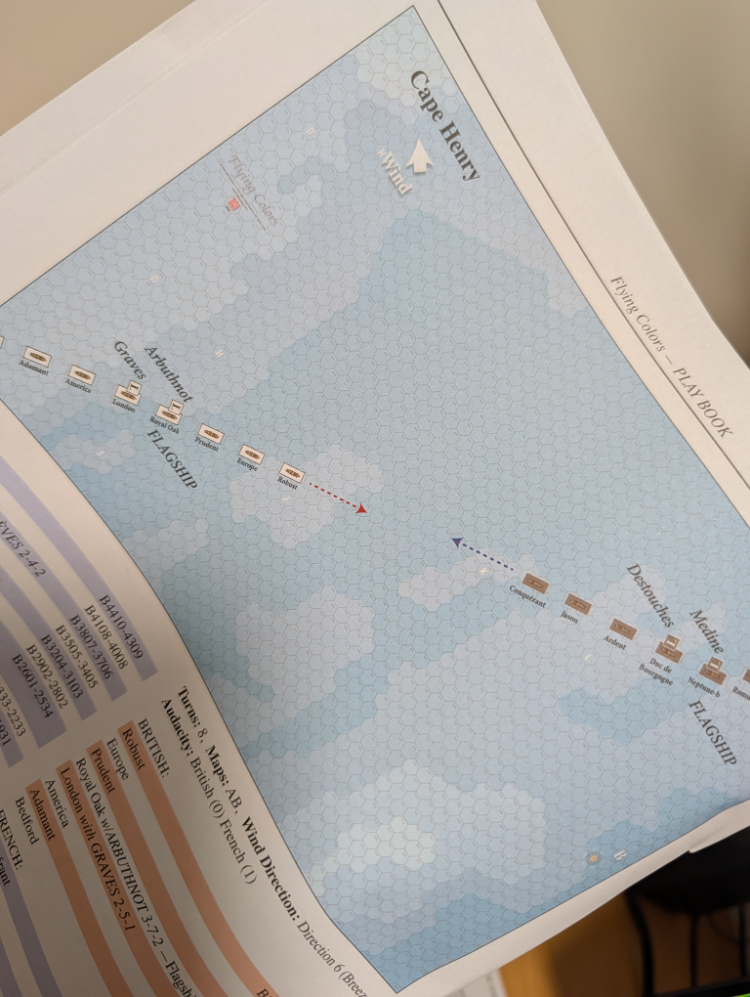
This is a game about fleet combat in the age of sail. Roy and I played the Cape Henry scenario, the 16 March 1781 encounter between British and French fleets near Cape Henry at the mouth of the Chesapeake.
In our replay, the French won, primarily by doing a better job of staying downwind of the other fleet. In this scenario, ships firing with the wind are penalized to the weather conditions at the time.
The game lets a lot of criticism about, for example, its command system, the lack of simultaneous movement, the ability of ships to fire two broadsides a turn, and the very restricted defensive fire. The number of markers can be a bit of a turnoff. All these are fair points. On the other side of the balance sheet, however, the game is accessible, fast, and at the fleet level gives a decent enough representation of some of the real-life issues. And, many of the criticisms can be dealt with by using roster sheets and house rules, especially importing ideas from some of the other games on the topic.
Talking of which, I have my eye on Man of War by Stephen Newberg. Originally he published this via his Simulations Canada company, it’s due to be reprinted by Compass Games. This game has a simultaneous movement system that could easily be added to Flying Colors. Watch this space!
Finally, while this game was fun, it set me thinking that it’s a long time since I played Wooden Ships and Iron Men…