
I was on a trip to the UK in August so gaming time was severely curtailed. (However, I did pick up fresh supplies of new games!) The games I did manage to play included the following:
Advanced Squad Leader
Ran and I played played Burnt, Blue and Gray (WP15) again. We played it last month when my Germans failed to crack the defending American line. This time I asked Ran to take the German side and show me how an expert would win as the attacker. And that’s what he promptly did. The fact that one of my key bazooka shots missed and another failed, amazingly, to penetrate — due to Schürzen — made it somewhat easier for the Germans. Anyway, I took notes after watching a master in action and we’ll see if that helps me improve my play.
Combat! Eastern Front
This is the solitaire WW2 skirmish game system whose first volume I have previously played. This is volume 4 and I primarily bought it because it looked as if the new designer was going to tackle some of the issues I had with the first volume, not least the rules. (Volumes 2-3 did not address the issues.) The new rules are much better. I still have some quibbles but this is a much more complete, enjoyable gaming experience.
I have been playing and replying the first scenario. It features a forest map. My forces are the Germans trying to eliminate and break through a line of Russian troops in the early days of the Eastern Front campaign. It’s hard to win the game — as it should be. I haven’t played it enough to be able to comment authoritatively on play balance, but so long as playing the game is fun and delivers an engrossing narrative, that’s enough for me. It delivers.
One of the nice features of the new game is that it has a rule for each side’s confidence. It’s a sort of morale tracker so that the more losses each side takes, the less keen they are to engage the enemy. Again, I have only scratched the surface here, but this addition is very welcome.
One other excellent change in this volume is now you can play either side in a scenario.
It also appears you can retrofit the rules to the earlier volumes though I have yet to try that.
In short, this is a much more mature product than the original Combat! and is likely to regularly appear on my gaming table.
Flying Colors
This is a game about fleet combat in the age of sail. Roy and I played the Cape Henry scenario, the 16 March 1781 encounter between British and French fleets near Cape Henry at the mouth of the Chesapeake.
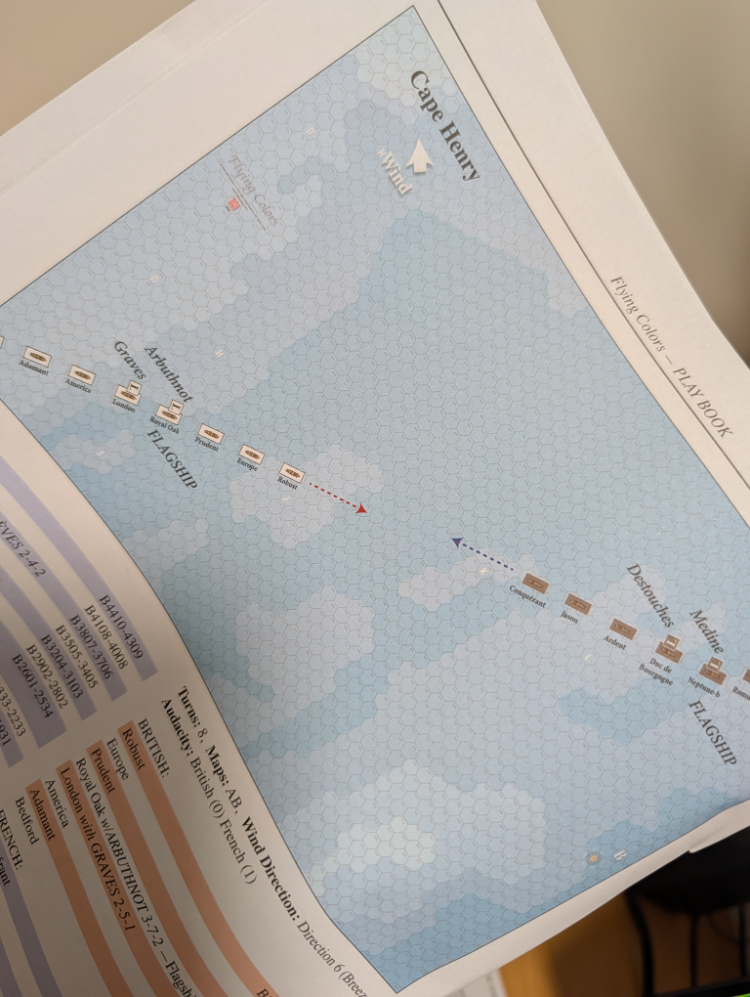
In our replay, the French won, primarily by doing a better job of staying downwind of the other fleet. In this scenario, ships firing with the wind are penalized to the weather conditions at the time.
The game lets a lot of criticism about, for example, its command system, the lack of simultaneous movement, the ability of ships to fire two broadsides a turn, and the very restricted defensive fire. The number of markers can be a bit of a turnoff. All these are fair points. On the other side of the balance sheet, however, the game is accessible, fast, and at the fleet level gives a decent enough representation of some of the real-life issues. And, many of the criticisms can be dealt with by using roster sheets and house rules, especially importing ideas from some of the other games on the topic.
Talking of which, I have my eye on Man of War by Stephen Newberg. Originally he published this via his Simulations Canada company, it’s due to be reprinted by Compass Games. This game has a simultaneous movement system that could easily be added to Flying Colors. Watch this space!
Finally, while this game was fun, it set me thinking that it’s a long time since I played Wooden Ships and Iron Men…