
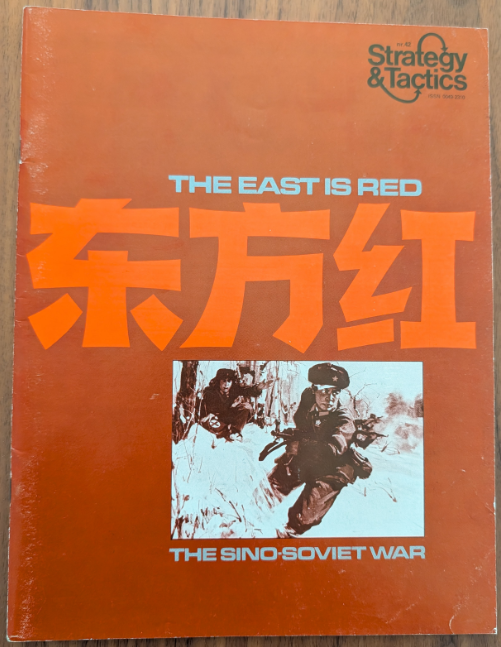
Date of publication (as given): January/February 1974
Context
- January 1974: Start of the three-day week in the UK due to the energy crisis. The Miami Dolphins beat Minnesota Vikings 24-7 in Super Bowl VIII, at Rice Stadium, Houston.The $6 Million Man starring Lee Majors premieres on ABC TV.
- February 1974: Playmobil toys debut at the Nuremberg Toy Fair. A bomb, planted by the Provisional IRA, explodes on a bus in West Yorkshire, England, carrying British soldiers and family members. Blazing Saddles, the Mel Brooks western comedy, premieres in California.
Game Included
The East is Red by James F. Dunnigan is a two-player game about a hypothetical Soviet invasion of China in the 1970s. Units are at the division and corps level. Hexes represent 50km of real terrain and each game turn is one week of real time. One distinctive feature of the game is that it includes, as standard, rules for atomic warfare.
Within the theater of operations it is assumed that tactical nuclear weapons and atomic demolitions will be used.
For more information about the game, see here.
Articles
- Outgoing Mail – editors
- The East is Red – Stephen B. Patrick
The vulnerability of the Transsiberian Railway will pose a problem to the Soviet forces to permit them to actually wage prolonged war. However, the USSR is capable of using the seas, especially since China is not a sea power itself and cannot, therefore, threaten naval resupply except as the shipping gets close to port.
- Napoleon at Waterloo – Albert A. Nofi
By 1800 the French had charged four times. Losses on both sides were extremely heavy, but at the end Napoleon’s cavalry was pretty much useless. Wellington’s cavalry was also more or less useless, having been expended in a series of countercharges, and his infantry was not in much better condition. Although no squares were reported broken, most were on the verge of collapse as a result of the heavy pounding they had received. The lack of horse artillery, beyond one battery which had somehow joined the charge, told on the French. With it, they might well have broken a number of squares. Without it, the cost of breaking squares became prohibitive.
- Sackson on Games – Sid Sacksom
- Pass in Review (book reviews) – Albert A. Nofi
- For Your Eyes Only – editors
SPI Games Advertised
- Deluxe Napoleon at Waterloo (no price stated)
- Sinai ($7)
- War in the East ($20)
- WW II ($7
Might Have Been
From Outgoing Mail, page 38:
The game in issue #44 will be Tank. This game will involve Tank-to-Tank combat during World War II…Tank, to give you fair warning, will probably be an unusual game. We are kicking around a number of rather radical game systems. The one that is currently a front runner for selection as the game system to be used relies upon a very different movement system. It is rather difficult to describe without actually showing it to you, but we’ll give it a try. Basically the one to five armored vehicles on each side will each occupy a hexagonal shaped area containing perhaps fifteen hexes across from one side to another. The actual playing board will be a much smaller area with each hexagon on the playing board representing one of the larger hexagons in which each side’s tanks actually maneuver. The actual playing board will be called the control board. The large hexagonal shape board will be the maneuvering board. A tank’s position will always be shown on the control board. That, in effect, will be its strategic position. Its tactical position will be shown on the manever board. We will have to use an as yet undefined system to show the terrain features on each of the many control board hexes. Each of the control board hexes, again, represents the much larger maneuver board hex. This system, hopefully, will allow for the sometimes substantial range differences between tanks, although we are aware of the fact that most tank battles occurred at under 500 meters range. The system just partially described makes use of control charts upon which each player keeps track of various mechanical functions for each of his tanks, such as current speed, position of turre[n]t, ammunition status, and the like. There is a lot more work yet to be done on the game Tank. In fact, it is not supposed to start, in theory, until January. But we usually get started on the design concepts far in advance of this.
Two points of interest. First, the version of Tank that was released bore no relation to the design described above. Second, note the emphasis on the design with no mention of scenarios.
On a Personal Note
This issue of S&T introduced me to the concept of gaming future, potential conflicts. The game, itself, was not of great interest and my recollection is that I hardly played it. The topic didn’t appeal to me. Also, the implementation – aside from the rules about nuclear weapons – had nothing novel.
I read the advert for War in the East knowing I had neither the funds to buy it nor the space to play it. By now I was realizing that if SPI kept up their output, I wasn’t going to have time to play all their games anyhow. As a gamer, that realization was depressing. I’m not sure I have ever recovered from it.