
The games I played included the following:
A Victory Awaits
This is an MMP publication of what was originally three separate Japanese designed and published games about Operation Barbarossa (the 1941 invasion of Russia by the Germans).
Roy and I played the shorter (6-turn) scenario on the Smolensk map. (Even though I knew we wouldn’t get to finish it, it was the best way to get us both up-to-speed on the rules, the situation, and some of the strategic and tactical options.)
Roy’s German forces inevitably wiped out the frontline Russians, most of whom died in a pocket. The German panzer forces pushed on like the proverbial hot knife through butter. However, the task for the Germans is demanding, requiring a lot of terrain to be captured in the face of an ever increasing supply of defending Russians.
At the end, the Germans were threatening in the center but well out of reach of the key victory point cities. It was fun, though playing the Russians you have to recognize you cannot go toe-to-toe with the Germans; it’s a waiting game.
We need to work out how to do a complete game. Perhaps we’ll use Vassal next time around.
Sniper!
This is an old (1986) update of an even older SPI game about man-to-man combat in WW2. Each hex is 2 yards and each turn a few seconds.
Roy and I played a 1943 encounter between a German squad (with 3 machine guns!) and a USA squad, in the Naples countryside. It was a meeting of patrols.
When I was preparing the game, I realized why I hadn’t played it more before: the rules are not that long, but there are lots of exceptions and a few loose ends. I applied some house rules to make sure we could get through the session without any major problems.
The two squads bumped into one another and there was an exchange of fire. Down went one of the Americans, wounded.
The Americans took cover in the heavy terrain, seeking to advance slowly into firing positions. The Germans threw a couple of grenades and kept up their defensive fire, wounding another American. The Americans moved deeper into better cover.
The game ended in a sort of stalemate. Although the Germans were well ahead in victory points, neither side was budging from its positions, so we called the game.
While this was fun, the game’s poor ergonomics made play a bit of a drag. Each soldier has several ratings — initiative, panic, and combat skills and deficiencies — which you track on a roster, so there’s a constant switch between map and roster. In this way, as Roy pointed out, it’s like a miniatures game. It would be much easier with all the ratings on the counters.
The activation system is interesting. Each soldier has an initiative rating and activates if his side draws a chit that’s equal to or greater than the initiative. Also, each side may get multiple rounds of activation per game turn, depending on the activation chits drawn. In this way, you might get an advantage of seeing your opponent running out of activations. That having been said, if you keep your soldiers within sight of the squad leader, and that soldier has an initiative rating of 1, you’re going to be less restricted. That part needs work.
I doubt we’ll play this again, though if I could ever summon up the perseverance to create my own counters with all the information on them, and redo the activation, leadership, and panic rules, there could be a good game here. On the other hand, there are all these other games…
Barbarossa: Army Group North, 1941
This is one of a series (East Front series) of monster games at the operational level scale (5 miles per hex, each turn is 2 days, and units are divisions, brigades, and regiments) about the WW2 campaign in Russia.
The first scenario — neatly presented in a standalone card with combined map and setup details — is a solitaire training exercise to get you up to speed on the game’s basics: movement and combat. It does a good job. Also, the Playbook includes a detailed play through of that first scenario so you can see exactly how the game is played and check your rules understanding.
The second scenario, which I played twice covers the opening ten days of the campaign from the border to the capture of Daugavpils.
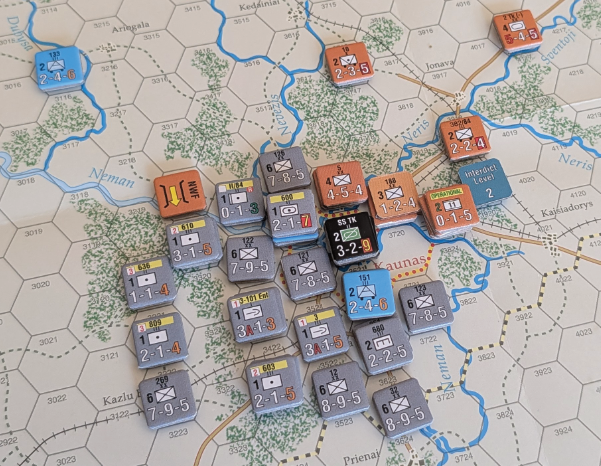
I would summarize the experience as follows:
- The rules are well written and comprehensive but they are long and detailed. There are many exceptions. You need to have the time to invest in learning the system.
- The example play through is a big help.
- The maps are gorgeous.
- The counters are clean, crisp, and easy to read.
- The player aids are excellent. However, I would have preferred the terrain effects chart to be on two pages with a larger font.
- There are lots of tricks and tips that experienced players will have picked up. So, my play will not have been optimal.
- The many scenarios are a blessing. You don’t need to play the campaign!
- The supply rules are so much easier than OCS. The airpower stuff doesn’t convince me it’s at the right level of complexity or decision making. The play, once you get the rules into your brain, is engrossing. The sequence of play is not symmetrical so you have to play differently according to which side you have.
- If you have the time and like the topic, this is highly recommended. This (or one of the other games in the series) will be on my table again.
Advanced Squad Leader
I played The Vital Hours (WO37), a September 1944 encounter near Arnhem in the Netherlands between British parachute forces aiming to force their way to their destination through a motley crew of second-rate SS soldiers.
The British inevitably ground their way forward but took casualties and couldn’t get to the exit point in time, giving me and my defending Germans a rare victory.
I also played Burnt, Blue and Gray (WP15), a July 1944 scenario set in France. I led a force of German Fallschirmjagers, backed by three StuG IIG vehicles, in a counterattack on bocage territory held by Ran’s forces (infantry, machine guns, and a couple of bazookas) from the USA 1st Battalion, 116th Infantry Regiment.
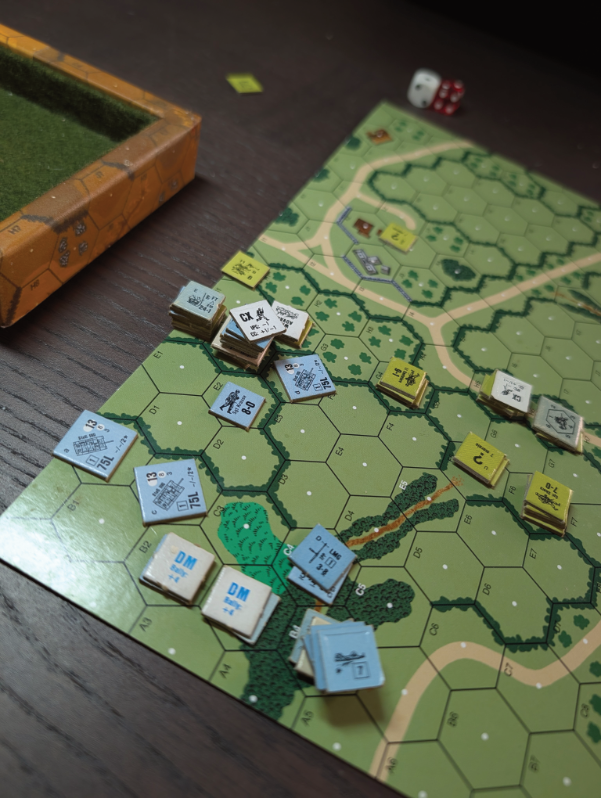
The short version of the story is that I focused my attack on one wing and didn’t make enough ground. This allowed Ran to bring all his previously strung out defenders into play and bottle up my spearhead. We called it ahead of time as it was plain the defenders would easily hold the line.
Next time around I am hoping Ran will agree to play this again and switch sides so he can show me how I should have played it.
As I have said before, all part of my continuing (and losing) ASL education.