
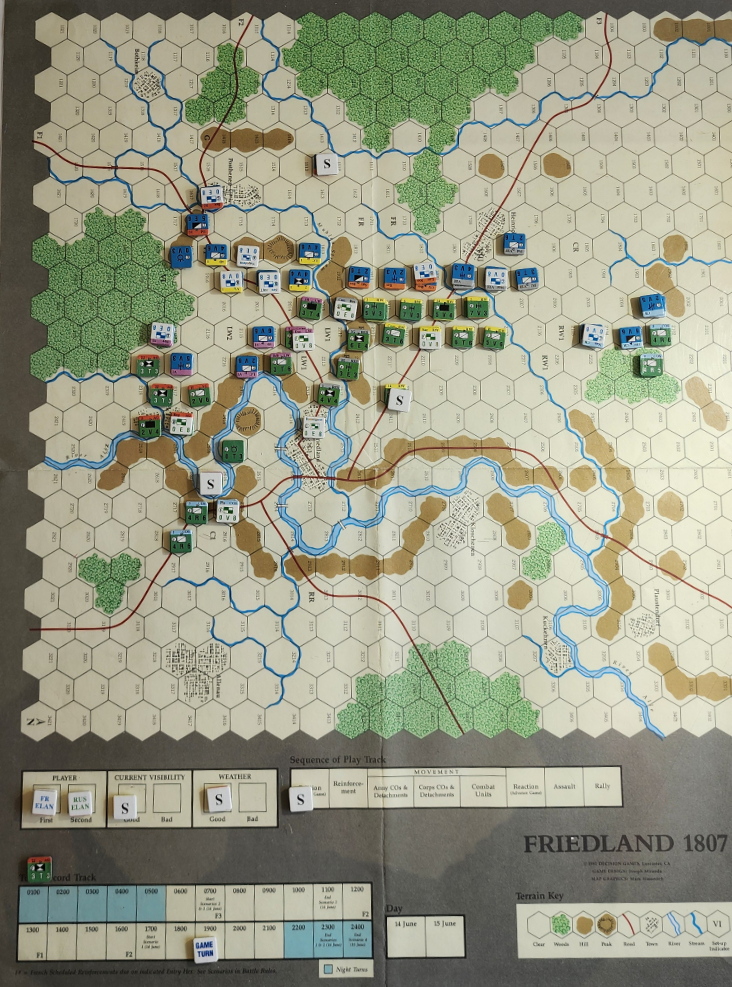
On my game table now is Friedland 1807, a division level game about Napoleon’s defeat of the Russians on 14 June 1807. No ground scale is given, but it appears to be about 4-500 yards per hex. Turns are one hour.
Designed by Joseph Miranda, this was the first (and only) of his Napoleonic Battles System games. The natural reaction might be to assume the short-lived series was due to Friedland being a bad game, but I don’t think that’s accurate. The first strike against the game was probably that it was published in Strategy & Tactics 151 alongside Vittoria resulting in the rules and charts for both games being intertwined. That made each game less accessible. The second strike against the game was that it uses some novel techniques, many of which reduce player control. In other words, the soldiers of your army don’t always do what you want them to do. The challenge of new systems and disobedient soldiers is a hard one for gamers to overcome! To add insult to injury, the rules were presented in a basic and advanced version. It would have been better to combine them into one standard system.
Let’s step back a moment and look afresh at the game. My thoughts are based on using the advanced rules apart from Fog of War. (More on that later.)
Each side’s game turn consists of:
- Friction
- Reinforcements
- Command Control and Movement
- Reaction
- Assault
- Rally
Before looking at the game turn sequence, some preliminary points:
- Each army has a disintegration limit which, if matched or exceeded, causes bad things to happen. The disintegration level goes up with casualties and can be reduced by staying out of action for a complete turn.
- Units have Engagement Zones (EZ) which seem to be Zones of Control, renamed. EZ are sticky, meaning that once in an EZ, getting out of it requires undergoing an attack from the enemy projecting the EZ.
- A common result of combat is disorder, causing a unit to flip to its reverse side. This makes it slower and less effective in combat.
Now, let’s look at each part of the game turn sequence.
Friction
You roll 1d10 and refer to the appropriate table to find out if any random event has occured. This may be a temporary ammunition shortage (which magically affects the whole army) a change to army morale, bad weather, and so on.
Reinforcements
Self-explanatory. Note that certain Friction results can bring on reinforcements one turn earlier.
Command Control and Movement
This is one of the core parts of the system. Each leader, from the army commander down, is rated as to his leadership: (A) Genius, (B) Good, (C) Standard, (D) Aggressive, and (F) Lethargic. To get a leadership result, starting with the army commander, you roll 1d10 on the Leadership Table and determine if the commanded leaders and soldiers do what you want (a Command result) or not (an Out of Command or Impetuous result).
For example, the French player starts with Napoleon. Being a Genius, he is going to give you a Command result 80% of the time. On that basis, he and all the French leaders within his command control range are good to go. Then, the French player rolls for any leaders outside Napoleon’s range and then any individual combat units out of any leader’s range.
This system highlights the difference in the quality of the leaders on each side. It also shows how dangerous Aggressive leaders can be as an Impetuous result forces the involved combat units to move adjacent to the enemy. Once adjacent, it’s not so easy to get free.
Reaction
This is where the opposing side gets to go. There’s lots of neat stuff here. First, reaction is subject to a roll on the Leadership Table. Second, there’s a neat optional rule that make Reaction checks mandatory. Why? It allows those Aggressive leaders and Impetuous results to throw a spanner in the works of both players.
Assault
There’s more innovation here. There are six combat results tables: one for artillery, two for cavalry (probe and charge) and three for infantry (skirmish, linear, and column). Combat is, generally, driven by the strength of the attacking force and the terrain, with many of the results requiring a morale check. Combat units are rated, in decreasing order of quality, as one of elite, veteran, trained, or rabble with a matching decrease in the chance to pass a morale check. The results are not your typical DR, DE, and EX. Instead, you get an alphabet soup of results including C (counterattack), P (pursuit – when cavalry can be deadly), and H (heavy cavalry charge). After a few combats, they are easily assimilated.
Note:
- Out of command units can assault. I assume that’s to avoid even more die rolls, but if you think it’s more realistic to require them, it’s an easy fix.
- Only light infantry may use the skirmish combat results table (CRT). However, there’s no restriction on the use of linear or column CRT. So, every gamer is going to pick the CRT which gives him the best chance of success. In reality, much would be dictated by doctrine. As a generalization, that means the French attacking using the column CRT. But the game gives them complete freedom which may be unrealistic.
- The system includes Elan counters which each side can spend to speed a unit’s movement or enhance a combat. The French do better when using Elan for the column CRT, so maybe that goes part of the way to counter my criticisms about doctrine.
- Artillery can blow away entire divisions, even at long range – up to three hexes. This may happen too often for comfort. I implemented a house rule which restricted such results to point-blank combat only.
Rally
In this part, you get to try and rally your disordered or shattered units.
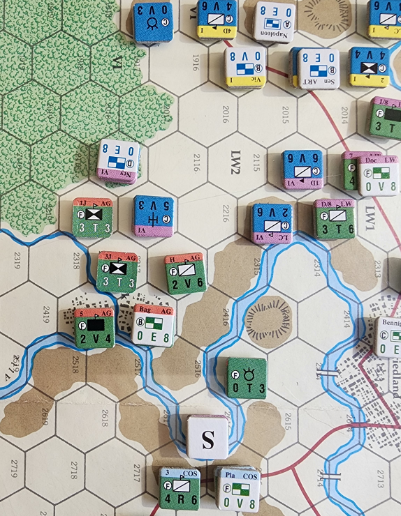
So, how does it play?
My overall conclusion is that this game is a wee cracker – something of an overlooked gem. Like all games, it has its faults, and the packaging alongside Vittoria surely doesn’t help, but perseverance brings good rewards.
I should also say that the rules are in better condition than I initially thought. There are some rough edges, but nothing critical. For example, it appears each side is supposed to have the possibility of gaining more Elan markers from the Friction Table, but the results are silent on this. As another example, engineers can put up pontoon bridges, but the rules are silent as to whether the engineer can move in the turn of creation. I don’t like how artillery all on its own imperiously defends against waves of cavalry charge. Also, the ability to (apparently) rally while still in an EZ doesn’t ring true. Even at this scale, I would expect some units to need to withdraw to recover. A house rule could fix that.
The command and control system, albeit there’s a lot of die rolling going on, does a pretty impressive job of replicating many of the issues the real combatants faced. The French are swift and decisive, but every so often, things go awry. In reverse, the Russians are unreliable, but can often spring a surprise. The lack of player control is good.
The combat system is unlike anything I have ever seen before. The absence of any combat ratios sure takes some getting used to. My hesitation in accepting the whole shebang is because my play generated one or two unusual results. Overall, the design for effect approach works reasonably. But I cannot help feeling that a 2d6 version of the combat results table would be an improvement. Also, while there is a rule about artillery fire being more effective against infantry if the artillery is stacked with cavalry, I’m not convinced the full scissors-rock-paper interaction of the three combat arms of Napoleonic times is shown here. Quite how that could be done at this scale is not obvious to me. At least you get some of the flavor.
So far as I can tell, the Friedland map scale is about 4-500 yards per hex. The closest development of the system seems to have been to treble the scale and go forward into the later part of the 19th century. The games Empires at War (here) and Chancellorsville (here) use much of the core command ideas. That makes them appeal to me. (I only have Chancellorsville & Plevna.) However, the combat system in these games is very old school and that is a big turnoff. One detail: the Empires at War command rules introduced an ‘F’ result meaning that the affected units had to fall back. That, I very much like. However, fitting it into the current 1d10 structure would be a struggle because it would probably happen too often to be realistic.
Summary: I have enjoyed my time with Friedland.
Fog of War
I am playing solo, so I didn’t attempt the fog of war rules. However, they look like they could be fun. Units are stored on a display off-map. Each counter on the map may represent a major force or a detachment. Depending on the visibility, you may try and see what is out there. When seen, the combat units are deployed on the map.
Dreams
If I ever get to meet Joseph Miranda, I would want to ask him why this series wasn’t continued. And, I’d love to understand the logic behind the different combat results tables. It will never happen, but I would love to create a new game using a 2d6 version of the tables – both CRT and command. I wonder if this would work for the American Civil War…
Why Now?
Why am I playing and writing about a game that is over 30 years old? Having retired, I now have a bit of time to scratch my gaming itch by playing some of the games in my collection that I have either never or barely played. (I won’t be able to play them all. Too many games. Not enough time!) I am also giving particular emphasis to looking back at my Strategy & Tactics magazines, but in no particular order) knowing that many of the games there got short thrift for one reason or another. SPI games should get some coverage to as befitting the S&T publishers. If I can keep going, there will be more of this type of blog post in the future.
Tip of the Hat
My thanks to fellow gamer John Forgy. John supplied me with a scan of the rules that allowed me to put together a set without any Vittoria material. That made assimilating thge rules easier. And our email exchanges helped me to focus my thinking about the game, play it extensively, and write about it.