Antizionism is a hate movement.
This initiative has gained traction and is worth following and supporting.

Antizionism is a hate movement.
This initiative has gained traction and is worth following and supporting.
The games I played included the following:
I played The Middle Gate (Thermopylae) scenario from Expansion Pack #6 which presents an overwhelming Persian force with about half the number of opposing Spartans, behind ramparts, featuring a vulnerable flank that can be marched around.
The Persians did the flank march and, despite suffering high casualties, secured the flags (victory points) needed for the win. The final score was 10-6 so the Spartans were well out of touch.
It’s difficult to see how the Spartans can hold out here, especially if the cards aren’t there for the required counterattacks. Both sides had turns where the available cards were useless. I’m thinking of using a house rule to overcome this, such as allowing each player to be able to use any one card as a single unit activation (anywhere on the board) instead of whatever it says on the card.
All of that having been said, it’s a long time since I’d played the system and I enjoyed it much more than I remember.
I continued playing the Naktong River Campaign from the Korean War in this top-quality solitaire game system. I completed missions 4 and 5 successfully.
I played First Dance (AP228) again, an early war encounter in Belgium between French and German mixed forces of infantry and tanks. The French enter and set up a defense line. The Germans enter and try to break the line.
The Germans lost two key carriers and troops in the first turn and that decided the game, although we kept playing. The Germans made progress but they no longer had the troops required to capture the objectives. The French tank reinforcements are virtyually invulnerable.
A difficult scenario for the Germans, but that maybe only because it was me!
A sophisticated, two-player, worker-placement euro game with a theme about two clans vying for supremacy in technology and trade as the Portugese bring western ideas into Japan.
You play your workers to choose actions and some actions generate more actions or resources which you can use to generate more actions or resources and so on, each player vying for the best victory point score. Of course, there are multiple ways to attain (and calculate!) victory points.
It was too complicated for my taste. (I don’t mind complicated games but in an abstract game the complication has to bring something to my enjoyment. If not, as is the case here, it feels like complication just for the sake of it.)
The game uses a lot of icons to avoid language and eventually I became familiar enough with them, so it gets a pass there.
However, there’s one nuclear option that allows the opponent to screw with the available actions. I seriously doubt the play-balance of the game because of this.
I also didn’t like the use of color: there were 1,001 colors in use, or so it seemed, creating an obstacle to understanding the game.
In short, although I played it twice and tried hard, I didn’t like it. YMMV.
Part of a series of solitaire games, this one features US (player) versus German (system) soldiers battling it out in WW2 over a range of scenarios. The rules were lacking, but eventually I cracked the code.
The graphics put walls and hedges in the middle of hexes and that doesn’t work for me. It’s like a perversion of Schrödinger’s cat where the soldier in a wall hex gets the benefit of the wall no matter from which side he is attacked! I applied my own house rule to put the soldier on one side of the wall or hedge.
I don’t think it compares favorably with Ambush because of the design decisions, but it’s a brave try and I’m probably going to invest some serious time in exploring the system and scenarios.
One main criticism is that, for the most part, the system gives the German soldiers orders without any regard as to whether they can see the enemy. Orders are, instead, given based on the soldier’s morale. This can produce surprises as well as strange results. And that may be a fair reflection of the chaos of combat. Alternatively, it may be that more logical action choices should sometimes be taken.
I am still enjoying the game because it does generate a decent narrative. However, because of the stated issues, I am thinking about creating my own version of the solitaire system. There is an updated version that has allegedly made some improvements, and I’ll try and get a look at that.

As the Times of Israel reports here:
National Security Minister Itamar Ben Gvir posted a video on Wednesday in which he is seen taunting activists from a Gaza flotilla intercepted by Israel, immediately sparking an international outcry.
Dozens of activists can be seen in the clip forced to kneel on the ground, with their hands tied, at an Ashdod port facility where they were being processed ahead of their likely deportation.
Those aboard the flotilla intercepted by Israel earlier this week included Italian and Spanish nationals, whose governments said they would summon the respective Israeli ambassadors in their countries for a reprimand over Ben Gvir’s behavior. Prime Minister Benjamin Netanyahu issued a rare rebuke of the far-right cabinet member he appointed, insisting that the national security minister’s conduct was not in line with Israel’s values.
The detained activists are criminals because they tried to break a legal blockade. I have no sympathy for them. If their conditions are not Hilton-level hospitality, that’s tough. But what Ben Gvir did was stupid and unnecessary. It achieved no good. (Well, I’ll come back to that.) It certainly caused Israel harm. The man is a racist, a buffoon, and a disgrace to the country. I despise him. I wish he were gone.
That brings me to the next point. As much as Ben Gvir did the harm, Bibi enabled it by appointing him to the government. Bibi knew what Ben Gvir was, but Bibi’s personal needs — staying in power — were more important to him than the needs of the country. In a responsible democracy not only would Ben Gvir resign, but so would Bibi. Of course, neither will, which says everything about the lack of principles and professionalism in our blasted government.
The second point is to explain why Ben Gvir acted like this. He knows it’s wrong. However, his voters love it. They very much enjoy seeing Israel’s enemies not only beaten, but humiliated. (The same principle drives his death penalty obsession.)
If an Israeli and an Arab fight, for example, a judo contest and the Israeli wins, what should he do? He should shake hands with his opponent. He should be gracious in victory (and defeat). If his Arab opponent refuses to shake hands, that’s on him. The world looking on will form an opinion. If the judo fighter were Ben Gvir, he wouldn’t offer to shake hands. He would laugh, gesticulate, and do his level best to humiliate the losing opponent. Guess what? The world looking on will form an opinion.
The final point about this tawdry episode is that it also highlights that a universal suffrage democracy is not a perfect system. Everybody gets one vote, but not all votes are cast by principled thinkers. Some of the population are like Ben Gvir. They like to lord it over beaten enemies. So, they vote for Ben Gvir. And, so the circle continues, that’s why Ben Gvir acts the way he does. I don’t offer this observation as a precursor to damning democracy, but instead to remind us all that it has its advantages and disadvantages.
I suspect, but this is pure speculation, Israel would benefit from moving away from a countrywide proportional representation system to one with constituents. That should dilute the Ben Gvir rabble enough to enable better quality candidates. And, yes, I recognize this is not an objective observation; it’s purely subjective and prone to bias.
I thought about how to punish the flotilla criminals. I posted this on X:
As for a suitable punishment for the flotilla members, I suggest they be sentenced to 21 days hard labor working to help deliver aid to Gaza. Let them schlep crates and sacks for three weeks and actually deliver aid!
If you have any better ideas, do share them!
Note: this is a spoiler-free zone!
When I was younger, my main reading interest was science fiction. In the last couple of decades, I’ve been less successful in finding sci-fi that I wanted to read. I have a subscription to Locus to keep me up to date. In essence, most of the reviews convince me that the book under review is not for me. But, every so often, I pick up a couple of hints and take the plunge.
The first book I’ll mention is a Locus find: Murder by Memory by Olivia Waite. This is a novella (101 pages) containing a comfy murder-mystery set in space.

The action takes place on an interstellar generation ship. One of the ship’s detectives, Dorothy Gentleman, wakes up in someone else’s body just as a murder takes place. The important detail is that the passengers can avail themselves of a storage facility for their minds between awakenings. However, it seems that not only has there been a physical murder, but also someone is deleting minds from the storage.
I say it’s a comfy story because it’s reminiscent of one of those TV mysteries where the violence is largely subdued and although a murder has occurred, people are polite, chilled, and going on with their regular lives. That’s the score here.
The writing is pitched well as it tells the story without too much unnecessary embellishment and presents the neat solution with confidence and style. In short, I liked it. However, while I knew beforehand it was a short read, near the end I was frustrated that there wasn’t more. Some of the ideas presented have great potential for lengthier, more detailed tales and I hope the author returns to the setting again. I would recommend this if you like short, straightforward stories and can handle a science-fiction setting.
That was the small read.
The big read is To Sleep in a Sea of Stars by Christopher Paolini. This is an 800+ page doorstop of a space opera novel. It’s at the opposite end of the scale to the small read. It didn’t come to my attention because of a Locus review. I saw it in a bookshop in London last year and liked what I saw.

The story revolves around a female character, Kira Navárez who finds an alien relic on an uncolonized planet and all that happens after that encounter. The mix includes aliens, battles, war, and politics. There’s also a love story or two and a veritable feast of future technology and cracking ideas, most of which are really cool and interesting. To put it another way, the book is packed with good stuff.
Another positive is that the main character is sympathetically drawn and believable, doesn’t totally hog the spotlight, and is aided by several good quality supporting members of the cast.
On the other side of the coin, while there’s no doubt this author can write beautifully, sometimes there was just too much description and a hint of repetition, none of which seemed to me to bring anything of great value to the story. Given the history of how the book was created (told in an afterword) I wonder if the editorial team were told to go easy on the writing. If so, that was a mistake.
It’s a good book, but not great. It cannot match Banks, but it suggests the author might achieve that in the future, if guided appropriately. It’s worth reading, especially if space opera is your thing.
I previously referred to the Perfidy of Amnesty. Their continuing bigotry has been brought to my attention by the indomitable Elder of Ziyon in a post entitled Amnesty proves it is antisemitic, again.
I encourage you to follow the last link and read the post on the Elder’s site. For those who want a summary, here goes:
Amnesty tweeted about a Holocaust survivor:
Right now, Holocaust survivor Stephen Kapos is at the Nakba Day demonstration in London. The 88-year-old has attended almost every demonstration in the last two year’s protesting Israel’s genocide in Gaza. Stephen stands and sits with family and members of his group the ‘Holocaust Survivors & Descendants Against the Genocide in Gaza’.
The Elder pointed out:
Amnesty-UK is publicizing a child Holocaust survivor who marches in anti-Israel demonstrations, calling the Gaza War a “genocide.” The only reason they want to promote him is to make the point that as a Holocaust survivor, Kapos knows what genocide is and has a particular moral authority to be able to describe Israel’s actions as the most heinous war crimes.
But if Holocaust survivors have a unique perspective on genocide – and they do, having survived the paradigm of all genocides – then what about the 99.9% of living Holocaust survivors who support Israel, and who recognize Hamas and October 7 as being the closest modern equivalent to Nazis? If Holocaust survivors have an important perspective on the matter, why is Amnesty ignoring the feelings of nearly all of them and promoting a fringe figure among them?
From this, the Elder (rightly) concludes that Amnesty doesn’t think most Holocaust survivors’ opinions are important. I agree. How arrogant is their attitude? How bigoted is it?
The Elder makes two particular points following this.
First, Amnesty means that the other Holocaust survivors who support Israel are — by Amnesty’s logic — supporting genocide.
Second, by promoting Kapos above the majority of other Holocaust survivors, they are clearly using him as a prop. If they cared for Holocaust survivors, they would instead quote the others who would tell Amnesty about Hamas, Hezbollah, Iran, and the Houthis who want to finish Hitler’s job.
And, as I don’t want to lessen the impact of the Elder’s closing words (with which I wholeheratedly agree) I set them out in full here:
To Amnesty, the Holocaust is not a lesson for them to learn from. It is only a lesson for its victims and their descendants. It wasn’t a genocide, exactly, but a giant classroom for Jews to learn to behave themselves and not act like Nazis. The rest of the world, the world that let the Holocaust happen, are now the judges that determine whether Jews fighting for their lives are crossing the line or need to be taught Remedial Holocaust 102. To Amnesty, the Holocaust is a prop meant to be trotted out when it is convenient for them to hurl the most hateful accusations against Jews and then use fringe, mentally ill Jews as a cover to protect themselves from being accused of antisemitism.
No one else can be compared to the Nazis but Jews, in Amnesty’s universe.
This tweet, alone, exposes the cynicism and hypocrisy of this supposedly “human rights” organization. And, yes, the implications of this tweet are pure Jew-hatred.
This is not imaginary. This is real. This is a once worthy human-rights organization that is clearly engaged in naked antisemitism — repeatedly. Their brand is poison and should be shunned forever.
This month, the games I played included:
Today I had one of the worst experiences of my life.
I went to the funeral of the six-month old baby grandson of some friends.
My tears flowed freely. And as I was there, to do the only meaningful thing I could do to help, to show support for the family, I recognized that as hard as it was for me — and all the other mourners gathered there — it had to be almost unbearable for them. I cannot begin to imagine their pain and suffering.
Based on my own experiences, mourning for a loved one is a personal, individual pain that transcends physical limitations. It swamps you with darkness. It impacts your thoughts about life and the future while sometimes necessitating a pause for breath before returning to mourn some more. You think of things you might have done differently. Regrets gnaw you. Guilt lurks in the corner.
Eventually, one hopes, the pain will lessen. But it rarely disappears. And life goes on. Pain is a key part of being human.
I’ve had my bike (a Trek full-suspension mountain bike) for around 20 years. Today, it died: one of the clips holding a gear cable in place snapped off, leaving a great big hole in the frame. Without realizing the extent of the damage, I took it to the bike shop. The mechanic there said it wasn’t worth repairing because — even were a repair possible — once the integrity of the frame has been compromised, the whole frame could collapse at any moment. It was a sign: time to move on. Now I need to look around for a new bike.
Postcript: I took my bike from the storage area where it’s kept to the garbage collection area. Just moving the bike that short distance was enough to crack the frame completely. A close escape.

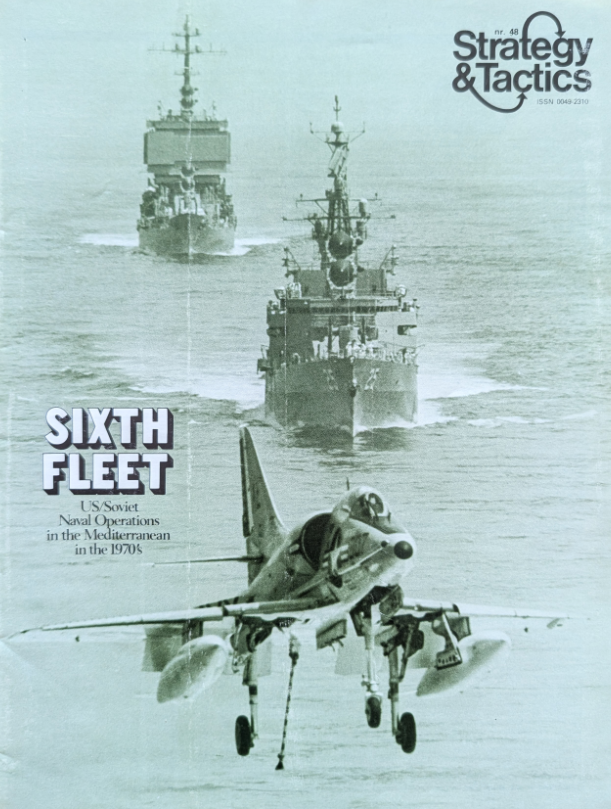
Date of publication (as given): January/February 1975
Sixth Fleet by James F. Dunnigan is an operational level game about naval warfare in the Mediterranean Sea in a hypothetical scenario in which the Cold War goes hot in the late 1970s, pitting the forces of the NATO Alliance against those of the Soviet Union.
For more information about the game, see here.
Ever since we’ve been conducting Feedback surveys, we have found about 1% of our subscribers are women. Additionally, from time to time, we have had women gamers come by SPI. Usually just to buy games. In addition, one of our female staff members is a gamer. There are any number of reasons put forward as to why the composition of historical gamers is 99% male and 1% female. We would like to hear the viewpoint of the women gamers. We appreciate hearing from women gamers, either in writing or, if you’re in the New York area, in person. Since the subject matter of historical games affects all people, male and female, we would like to explore ways in which we can make historical gaming more accessible to women.
One thing that is certain about any future naval struggle in the Mediterranean is that the main destroyer of ships will not be other ships, but aircraft. As in the Second World War, ship-to-ship combat will only take place when environmental or tactical conditions prevent one side from placing aircraft in the area. The fact that airpower controls the seas was demonstrated in 1939-1945 and it is even more decisive today.
There is no telling what Germany might have produced if it had not been for the Allied strategic bombing campaign. Speer guessed that, while the damage done by bombing in 1943 was nil, the loss in 1944 was in the neighborhood of 30 to 40%. In spite of this, while the Allied bombers wrecked more and more factories, German war production went up. In July, 1944, when nearly 100,000 tons of bombs were dropped on German-held territory by Allied strategic bombers, German war production hit its peak at a level that was more than three times the rate of production in 1941. Even at the end of 1944, armaments production was still at a level higher than it had been at the beginning of the same year. Strategic bombing dealt a death blow to the Geramn war effort, not by destroying the ability to produce weapons, but by wrecking Germany’s transportation system and ability to produce synthetic oil. So, the tanks and planes that were still coming out of the factories at the end of 1944 could not be delivered to the troops and could not be run very much anyway.
This issue was the first advert for the PRESTAGS (pre-seventeenth century tactical game) series: Chariot, Spartan, Legion, Viking, and Yeoman. I cannot remember why, but this generated no interest with me. Like 95% of the times when I decided to pass on a game, it was a mistake.
Tom Holland

Dominion is a book about Christianity and its impact on aspects of the modern world. It’s not a comprehensive history, instead focusing on what the author sees as the key moments in its development and spread. The author’s main message is to promote the idea that Christianity’s influence has been revolutionary throughout history. Indeed, the front cover of the paperback version has the subtitle The Making of the Western Mind. That’s quite a claim. I’ll come back to it.
To make his point, the author delivers a compelling narrative. It starts, not with the birth of Christ, but 500 years before in Greece. The story continues with that civilization’s clashes with Persia and then the Kingdom of Israel’s defeat at the hands of the Romans before Jesus makes his brief appearance followed by Paul and the rest of his disciples. This scene setting is one of the book’s strengths because comparing the world before and after Christianity highlights — thanks to the author’s commentary — the diverse impact it had and why.
Holland deftly weaves multiple strands together to form an interesting, engrossing, and informative read as he tells the story puctuated with terrific bits of trivia and nuggets that only a true master of the topic could know in such depth.
I have always been impressed by Holland’s grasp of the material he tackles, but reading this book increased my admiration for his ability and the depth of his knowledge. To give just one example, the following quote is from the part of the book where he discusses persecution of the Jews by the Christians.
Yet the backwardness of the Jews was not quite as manifest as the Church authorities liked to pretend. Unlike the Waldemsiand, they had a degree of erudition that put most Christians to shame. Aquinas was not alone in admiring the achievements of their scholarship. Even the pope’s own household had long been managed by Jewish administrators. As a pupil of Abelard had freely acknowledged. ‘A Jew, however poor, if he had ten sons, would put them all to letters, not for gain as the Christians do, but for the understanding of God’s law — and not only his sons, but his daughters.’
Now back to the claims about Christianity’s significance. Of course, I don’t have Holland’s expertise and I am nowhere near as well read. Therefore my opinion is of little value. But, for that little it’s worth, I wasn’t completely persuaded by his arguments. Almost, but not quite. However, that didn’t stop me enjoying every minute I spent in the company of his writing. It truly is a joy to behold and read.
This is an excellent book. Even though it’s not a detailed history, it thoroughly covers the elements that are included. (In other words, there are still plenty of details in the book.) So, it’s not a light read. On the other hand, the author does a great job of making his argument without — metaphorically — trying to bash the reader over the head multiple times to pay attention to the author’s message. In this regard it’s as much show as tell. You will find a lot to inform and enlighten you. Highly recommended.