Date of publication (as given): November/December 1974
Context
November 1974: Lord Lucan disappears, never to be seen again. The John Lennon single Whatever Gets You Through the Night goes to #1 in the USA. MLB Commissioner Bowie Kuhn suspends George Steinbrenner (New York Yankees owner) for two years after his conviction for illegal contributions to political campaigns.
December 1974: Jean-Paul Sartre visits Andreas Baader (Baader–Meinhof Gang leader) in prison. The Towering Inferno movie, starring Paul Newman and Steve McQueen, is released. Australian Evonne Goolagong Cawley beats Martina Navratilova of Czechoslovakia 6-3, 6-2 at the Australian Open Women’s Tennis to retain her title.
Game Included
Wolfpack by James F. Dunnigan is a solitaire game about the submarine campaign in the North Atlantic from 1942-44. The player, as the German U-boat commander, is trying to sink the maximum number of Allied merchant ships while trying to conserve the U-boat forces.
Coming:… in S$T 50, a game called Twentieth Century…The exact design parameters for The Twentieth Century game are still up in the air. In all probabibility, it will be a two-player game with a Multi-Player option. We have a rather novel game system in mind, but, since nothing is firm yet, we will wait until the next issue of S&T to give further details.
Wolfpack; The German Submarine War in the Atlantic, 1939-43 – Frank Davis
With a little help from their Italian allies, the Germans lost over 800 submarines during the six year war against Allied shipping. About 15,000 tons of Allied shipping was sunk for each U-boat lost. This is approximately two merhcant ships lost for every U-boat lost. While the Allies were able to absorb such losses, the U-boat losses proved too severe for the Germans.
World War 3; Potential for Conflict in the 70s – Stephen B. Patrick
…the Middle East. Here we have everybody else in the area arrayed against Israel. Israel easily outnumbers (in terms of ground combat strength) her immediate neighbors and enemies, Egypt, Syria and Jordan. The element that gives Israel a decisive edge is the qualitative superiority of her soldiers and their equipment, particularly tanks and aircraft. While the main confrontation is between Israel and all of the other Middle Eastern and North African states, one must not forget that between these states there are also long standing animosities which have only been temporarily put aside due to the confrontation with Israel. Once the Israeli issue has been settled, it is entirely likely that certain Middle Eastern and North African nations will turn their armed forces on each other to settle old (or new) grievances.
The Sackson on Games article featured some games newly introduced to the USA – including Election, and The Game of Nations – which I had been playing extensively and enthusiastically before starting my S&T subscription. After then, I barely played them again.
For as long as I have been gaming – and that’s a long time – the WW2 campaign in the east has been one of my favorites to refight. I have a Battalion Combat Series game (Inflection Point – The Battle for Kalach and the Battle of Chir) in the ‘to-be-played’ pile, but it’s a more complex undertaking than I was in the mood for. This meant that a purchase from my recent UK trip, Battles in the East 4: Mius River and Vitebsk, designed by Antony Birkett and produced by Decision Games, touted as part of an accessible game series, was more suitable. And so, it’s now on the table.
Each hex is 5-8km, each turn is 2-3 days, and units are typically regiments, brigades, or divisions. The system is a modern version of PanzeGruppe Guderian and similar games, but with a very neat supply system at its core. In essence, your units only work at full strength when in attack supply. This comes from your HQ units, and – varying from scenario to scenario and turn to turn – is a huge influence on the campaign.
For example, in the Mius River battle, in turns 1-5 the Germans may only have one HQ (of their choice) in what’s called Attack Supply (the best condition) and in turns 6-10, they may have 2 SS Panzer Corps HQ plus any one other HQ in Attack Supply. The Soviets have 5 Shock Army in Attack Supply in turns 1-3, 28 Army in turns 2-3, and 2 Guard Army in 2-4. After turn 4, no Soviet HQ are in Attack Supply. This means the Soviets have to make hay while the sun shines in the early turns and the Germans have to recover their lost ground in the later turns.
While the supply system is simple, it achieves much of what more complex supply systems try to do with far fewer rules and overhead. I like it a lot. It’s not perfect, but it works. Further, you can see how more subtle variations might be utilized in different designs. For example, there might be a game where each side, at the start of the game, has to predesignate which of its HQs are in Attack Supply in which turns. A player might be allowed to change his plan part way through the game, but at a cost in supply availability, victory points, or something else. As another wtist, the rules might limit each HQ to only being in Attack Supply for a limited number of consecutive game turns, reflecting unit fatigue. And so on.
The rest of the mechanics are straightforward: odds-based combat with shifts to reflect terrain and unit integrity (bonuses for keeping formations intact) as well as armor and anti-tank capabilities, leadership, and artillery support.
The physical production standards are good. It has one double-sided, mounted map with excellent graphics, a rulebook printed in color, decent backprinted counters, and play aid charts and tables. The rules don’t seem to have any major holes, though given this is the fourth outing, that’s as it should be. I found two small pieces of errata in the Mius River setup. One was an obvious typo and the other was an extra unit that had been omitted from the setup list.
So, a very playable game, at least superficially. Now I’m going to give it a go and see how it turns out in reality.
I spent some time fiddling around – and largely enjoying – Gettysburg: The First Day, designed by Steve Carey and published by Revolution Games. That game uses the Blind Swords system, meaning formations are activated by chit draws and some of these trigger random events that the players can use to interfere with each side’s plans.
There’s a lot to like: the rules are refreshingly short, the physical production is outstanding, and the game plays quickly enough. The two areas that give me cause for concern are (a) how the players are able to game the random events by sometimes deciding when and where fate strikes the enemy; and (b) how each brigade is automatically able to choose its orders every turn. I don’t know an easy way to fix these, so I need to have a think.
While pondering, I moved on to Last Chance for Victory, the massive game designed by the late Dean Essig and published by MMP about the complete battle of Gettysburg. There’s also a lot to like here: the system – called Line of Battle, now at version 2.0 – has a ton of detail, but once learned goes quite quickly. There are 20+ scenarios in the box ranging from small introductory encounters to teach you the basics of fire and movement, to multi-map campaign scenarios of the whole battle. What’s especially nice is that there are separate 1st day and 2nd/3rd day maps that mean if you are short of space you can still have a go at the bigger scenarios.
The physical production standards here are also good, albeit with one annoying defect: the maps faithfully (I assume) portray the slopes and elevation changes of the battlefield, with each height level represented by a different color. There is a color key, but it does not quite match the on-map colors. Sometimes, it’s hard to work out what level units are on, and what level intervening terrain is. The Blind Swords game by Revolution mentioned above does this much better with the simple addition of a number matching the height on parts of the slope line. It also doesn’t help that the line of sight rules are less than crystal clear. I think I am doing line of sight correctly, but I’m not sure…
Previously I have played the training scenario – Dogs of War – to start me off and then got stuck into the first day of the battle as it begins small and grows and the situation remains – despite me having gamed this situation hundreds of times in different systems – one of my favorites. I have read and reread Pfanz (Gettysburg: The First Day), Martin (Gettysburg July 1) and Gottfried (The Maps of Gettysburg) and am probably nowhere near a complete understanding of what happened all those years ago.
Fighting the first day of the battle has its advantages and disadvantages. On the plus side, you get to see the command system work because things will never go according to plan. However, to maintain a historical encounter, there are quite a few special rules to add to your load. It’s bearable, but if you prefer to avoid these, tackle the second or third day scenarios.
This time around, I redid the Dogs of War scenario to make sure I had the basics well assimilated, then decided to try the Flying Dutchmen scenario which deals with the CSA attack on 11th Corps north of Gettysburg town. The victory conditions demand that within the seven turns the CSA break through the Union defenses and exit 45 strength points of units from the brigades of Hays and Gordon. Breaking through is straightforward enough – the CSA have superior numbers and quality – but doing so fast enough and with low casualties is very challenging. It’s fun for the CSA player whose entertainment includes getting to use some cool sharpshooter units and beating up many low-morale Union units. The Union player has to skilfully defend, knowing that it’s unlikely the line will hold.
Hoke has taken Blocher’s Knoll while Hays and Gordon try to force a final breakthrough. Doles has departed, wounded.
I have played it through to a completion twice, but have yet to get a CSA win. The last occasion, I was a single strength point short of victory. Damn! I may try again.
One of the reasons I have this on the table is that there’s a version 3.0 of the Line of Battle system on the way and I wanted to remind myself of the strengths and weaknesses of the system. I am intrigued to see what will change. Meantime, if serious ACW tactical-level gaming is your thing, I recommend the system wholeheartedly.
Date of publication (as given): September/October 1974
Context
September 1974: first showing of The Rockford Files on NBC-TV. General Francisco da Costa Gomes succeeds General António de Spínola as President of Portugal. Scientists first report that freon gases from aerosol sprays are destroying the ozone layer.
October 1974: Frank Robinson becomes MLB’s first African-American manager, signing as player-manager for the Cleveland Indians. The Guildford pub bombing by the IRA leaves five dead and 65 injured. The Labour Party, led by Harold Wilson, wins the UK general election.
Game Included
Combined Arms by James F. Dunnigan is a game about combined arms land warfare from 1939-1970s. Each turn is an hour, each hex is 300m and units are companies and battalions. There are six scenarios running from Defense of the Vistula Bridges (1939) to the Battle of the Chinese Farm (1973).
Combined Arms; Combat Operations in the 20th Century – Stephen B. Patrick
Because of the need to be centrally located in order to take action, this meant that battalion commanders would often not see any of the fighting in a critical sector – the crisis would often be over for better or worse by the time he arrived. Consequently, reliance on radio messages became the rule rather than the exception.
Patrol; Modern Infantry Tactics, 1914-1974 – David C. Isby
In summation, one can say that the essence of infantry tactics is: stay under cover, dig in whenever possible, combine fire and movement to make effective use of terrain, advance from cover to cover. If possible, surprise the enemy, hit him where he is weakest, and shoot him in such a way that he cannot shoot you back.
Outgoing Mail – editors
Last year, more than half the historical games sold in this country were SPI games. In the first 6 months of 1974, we sold over 150,000 games. In each of the last three years, we have published more new games than were published by all other historical game companies combined in the past ten years.
Sackson on Games – Sid Sackson
Footnotes – everybody
Player’s Notes – Redmond A. Simonsen and John Michael Young
We also received an order from a prison administration a while back. They wanted a copy of Breakout & Pursuit. The request was legitimate, we sent off the game, but never heard what their reaction to it was, or in fact, why they wanted that particular game.
On a Personal Note
The information about SPI sales (see Outgoing Mail quote above) astonished me. The USA had to be full of gamers!
The game in this issue disappointed me. It may have been the decision to use generic counters – for example “Light Armor” units had different ratings (not printed on the counters) according to the scenario – or that I was growing tired of the cumulative disruption (D1, D2, D3, etc.) combat results system. However, over the years, it was also one of the few games I kept thinking about going back to.
The Moves advert on the back page of S&T 46 won me over. My subscription to that magazine followed shortly.
This year I was able to attend the Compass Games Expo in Meriden Connecticut which ran from 5-9 November. Based in the Comfort Inn and Suites, the playing facilities were good with plentiful tables and space, and lots of different games to sample. In addition, Compass ran a pop-up store offering its games at a substantial discount. In such a situation, it’s a bummer having restricted luggage capacity, but I did buy some of the games I wanted.
The convention noticeboard showing the available game demonstration and teaching sessions.
I invested my playing time mostly in MMP’s Great Campaigns of the American Civil War (GCACW) because it’s one of my favorite systems and I’ve only ever played it solitaire. The con was an opportunity to play, watch, and learn.
First up, along with Bruno, Jeff, and Marshall, I played scenario 7, the Virginia Campaign (the 1861 Bull Run campaign game) from All Green Alike, part of the Stonewall Jackson’s Way II game. At a fairly leisurely pace, we finished the 14-turn game inside two days, resulting in a CSA victory. (You should be able to guess which side I was on…) I don’t have any way of properly assessing how balanced the scenario is, but it truly didn’t matter to me as the focus was on playing the game and learning. Certainly the others seemed to know what they were doing! And it was good fun.
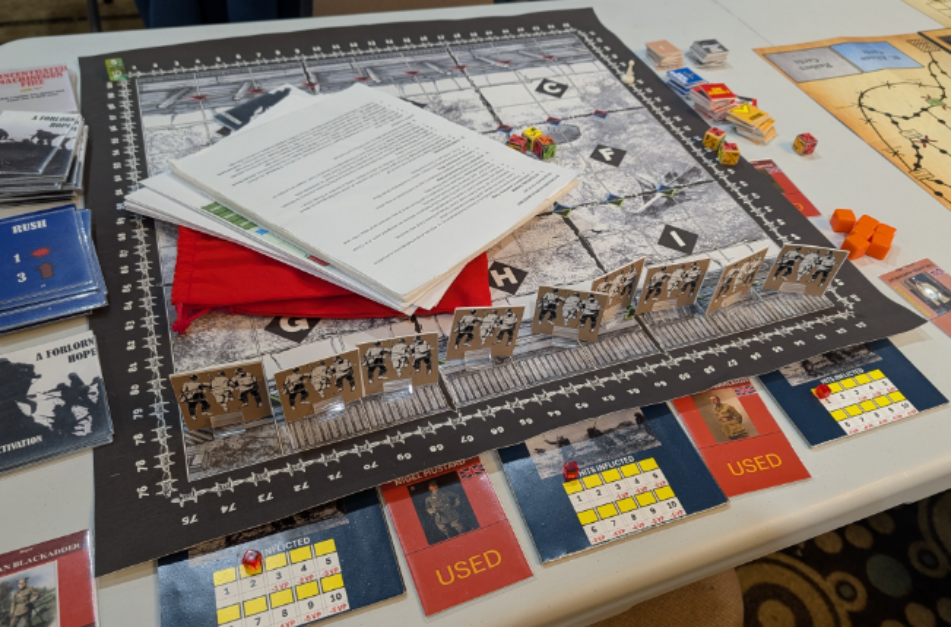
Before my next GCACW game, I played several turns of American Tank Ace – a solitaire game – because the game I had arranged never happened due to my opponent ghosting me, and I didn’t fancy any of the other open slots. American Tank Ace, a solitaire game about being a USA tank commander in Western Europe in 1944-45, was one of my Compass purchases and although the rules have several loose and stray ends, I persevered and the end result was worth the effort. I plan on spending some more time with this game.
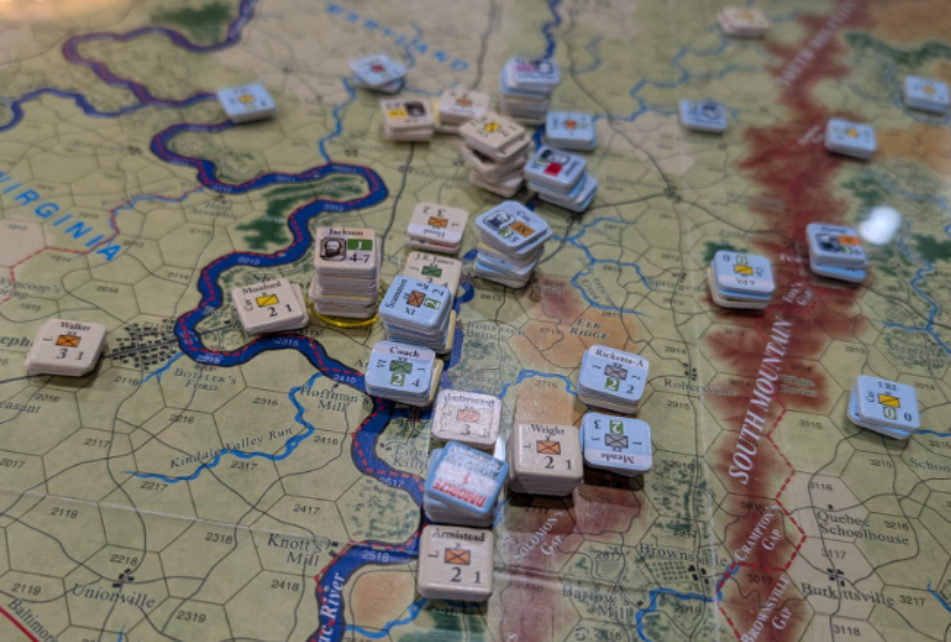
Second of my GCACW games, I played scenario 3, McLellan’s Opportunity (the time between South Mountain and Antietam) from Roads to Gettysburg II with Rob. This is a short 3-turn action-packied scenario. My CSA forces failed to hold back the swarms of Union soldiers. Rob’s analysis, which I think is correct, is that the CSA player has the harder task in the scenario as his forces are limited and any one mistake or bad luck in the initiative rolls can make a significant difference. The Union player, however, has plentiful forces and if one division is fought to a standstill, there are plenty more to get the job done. The CSA side can win, but it’s a tougher challenge. Regardless, I enjoyed playing the game and learned a lot.
It was a long way to travel to play games, but that comes with living in Israel. It was definitely worthwhile, despite the jet-lag. The gamers I played with were all courteous, patient, and willing to share their knowledge and I had a ball. It was wonderful being able to see all the other games being played in the flesh – from fifty-year-old classics to brand new unpublished designs – and chat to people about the games and the hobby. The experience has cemented my love affair with GCACW and I’m now going to make a concerted effort to play more of the series.
I stayed in the convention hotel. Let’s just say it’s basic, and if I ever get the chance to go to this convention again, I’ll probably stay elsewhere. It was clean and the staff tried hard, but the shower was less than brilliant and the breakfast uninspiring, and that’s being kind. The food options in the immediate area are typical USA main street fare and not fantastic. Thankfully GrubHub solved that challenge.
The main street in Meriden, where the action took place, isn’t especially picturesque, but beyond the town, Connecticut was beautiful. The autumn foliage colors were glorious. I didn’t do any touring there, but that’s definitely on the agenda if I return.
The Compass Expo is a good convention. I do hope I get the chance to go again. Thanks to Bruno, Jeff, Marshall, and Rob for helping make it such a good time.
Click on the following images to enlarge them.
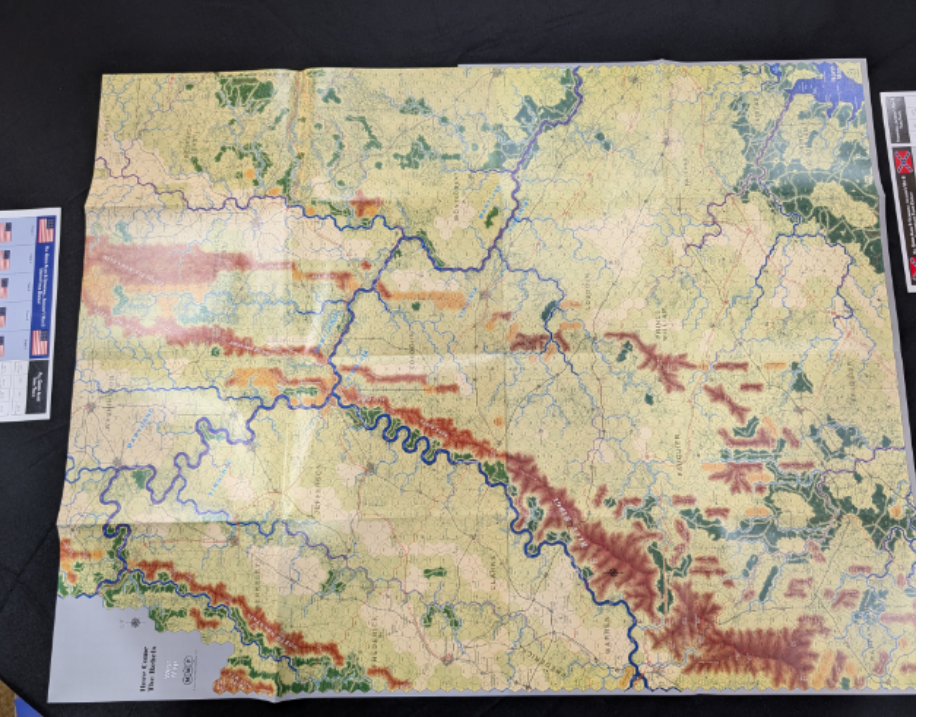
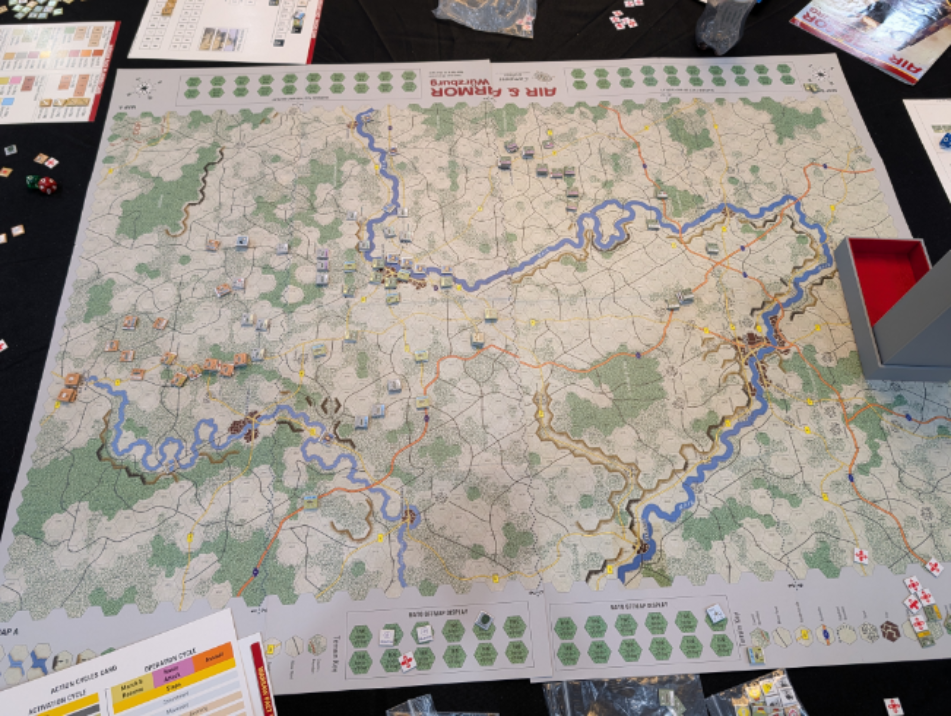
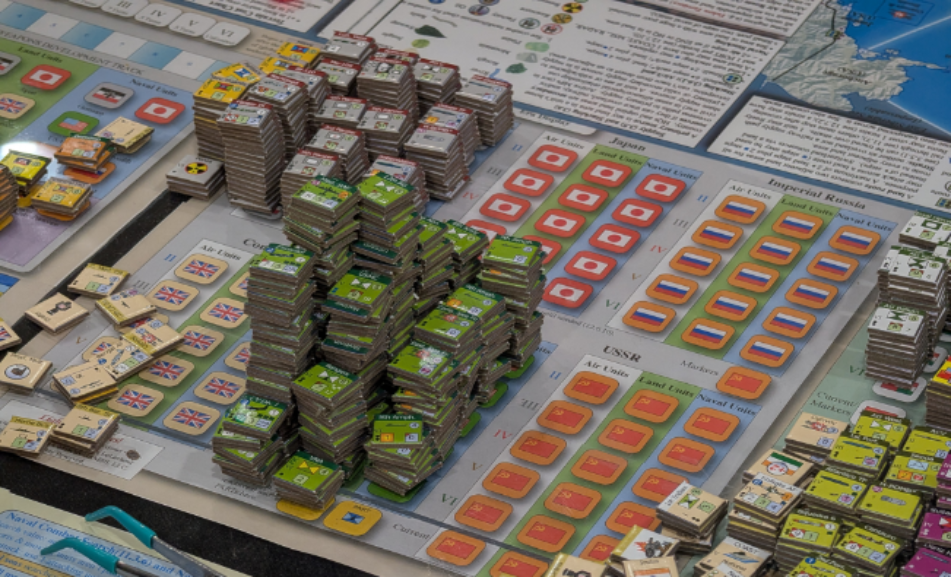
You only had one job…The convention hotelMaps for the campaign game I playedArdennes ’44Air and ArmorThe Emperor ReturnsNear the end of the McLellan’s Opportunity scenarioJohnston’s at start forces in the Bull Run campaignCrusade and Revolution – Spanish Civil WarCrown of RosesUnidentified wargame – possibly WW2 global?Closeup of counters from that worldwide game.Forlorn Hope – WW1 trench warfareCombat – WW2 solitaireA (forthcoming Wes Crawford?) game about the St. Albans raid during the ACWGrant – The Western Campaign of 1862
July 1974: West Germany wins the (Soccer) World Cup, defeating the Netherlands 2-1. Turkey invades Cyprus. The USA release of the film Death Wish (based on a novel by Brian Garfield) starring Charles Bronson and directed by Michael Winner.
August 1974: USA President Richard Nixon resigns and Vice President Gerald Ford takes the oath of office to become the 38th USA President. Zaheer Abbas scores 240 for Pakistan against England at The Oval. RCA releases in the USA Harry Nilsson’s tenth Album, Pussy Cats, produced by John Lennon.
Game Included
Operation Olympic by James F. Dunnigan is a solitaire game about the hypothetical USA invasion of Japan in 1945. Each turn is a week, each hex is 6.5km and units are regiments, brigades, and divisions. There is a two-player option.
During the last year of the war in which Japan lost one decisive battle after another, hundreds of thousands of Japanese had been sacrificed. If the Emperor prematurely agreed to surrender, these lives would appear all the more wasted. Thus, the war must be allowed to continue until Japan’s ruin became visible to all and the suffering caused by it had produced a popular clamoring for peace.
Science Fiction Futures – Stephen B. Patrick, John Boardman, and Redmond A. Simonsen
The real object is to reveal human behavior under stress – and the stranger the source of stress the better. The “weird” factor in science fiction is what lifts it above other genre writing in importance. It provides a unique esthetic distance from which the reader can appraise the characters and the situation. It enables the writer to arrange all of the background to focus attention on the main players. It can, and consistently does, carry the reader beyond the narrow defiles of his here-and-now reality set so that he can more successfully turn back and see his life. Science fiction is a way of looking at the past.
Outgoing Mail – editors
Footnotes – everybody
Sackson on Games – Sid Sackson
Pass in Review (book reviews) – Albert A. Nofi
Player’s Notes – Irad B. Hardy and John Michael Young
Just wanted to complain about Hardy’s (IBH) comments in the Civil War rules folder. Deesigner’s notes should explain the historical considerations utilized or reflected in the game system. However, Hardy’s suggestion that the Union player set up in odd-numbered hexes to minimize Command Control problems is an example of gamesmanship rather than historical accuracy.
On a Personal Note
My knowledge of the war in the Pacific was sketchy. I knew nothing about proposed plans for the invasion of Japan. This issue of S&T went some way to fill in in the gaps. Although the historical article’s focus was on the later stages, there was some useful material about how the participants got to that part. As for the invasion, while I was happy to play the game, I think I took it less seriously because – perhaps naively – I found it a highly unlikely scenario. No power could have resisted the force of the USA’s nuclear arsenal. Surrender was inevitable.
May 1974: Israel and Syria sign an agreement about the Golan Heights. In hockey’s Stanley Cup, the Philadelphia Flyers win the series 4-2, becoming the first “expansion” team to win the trophy, with Flyers’ goaltender Bernie Parent named playoff MVP. ABC Records releases Rikki Don’t Lose That Number from Steely Dan’s Pretzel Logic album.
June 1974: Yitzhak Rabin becomes Israeli Prime Minister, replacing Golda Meir. At the French Open, USA teenager Chris Evert beats Olga Morozova of Russia to win the Women’s title, the first of a record 7 French singles titles for her. Mean while, Sweden’s Börg beats Manuel Orantes of Spain to win the Men’s title, his first career Grand Slam title. The Provisional IRA bomb the Houses of Parliament in London, injuring 11 people, part of a renewed IRA campaign against targets in England.
Game Included
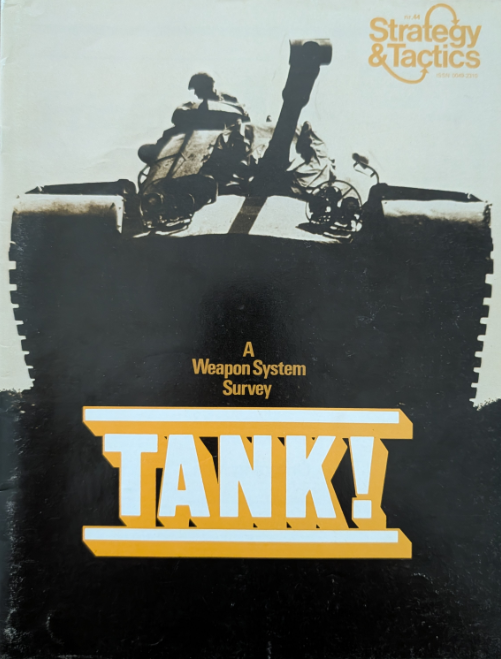
Tank! by James F. Dunnigan is a two-player game about armored combat in the 20th century with each unit representing an individual tank or vehicle or gun or infantry squad. Hexes represent 50 meters of real terrain and each game turn is “36 seconds to two minutes of real time depending upon the scenario played.” It uses pre-plotted simultaneous orders.
Oddly enough, if a tank was destroyed, the crew was not necessarily destroyed with it. In fact, the average deaths in the crew of a destroyed tank was only 1.3 men per tank for the war. Also, only 75% of all tank casualties occurred inside the tank. This goes to remind us that tank crews did not spend all of their time in the tank. In fact, they spent the majority of their time outside of the tank.
Sea War in the Age of Sail –David C. Isby
Throughout history, the sea has been the great thoroughfare for trade and communication. Small wonder that man, clever fellow that he is, took to fighting on the planetary sea not very long after he learned organized violence on land.
Shortly after the publication of The East is Red, we received a visit from a high-ranking Soviet diplomat, stationed in New York. He was interested in looking around, and also wanted to pick up a copy of War in the East. Unfortunately, War in the East was not yet ready, so we just showed him around. During the tour, we came across a copy of NATO, which was being played. We asked him if he’d like to get a copy of it, to which he replied, “No, I believe we already have that one.”
On a Personal Note
This was the first issue of my renewed subscription. The game had an expansion kit (more counters, rules, and scenarios) which subscribers had to apply for separately. I got mine from the UK distributor.
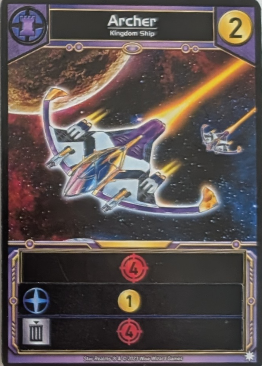
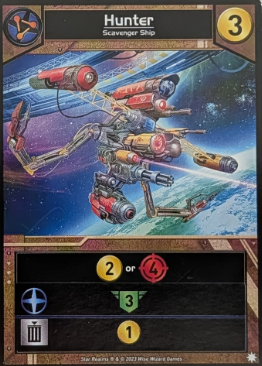
Star Realms is a non-collectible deck-building card game, primarily suited for two players (though multi-player is possible) with a science fiction theme and easy core mechanics. Each player starts with his own small deck and 50 authority (life). The first player to reduce his opponent’s authority to 0 wins.
This nifty device, making it easy to track your authority (life) comes with the game.
Card play provides resources, combat damage, and boosts to your authority (life).
You use the resources to buy new cards to add to your deck. But first, in general, they go to your discard pile and so take time to be available.
You use the combat damage to reduce your opponent’s authority.
You add boosts to your own authority, making it harder for your opponent to win.
In your turn, you may play all of your cards. At the end of your turn, played cards and purchased cards go to your discard pile, and you draw new cards from your deck. When your deck is exhausted, you take the discard pile, shuffle it, and that’s your new deck.
Most cards belong to a faction. Some cards have a basic effect and an additional effect that is available if you simultaneously play a card of the matching faction. Therefore, making your purchases has some strategic depth as you want to be able to trigger additional effects, but you also don’t want to focus only on one faction.
Some cards trigger an effect when you buy them. It’s important to also maximize these effects, but it can be tricky.
Some cards are bases and these, when played, stay on the table and continue to have an effect each turn unless your opponent destroys them. One type of base (outpost) even protects you by taking damage before your own authority is hit.
There are several games using the same key mechanics but with a different twist. This version is a campaign game of twelve scenarios with the following features:
Each player takes either the Star Empire or Trade Federation. Each starting deck is slighly different.
During play, you can upgrade your purchases and align them with your faction. This is done by applying stickers to your cards.
In each of the first four scenarios, you get a new set of upgrade stickers. In these scenarios you can also win by being the first to utilize five upgrades.
If your opponent wins four or more scenarios, you get one gambit for every victory over three he has. Gambits are typically one off benefits that reduce the cost of buying bases or add to damage of certain cards, and so on.
At a certain point random event cards are introduced. They do exactly what they say and tend to affect both players.
Roy and I just finished the twelve scenario campaign game of this Star Realms product. In the early scenarios, I built up a decent lead. But Roy was the clear winner in the second half and finally edged me out 11-10 in the final reckoning.
I suspect that, in a sense, I was penalized for being first to four wins as that gave Roy access to the gambits. They weren’t cards with big effects, but they were a definite advantage. By the time I got some, the pendulum had swung.
The events were not too powerful and added some surprise and variety to the game.
We enjoyed playing the game and it held our interest so that we were keen to complete the campaign. However, as Roy pointed out, once we had done the upgrades in the first four scenarios, the game seemed to lose its focus: there were no more new sticker sheets and the victory points available for being the first to upgrade 20 purchases didn’t seem much of an incentive.
The scenarios did a reasonable job of presenting a different type of game, but truly it’s all about how quickly you can kill your opponent. The exception is the last scenario. Spoiler alert! In the twelfth scenario, both players have to join forces to fight the Blob. The Blob uses different mechanics to generate damage against the players and there are some interesting challenges. That scenario, for me, was better than most of the latter half-dozen.
Basic Star Realms is fun. This version was also fun. It could have been better with a bit more work done on some of the scenarios, though. The physical quality of the game is very high. The rules are clear and easy to understand. I Have had more than my money’s worth because I played through to the end of the campaign. So, if you think you will manage to copmplete the campaign, I’d recommend it. Otherwise, not.
March 1974: 29 years after World War II ended, the last Japanese soldier, a guerrilla operating in the Philippines, surrenders. In China, farmers discover 8,000 clay warrior statues (The Terracotta Army) buried to guard the tomb of China’s first emperor Qin Shi Huang. At the Grammys, Roberta Flack’s “Killing Me Softly” wins the Best Record award.
April 1974: the Agranat Commission publishes its report on the Yom Kippur War. The Swedish Band Abba win Eurovision with their song “Waterloo”. Ray Kroc (San Diego Padres owner) tells fans “Ladies and gentlemen, I suffer with you… I’ve never seen such stupid ball playing in my life!”
Game Included
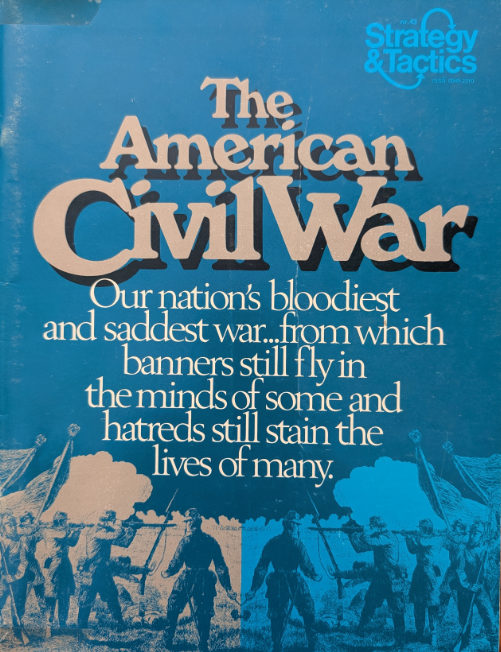
The American Civil War by James F. Dunnigan is a two-player strategic-level game about the whole civil war. There are ground and naval units backed up by forts and leaders. No unit nor ground scale is given. The map shows from New Jersey to the northern parts of Florida on the east coast and the southern part of Iowa down to Louisiana on the west coast. There are four turns in a year. One basic scenario covers the whole war with options available to adjust the historical setting to your tatste.
This game uses the (almost-standard) command control rule whereby certain of your units (occupying hexes whose last number matches a dice-generated number) will not contribute to the fight each turn. In this case, I would stick with the original rules as drafted. Why? Union reinforcements enter in Washington (6 Strength Points, hex 4507) , Cincinnati (3 Strength Points, hex 2607), and Cairo (2 Strength Points, hex 1513). While the Union Command Control Level is at 5 (which is where it starts), there is a 50% chance of Washington and Cincinnati being affected, and a 50% chance of Cairo being affected. It means the Union may struggle to get his troops into battle. It’s a nice wee design touch.
Between 1861 and 1865 the United States of America was almost torn apart in the bloodiest war in its history. In a strange conflict combining features of the Napoleonic Age with features of the Machine Age, fully 600,000 men perished fighting for sectional particularism, constitutional principle, economic self-interest and moral righteousness. And, in the end, vast changes were made in the nation, yet the nation remained unchanged. All with fateful implications for the present.
The Soldier Kings 1550-1770 – Frank Davis and Ron Toelke
But perhaps the best measure of the horror and cost of the Thirty Year’s War can be seen in the actions of the generations born soon after the conflict. For a century and a half following the Peace of Westphalia [24 October 1648], war was conducted with a degree of civility and restraint which is umatched in the entire length of the rest of history.
From page 42 of this issue’s Outgoing Mail referring to the then upcoming Tank! game:
Each tank is represented by two counters. A bottom one for the body of the tank and a top one representing the turret, which of course can be turned at various aspects.
On a Personal Note
This issue marked the end of my first year’s subscription. I remember looking back at the games received and thinking that renewing the subscription was a no-brainer.
The front page text is one of my favorite quotes. Perhaps that’s why this issue was also the tipping point for making the American Civil War one of my favorite historical periods – to read about and to game. The Gettysburg article in issue 38 was the spark and this issue converted it to a passion.
KampfPanzer by James F. Dunnigan is a two-player game about early tank warfare (1937-40) with each unit representing five tanks, a platoon of infantry, or a battery of guns. Hexes represent 100 meters of real terrain and each game turn is three minutes and forty seconds of real time. One of several distinctive features of the game is that it uses pre-plotted simultaneous orders.
Components
KampfPanzer was released with Strategy & Tactics 41. The counters (not backprinted) have silhouettes for vehicles and are pretty nifty. All are clear and easy to read.
The map is bare and dull. The rules are printed on one of the foldout pamphlets that were a regular feature of SPI’s output. (There’s a small amount of errata which you should track down if you want to play the game.) There’s also a separate sheet with scenarios, historical notes, and the charts and tables.
Game Turn Sequence
Each game turn includes the following:
Simultaneous Movement and Combat Plot Phase
Panic Determination Phase
Combat Execution Phase
Panicked Movement Plot Phase
Movement Execution Phase
Disruption Removal PhasePlaying the Game
Playing the Game
To get me in the right place to do this post, I chose Hannut from the nine available scenarios.
The game is not really suited for solitaire play given that you start each turn by writing out the detailed orders for each unit. The plotting system is well explained with plentiful examples, and in face-to-face play it adds a considerable amount of tension to the game play.
When playing this solitaire, I wrote out orders for one side first. Then, took a coffee break, returned and did the other side. To try and alleviate my knowledge of the other side’s orders, for the second side I tried to give each unit at least two sensible options and let the dice decide which one was selected.
Panic determination involves one die roll per side and a quick and easy process for finding out who has been affected. However, as with PanzerArmee Afrika, the system has its limits in that not every hex is equally at risk. For better play, I suggest using one of the options mentioned there.
Panic is a misleading term as it’s more to do with command and control. (And, in PanzerArmee Afrika, it was referred to as command control.) Units plotted to fire, don’t fire. Units plotted to move, do a random (die-roll determined) move. The latter was too chaotic and unrealistic for many players with several suggestions for house-rule replacements being touted. For sure, the result does give you a challenge because you cannot guarantee your units will do what you want them to do. In my opinion, that’s both a good thing and realistic.
Action from my replay of the Hannut scenario. The French, suffering from bad command and control, are outmanned.
The scenario runs for ten game turns. In the first game turn, both sides plot movement orders as each needs to head for the victory point area.
The French (with a Panic Level of 3) suffer a bad breakdown of command and control with several units going off in the wrong direction in the first turn. The Germans are untroubled. By the end of the turn, the French have a toehold on Hill 2, and the Germans are not quite there. Turn two sees the advance German forces start to arrive and turn three sees much combat. By the end of turn four, lots of damage has been down. Slowly, but surely, the German superiority in command and control tells – as does their superior firepower against the French infantry and anti-tank guns – and by the end of turn seven, it’s clear the Germans are going to win.
In this system, units take hits in terms of levels of disruption. There’s also a Pin result that prevents units with a move order from moving. You have to roll for recovery from disruption, so disrupted units are potentially out of the action forever if you roll badly. Pinned units automatically recover. I’ll admit the French recvovery rolls were awful. Such is war.
Good Stuff
The capability of the different types of unit (tank, infantry, guns) is portrayed well, as is the fact that the German tanks were not necessarily the best in the world.
This game is a great starting point for looking at creating your own game about tactical warfare in World War II. You get an impression – broad brush, to be sure – of what combat at the sharp end might have been like and a sure appreciation of the difference troop quality can make. It would be straighforward to replace the simultaneous plotting parts to make the game more solitaire friendly.
The simultaneous plotting adds to the tension.
Not So Good Stuff
This game doesn’t teach a lot about the tactics of armored combat of the time. You won’t see much of a difference between the German forces that were masters of the Blitzkrieg and for example the French forces that were, in general, swamped. The exception is that the German forces will have a better Panic Level and so be less prone to panic and not implementing your chosen orders. That’s a somewhat shallow differential, albeit it does highlight the advantages of (presumably) better command, control, communications, and troop quality. But the influence of artillery and air power, not forgetting radios, are sadly missing.
The unit ratings are a mystery to me. For example, the article in Strategy & Tactics gives armor thickness figures that don’t seem to directly relate to defense strength. The speeds given seem more closely related to each unit type’s movement points (MP). Here’s a sample of units with the armor thickness (as given in the article) and the defense strength in the game, then speed per the article and MP in the game.
*Note: there is no Pz IVD counter, only a PzIVE counter. The latter type wasn’t available till 1941 so I assume it’s a typo and is really the type D.
The numbers are close, but it appears there are other factors being taken into account when calculating defense strengths. There’s no hint what these might be – size, speed, metal quality – making it next to impossible to expand the unit coverage for DIY projects. At least speed and MP seem close enough.
The combat system has not aged well.
The scenarios are not especially engaging.
The map is drab and dreary, and looks unrepresentative of any real-life battlefield.
In Conclusion
KampfPanzer is an OK game and while I enjoyed my time playing it, this may well be the last time it hits the table, at least in its present format. Some people in the hobby developed the combat system for the related game Panzer 44 (though it has a different ground scale) and hopefully at some time I am going to try that out.
I remember being excited when this game originally arrived as part of my S&T subscription. Some 52 (!) years later, it’s less exciting, but I had some great times with KampfPanzer and I’m glad I got the opportunity to enjoy it.