Date of publication (as given): May/June 1975
Context
- May 1975: Michael Shaara wins the Pulitzer prize for his novel Killer Angels. Bayern Munich win the European (Football) Cup, beating Leeds United 2:0 in Paris. In Stuttgart, the trial against the Baader-Meinhof group starts.
- June 1975: the Suez Canal, closed since 1967, is reopened by Egyptian president Anwar Sadat. Sony makes the Betamax version of a videocassette recorder available for sale to the public. The film Jaws is released, with Steven Spielberg directing; it’s based on the novel by Peter Benchley.
Game Included
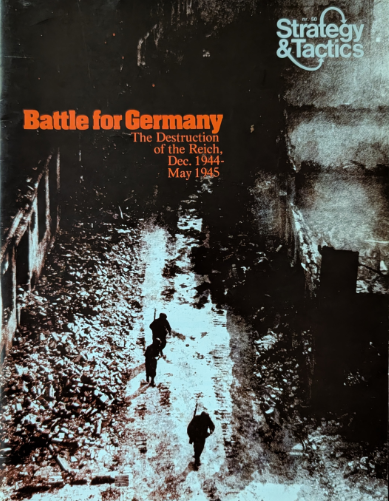
Battle for Germany by James F. Dunnigan is game at the corps/army level about the final WW2 campaign in Europe involving the Western Allies, the Soviets, and Germans, running from December 1944 to May 1945 on a 22″ x 17″ map using hexes 67.1km hexes. The game has several scenarios including three and four-player versions.
The game caused a stir for introducing the concept of each player being responsible for two armies. For example, in the historical scenario, one player runs the Soviet and the West German forces (the forces deployed on the western front of Germany, facing the Western Allies) and the other runs the Western Allied and the East German forces (the forces deployed on the eastern front of Germany, facing the Soviets). The Soviet player wants to mop up the East German forces quickly while using the West German forces to delay the Western Allied forces for as long as possible. So, in this game, each player gets to attack and defend each turn. You need to be good at both to win.
For more about the game see here.
Articles
- Outgoing Mail — editors
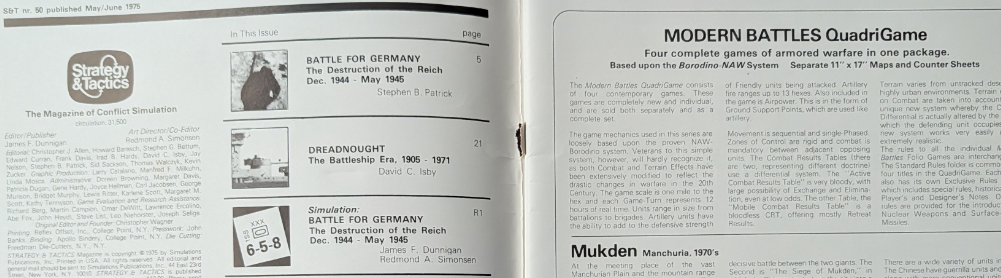
SPI was founded on the idea that if you take the trouble to ask people what they want, and then give it to them, you will be successful. Well, both the asking and the giving involve numerous problems. The giving end is fairly well covered by simply looking at what we produce. But the asking end is a bit harder to comprehend.
- Battle for Germany — Stephen B. Patrick
No one who has been raised in an English speaking country can really grasp the magnitude of what the Germans faced in December, 1944. By that time, all but the most optimistic knew the war was lost. They faced not only defeat, but occupation. Defeat, while hard to bear, was endurable. Occupation, particularly by the Soviets, was intolerable.
- Dreadnought — David C. Isby
The Dreadnought was not a decisive weapon. It was never intended to exercise the “quick kill” of an ICBM of [or] even of torpedo bombers. Even the biggest and best Dreadnoughts were, in the end, brought down by submarines and airplanes. Despite these failings in concept, the Dreadnought remains a memorable part of an era when majestic ships ruled the waves.
- Briefings — Short reviews of new games and books
SPI Games Advertised
On a Personal Note
I played a lot of the issue game, Battle for Germany, on its release. Not only was it easy to play and accessible — the rules run to seven pages of text, almost one of which comprises game notes — but the historical scenario included a useful set of notes about how the game would unfold if it matched real-life history. This not only sparked an element of tweaking (none of which have endured, nor are remembered) but the usual interest in seeing what history books had to say about the campaign.